
On May 14, 2026, OpenAI issued an official statement regarding the recently surfaced "Mini Shai‑Hulud" supply‑chain attack. The attack primarily targeted the popular open‑source library TanStack and several of its npm packages. After a rapid investigation, OpenAI's security team confirmed that the company's core production systems, intellectual property and user data were not exposed or accessed. Nonetheless, out of an abundance of caution for endpoint security, OpenAI has issued an urgent update requirement for macOS users.
According to OpenAI's statement, the incident originated from a supply‑chain attack against the TanStack npm ecosystem on May 11, 2026 (UTC). The attacker exploited GitHub Actions workflow vulnerabilities — including the pull_request_target trigger, cache poisoning and in‑memory extraction of OIDC tokens — to successfully inject malicious code into TanStack's legitimate release pipeline. The actor published 84 malicious versions affecting 42 @tanstack/* packages. These malicious packages contained credential‑stealing worms capable of targeting developer environments, cloud credentials, crypto wallets and other assets, and they possessed self‑propagation abilities.
OpenAI said its internal monitoring detected related risks soon after the attack and immediately launched a comprehensive review. The investigation found that only two employee devices may have been affected after downloading infected npm packages; those devices were not connected to OpenAI's core production environment, and no evidence was found of any user data, training data or system credentials being exfiltrated. OpenAI's core services (including the ChatGPT web app and APIs) were not impacted by this incident.
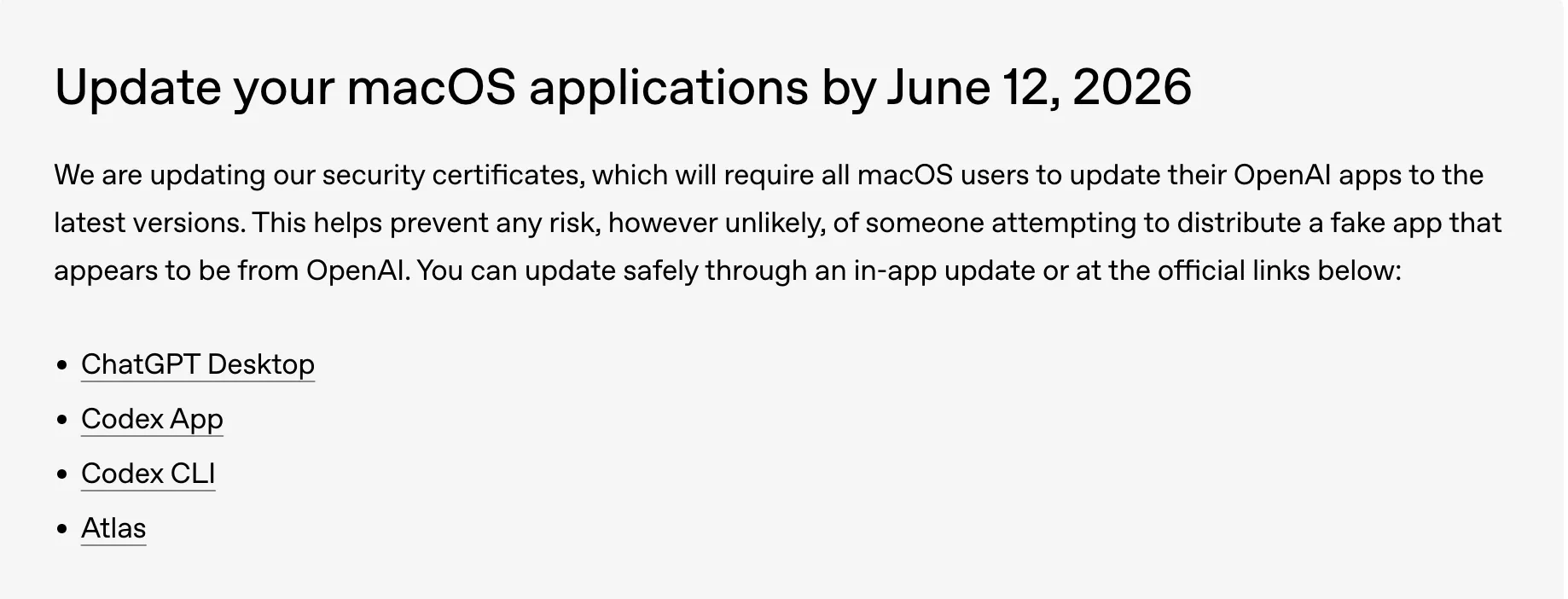
Key Security Advisory: macOS Users Must Update by June 12, 2026
To further harden endpoint protections and mitigate potential risk, OpenAI requires all users of its official macOS applications (including ChatGPT Desktop, Codex, Atlas, and others) to complete the update by June 12, 2026. Applications that are not updated by the deadline may cease to function normally or receive security patches.
This requirement is based on the following considerations:
- Prevent potential local environment contamination from spreading further;
- Revoke and rotate any code‑signing certificates that could be affected;
- Ensure all macOS clients run the latest secure versions with enhanced protections against supply‑chain attacks.
OpenAI emphasized that the update will not require users to reset passwords or rotate API keys; users only need to download the latest version via the App Store or official channels.
Impact Assessment
1. Impact on OpenAI's operations
Although the incident did not result in material data exposure, it highlights that even leading AI companies cannot fully eliminate risks when relying on open‑source supply chains. OpenAI's rapid and transparent response helps maintain user trust, but it also compels the company to further strengthen third‑party dependency review and internal isolation mechanisms. Going forward, OpenAI may accelerate in‑house development of critical components or adopt stricter SBOM (software bill of materials) management.
2. Impact on macOS users and the developer community
Millions of developers, researchers and enterprise users who use OpenAI's macOS applications must update within the prescribed timeframe. While this imposes some inconvenience, it demonstrates OpenAI's emphasis on endpoint security. Users who fail to update in time may face application outages or increased security risk. The incident also serves as a reminder to developers that popular libraries in ecosystems like npm can be targeted, underscoring the need to update dependencies promptly, verify provenance and use locked versions.
3. Implications for open‑source supply‑chain security
The "Mini Shai‑Hulud" attack continues a recent string of supply‑chain incidents that have affected ecosystems including TanStack, Mistral AI and UiPath. By leveraging complex GitHub Actions configurations to publish malicious packages through legitimate release processes, the attack bypassed traditional credential‑theft vectors and exposed weaknesses in modern CI/CD pipelines. This will likely prompt npm, PyPI and other platforms to strengthen release vetting, introduce stricter cooling‑off periods and behavior analysis measures, and may accelerate industry adoption of verifiable builds (SLSA) and supply‑chain security standards.
4. Broader industry and regulatory impact
Supply‑chain attacks are becoming a major threat in the AI era. OpenAI's response provides a reference model for other tech firms but may also intensify regulatory scrutiny. National cybersecurity agencies (such as the U.S. CISA and relevant EU bodies) are expected to increase oversight of open‑source ecosystems and AI company supply chains. In the long term, this should improve overall software supply‑chain resilience, although it may raise short‑term compliance costs for developers.
5. User confidence and effects on the AI ecosystem
Despite OpenAI's clear assurances about user data safety, such incidents can temporarily affect some users' trust in cloud AI services. The event also underscores that, as AI tools become deeply integrated into development workflows, weaknesses in any single supply‑chain link can have global repercussions for the developer ecosystem.
Conclusion: Supply‑Chain Security Is a Foundational Challenge in the AI Era
OpenAI's swift response to the "Mini Shai‑Hulud" attack demonstrates a mature approach to crisis management. The absence of user‑data leaks is the best possible outcome, but the requirement for macOS updates also reminds all users and developers that supply‑chain security is not to be taken lightly.
▶️ Enjoyed this piece? Creating content takes real effort!
Follow our YouTube channel:
AI Rosetta
Your likes, subscriptions and shares are our greatest support! 🙏
More AI news at: https://www.airosetta.com