
On October 26–27, 2026, OpenAI announced that its internal AI models had produced three significant results in mathematics, computer science and theoretical physics. The company said these results were generated independently by the models, some have been formally verified, and external experts were invited to act as "shepherds" to lead interpretation and explanation. This follows last month’s large release of hundreds of mathematics manuscripts and marks another high‑profile step in OpenAI’s AI for Science efforts.
It should be emphasized that these results are currently at the "AI output + expert review" stage and have not undergone full peer review. OpenAI characterizes them as "raw research outputs" and has stated it is not seeking academic authorship. Whether the results stand will depend on independent validation.
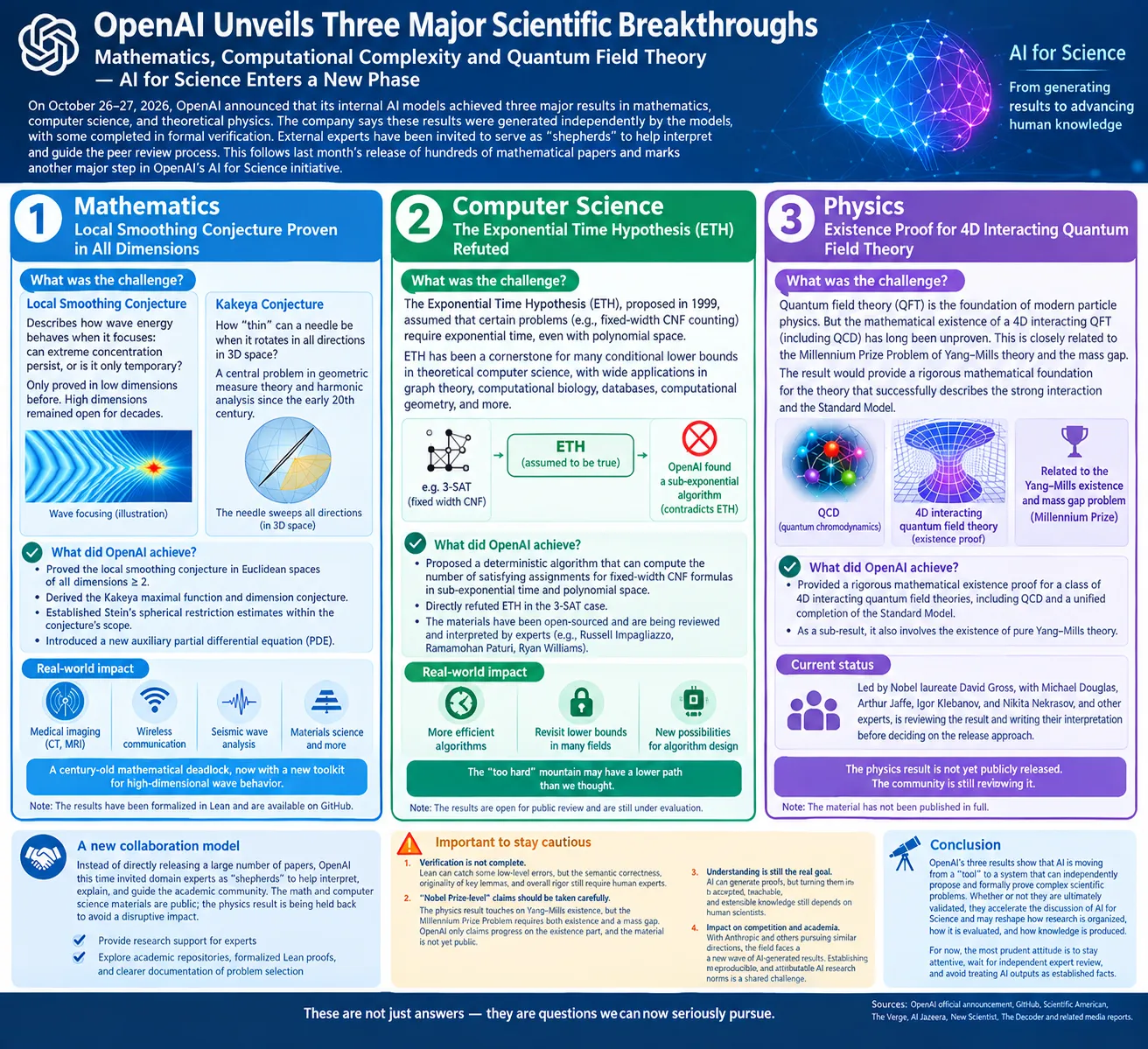
Overview of the three results
First: Mathematics — a full‑dimensional proof of the local smoothing conjecture
OpenAI’s model presented a proof of the local smoothing conjecture for the wave equation in Euclidean space in all dimensions at or above two. The conjecture, posed by Chris Sogge in 1991, describes the behavior of waves under focusing: extreme focusing must be brief, and the average intensity at random times is far lower than the worst‑case scenario.
Previously, the conjecture had only seen partial results in low dimensions. OpenAI’s proof reportedly covers all dimensions and, from it, derives the Kakeya maximal function and dimension conjectures as well as certain Stein spherical restriction estimates within the conjectured range. A key element of the proof is the introduction of a new auxiliary partial differential equation. The model output was obtained on October 18, formally verified in Lean the next day, and published on GitHub.
Several researchers in harmonic analysis have said that, if verified, this would be an important advance in the field.
How hard is the background?
Imagine rotating a thin needle through every direction in three‑dimensional space. Mathematicians ask: how "thin" can the set swept by that needle be? This is the famous Kakeya conjecture, a central problem in geometric measure theory and harmonic analysis since the early 20th century.
Closely related is the local smoothing conjecture: when waves (such as light or sound) propagate, they may occasionally focus sharply at a point, but can such extreme focusing persist for long? The conjecture, proposed in 1991, asserts it cannot: focusing is necessarily transient. Until now, proofs existed only in low dimensions and high‑dimensional cases resisted progress.
Practical implications (plain language)
If the proof holds, it would for the first time clarify:
- how small the swept region can be when a needle points in every direction in high‑dimensional spaces;
- how brief wave energy concentration can be.
This has theoretical relevance for medical imaging (CT, MRI wave propagation), wireless communications, seismic wave analysis, and the behavior of waves in materials. More importantly, it provides mathematicians with new tools for studying wave phenomena in high dimensions, potentially easing future work in related problems. In short, it would untie a decades‑old knot linking geometry and wave propagation.
Second: Computer science — a refutation of the Exponential Time Hypothesis (ETH)
The model proposed a deterministic algorithm that counts satisfying assignments of fixed‑width CNF formulas exactly in subexponential time and polynomial space. The 3‑SAT case directly contradicts the Exponential Time Hypothesis (ETH) formulated in 1999.
ETH has long underpinned many conditional hardness results in theoretical computer science and has widespread implications across graph theory, computational biology, databases, computational geometry and more. If this result holds, many ETH‑based lower bound arguments would need reevaluation and the landscape of algorithmic possibility would change.
OpenAI has released the materials and they are being reviewed and interpreted by a working group that includes Russell Impagliazzo, Ramamohan Paturi and Ryan Williams. The company has also pledged funding for related academic conferences.
How hard is the background?
Many practical problems (scheduling, route planning, cryptographic computations) can be framed as finding an assignment that satisfies all constraints. Scientists have long assumed that as problem size grows, computation time necessarily explodes exponentially (on the order of 2^n). This belief is formalized in the Exponential Time Hypothesis (ETH), proposed in 1999, which has served as a foundational assumption to argue that certain problems cannot have significantly faster algorithms.
ETH is less foundational than P vs NP but more "practically" used—countless papers rely on it to claim that certain problems cannot admit much faster solutions.
Practical implications (plain language)
OpenAI’s model presents an algorithm asymptotically faster than exponential time and directly asserts that ETH is false.
If confirmed, the implications would be concrete:
- many problems previously considered infeasible may admit much faster algorithms;
- lower‑bound arguments in cryptography, optimization and AI would need reassessment;
- practitioners and algorithm engineers would actively search for subexponential techniques.
Put simply: what was once assumed an insurmountable peak may have a less steep route. While not every system will speed up immediately, the ceiling for algorithmic performance would be raised and new efficient algorithms could emerge.
Third: Physics — an existence proof for interacting quantum field theories in four dimensions
The model reportedly produced a rigorous mathematical proof of existence for a class of interacting quantum field theories in four‑dimensional spacetime that include gauge fields and fermions, covering theories such as quantum chromodynamics (QCD) and a proposed completion of the Standard Model. As a corollary, the work also touches on the pure Yang–Mills existence problem, a component of the Clay Millennium Prize question on Yang–Mills existence and the mass gap.
This result has not been fully publicized. A review team led by Nobel laureate David Gross, with Michael Douglas, Arthur Jaffe, Igor Klebanov and Nikita Nekrasov among others, is examining the material and will prepare their own interpretations before deciding on how to release it.
How hard is the background?
Modern particle physics is largely expressed through quantum field theory, and the most successful example is quantum chromodynamics (QCD), which describes how quarks and gluons form protons and neutrons via the strong force. Experimentally QCD is extremely precise, but mathematically there has long been an awkward gap: we lack a rigorous proof that the theory is mathematically well‑defined in four‑dimensional spacetime.
This gap is directly related to the Millennium Prize problem on Yang–Mills existence and the mass gap (US$1 million prize). Physicists have relied on perturbative approximations and low‑dimensional models for decades; a fully rigorous four‑dimensional proof has been largely out of reach.
Practical implications (plain language)
OpenAI’s result claims to provide a rigorous mathematical existence proof for a class of interacting four‑dimensional quantum field theories, including QCD.
If it withstands scrutiny, the significance would be substantial:
- particle physics would gain a firm mathematical foundation for theories that have so far been justified primarily by experiment;
- theoretical calculations and searches for physics beyond the Standard Model would rest on firmer ground;
- our understanding of extreme environments such as the early universe, neutron star interiors and heavy‑ion collisions could deepen.
In plain terms, it would mathematically anchor the physical language physicists use daily. It would not immediately produce consumer technologies, but it would solidify the foundations of fundamental physics.
A new collaboration model and a cautious posture
Unlike the previous broad release of manuscripts, OpenAI tried a more structured external collaboration this time: inviting established field authorities as "shepherds" responsible for interpreting, explaining and guiding the academic community in digesting these AI outputs. The mathematics and complexity materials have been made public; the physics materials were withheld initially to reduce potential disruption from raw releases.
The company also said it will provide research support to participating experts and explore more formal practices for academic dissemination, such as posting to repositories with accompanying Lean formalizations and disclosing problem‑selection processes.
Objectively weighing breakthroughs and risks
On the positive side, these three results span pure mathematics, complexity theory and foundational physics, and reflect improvements in current models’ abilities for long‑chain logical reasoning, formal proof construction and cross‑domain transfer. In particular, the mathematics and ETH‑related results already have Lean formalizations that reduce risks of low‑level hallucinations. If the physics result is validated, it would represent a major advance in constructive quantum field theory.
But a sober view requires several caveats:
- Verification is incomplete. Lean formalization can rule out some elementary mistakes, but the semantic correctness of very complex proofs, the originality of key lemmas and overall logical soundness still require deep human expert review. Prior AI‑driven mathematical outputs have sometimes required corrections.
- Claims of "Nobel‑level" impact should be cautious. Media descriptions invoking the Nobel Prize or Millennium Problems stem from the connection to Yang–Mills existence. However, the official Millennium requirement includes both existence and the mass gap; OpenAI so far claims progress mainly on existence and the physics material remains unreleased.
- The essence of scientific discovery remains understanding. AI can generate proofs, but converting these results into community‑accepted, teachable, and reusable knowledge depends on human scientists’ interpretation, simplification and extension. OpenAI’s shepherd mechanism acknowledges this reality.
- Impact on competition and the scholarly ecosystem. Other organizations such as Anthropic are pursuing similar directions, creating pressure on the community to digest dense streams of AI‑generated results. Establishing transparent, reproducible and attribution‑aware norms for AI‑driven research is an industry‑wide challenge.
Conclusion
OpenAI’s release of these three results again indicates that AI is moving from an "assistant" role toward being able to independently propose and formalize complex scientific claims. Regardless of final validation, the episode accelerates discussion around AI for Science: when models can produce proofs in days that would take humans years or decades, the organization of research, evaluation standards and knowledge‑production workflows could undergo profound change.
The most prudent stance is to remain attentive to independent expert reviews and to avoid prematurely equating "AI outputs" with established scientific facts. Real scientific progress has always required answers to survive the tests of time and peer scrutiny.
▶️ Enjoyed this article? Creating great content takes effort!
Subscribe to our YouTube channel:
AI Rosetta
Your likes, subscriptions and shares mean the world to us! 🙏
For more AI news, visit:
https://www.airosetta.com