
On September 21, 2026, OpenAI announced the establishment of the Advisory Group on Mathematics and Artificial Intelligence (Advisory Group on Mathematics and Artificial Intelligence). The advisory group is based at the Institute for Advanced Study in Princeton, is composed of nine well‑known mathematicians, and will operate independently from OpenAI. At the same time, OpenAI disclosed that an internal model the company began training on August 28 has successfully solved more than 100 long‑standing open problems across multiple areas of mathematics, including the high‑profile Navier–Stokes Millennium Prize problem.
Advisory Group details
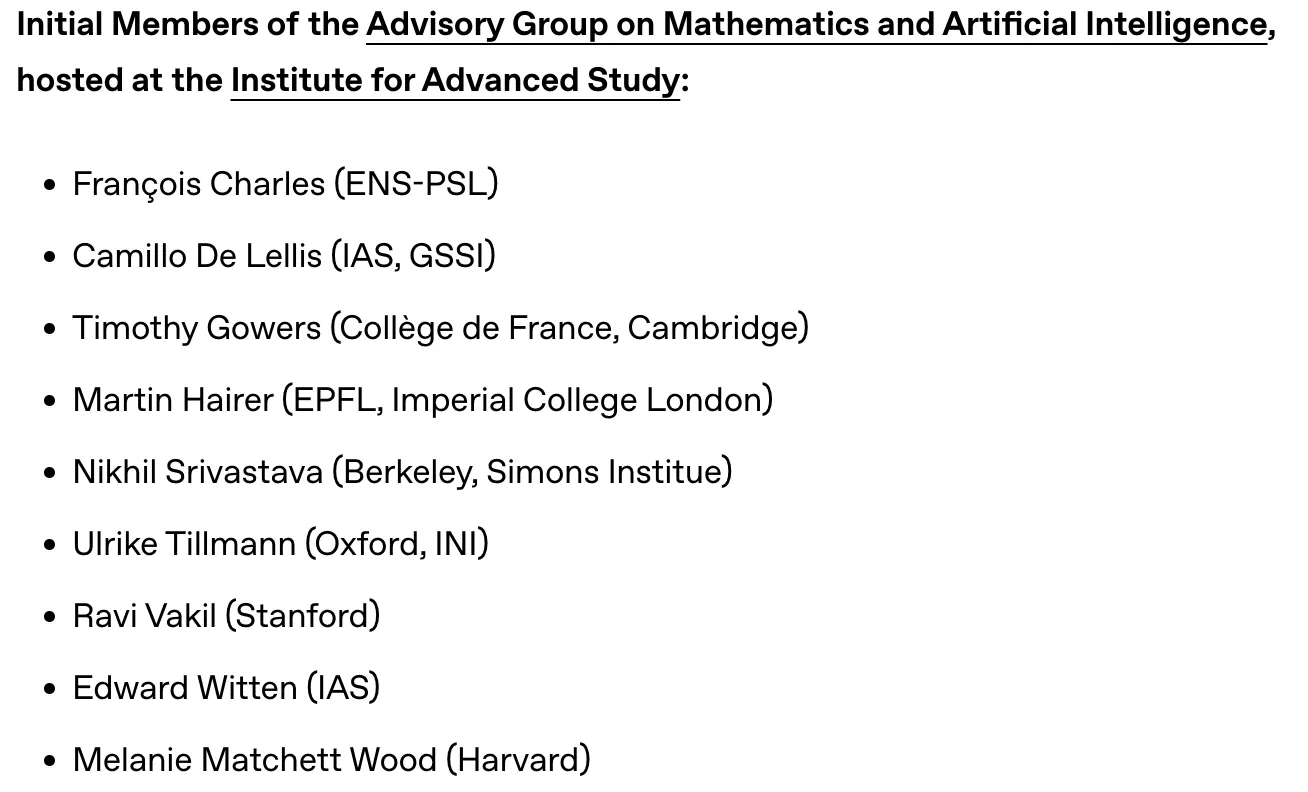
Initial members of the advisory group include: François Charles (ENS‑PSL), Camillo De Lellis (IAS, GSSI), Timothy Gowers (Collège de France, Cambridge), Martin Hairer (EPFL, Imperial College), Nikhil Srivastava (Berkeley, Simons Institute), Ulrike Tillmann (Oxford, INI), Ravi Vakil (Stanford), Edward Witten (IAS) and Melanie Matchett Wood (Harvard).
According to descriptions from OpenAI and the advisory group itself, the organization is positioned as an independent consultative body. Members will not be paid by OpenAI, may proactively offer unsolicited advice, may speak publicly, and may independently determine their membership. Its responsibilities primarily include: assisting in the assessment of the academic significance of emerging results, advising on how results should be released and communicated, offering input on academic and professional standards for mathematical research, and discussing how AI tools can better support mathematical research and teaching.
The advisory group explicitly emphasizes that its role is consultative rather than decision‑making and that it is not responsible for advising OpenAI on how to pace its internal mathematical research. This design aims to respond to recent concerns in the mathematics community about AI companies rapidly releasing significant results, particularly controversies over using unresolved problems as AI benchmarks.
Internal model and the "100+ problems" claim
OpenAI said the new internal model trained from August 28 (with capabilities substantially stronger than the released GPT‑6 Astra) not only solved the Navier–Stokes existence and smoothness problem but also resolved more than 100 long‑standing open problems spanning most branches of mathematics. OpenAI publicly released related proofs and Lean formalization materials for the Navier–Stokes claim in early September; reporting at the time indicated the work relied on large‑scale multi‑agent collaboration (on the order of thousands to tens of thousands of agents and tens of hours of computation), which triggered intense discussion in the mathematics community about verification standards, publication processes, and the distinction between "understanding vs. answers."
The assertion of "over 100 open problems" currently comes mainly from company statements. One direct context for the advisory group's establishment is how to handle and publish this batch of claimed results carefully and orderly. The group's current tasks include providing advice to OpenAI on coordinated release of these results and inviting input from the broader mathematics community.
Potential impacts
1. Impact on the paradigm of mathematical research
If, after independent review, a substantial portion of the results are confirmed, it would indicate that AI can achieve breakthroughs on problems that traditionally required years or decades. That would not only change the time scale for solving "hard problems" but could also alter how mathematicians work — shifting from purely manual derivations to collaborations with AI for verification, screening, and deepening understanding. The role of formal verification systems (such as Lean) would become even more prominent.
2. Tests for academic standards and trust mechanisms
Rapid generation of large numbers of results can strain traditional peer review, priority attribution, and the pace of knowledge accumulation. The advisory group can be seen as a buffering mechanism that attempts to build a bridge between company‑driven high‑speed output and the mathematics community's cautious standards. However, it only has consultative authority; its practical constraint is limited and ultimately depends on whether OpenAI adopts its recommendations and on acceptance by the wider community.
3. Effects on the narrative of AI capabilities
Framing "solving open mathematical problems" as a capability milestone strengthens the narrative of AI in formal reasoning and scientific discovery. At the same time, it intensifies philosophical and practical debates about whether correct answers equate to human understanding. Some Fields Medalists and other leading figures have previously voiced concerns about AI's impact on the mathematics research ecosystem; the advisory group's formation can be viewed as a direct response to those concerns.
4. Chain reactions in industry and the research ecosystem
Other AI labs may accelerate similar investments in mathematics‑focused initiatives; universities and research institutions will need to rethink training, evaluation standards, and norms for human–machine collaboration. For funders and journals, questions about how to define AI contributions and how to require reproducible, formalized proofs will become pressing issues.
Conclusion
OpenAI's establishment of an independent mathematics advisory group, coupled with the company's claim that an internal model has solved over a hundred open problems, marks a new phase in the interaction between AI and the frontiers of mathematics. The advisory group provides an institutional channel for communication that may improve the prudence of result review and release, but its consultative nature means it cannot unilaterally determine research pacing. The decisive factors will be whether these claimed results withstand broad, rigorous independent verification and whether the mathematics community can preserve deep understanding and the quality of knowledge amid rapid technological change. The group's actual operations, disclosure of a concrete list of problems, and progress on independent reproduction will determine the long‑term significance of this development.
▶️ Like this article? Creating it is hard work!
Subscribe to our YouTube channel:
AI Rosetta
Your likes, subscriptions and shares are our greatest support! 🙏
For more AI news visit: https://www.airosetta.com