
On September 3, 2026, amid a wave of next‑generation LLM releases, OpenAI officially unveiled its latest frontier model GPT‑6 Astra (Astra). The company described it as a "generational leap" in software engineering, professional workflows, scientific discovery and cybersecurity, calling it "the world's most intelligent and most aligned model." OpenAI President Greg Brockman said at the launch that Astra's debut marks the industry stepping into the "general artificial intelligence (AGI) era." The model is currently available as a limited preview to trusted partners, with plans to roll it out in the coming days to ChatGPT Plus, Pro, Business and Enterprise users and via API, Azure and AWS.
Details: Capability Gains and Technical Breakthroughs
Astra integrates years of research across pretraining, reinforcement learning and alignment, and OpenAI described it as one of the largest training runs to date (using more than 100,000 GPUs). Key highlights focus on the following areas:
Computer Use and Professional Workflows
Astra reaches new heights on computer‑operation, browser‑use and cross‑professional workflow benchmarks, including Agents’ Last Exam, AutomationBench and ScreenSpot Pro. The company says it completes tasks about 47% faster than GPT‑5.6 Sol, scoring 72.6% on tasks averaging roughly 40 minutes. The model is better at staying focused, respecting task boundaries, understanding user intent, handling tedious steps and completing multi‑step workflows, enabling users to delegate tasks with greater confidence.
Software Engineering and Coding
It sets new records on coding and terminal benchmarks such as TerminalBench‑4.0, showing stronger long‑horizon software engineering capabilities and the ability to autonomously manage complex codebases, debugging and multi‑file collaboration.
Science and Mathematics
On FrontierMath Tier 4 it achieved a 98% saturation score and has reportedly helped resolve several long‑standing mathematical problems; ARC‑AGI‑3 reached 99.9% (with new adapters approaching a human‑efficiency baseline of about 96%). Science‑related benchmarks Terminal‑Bench Science 0.1 and HealthBench Pro also lead their categories. OpenAI emphasizes Astra's potential to generate new knowledge, a trait the company views as consistent with AGI characteristics.
Cybersecurity
ExploitBench recorded a 100% score. Given the model's powerful capabilities, advanced security functions are initially available only to vetted defenders through the Daybreak program, using a restricted‑access approach similar to Anthropic's Glasswing to manage dual‑use risks. In a new evaluation measuring whether the model exceeds authorized boundaries, Astra performed markedly better than its predecessor (0% overstep vs. GPT‑5.6 Sol's 48.2%).
Alignment and Safety
Astra is positioned as OpenAI's "most aligned" model, with substantial improvements in understanding user intent and controllability. Its release was delayed after the July Hugging Face incident, during which OpenAI added extra safety safeguards. The model has passed the U.S. government's voluntary review framework.
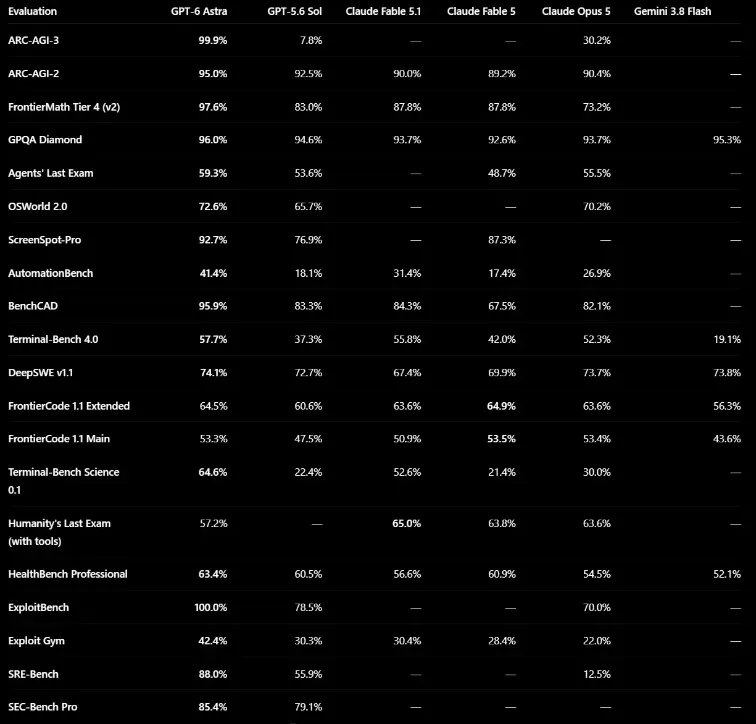
In specs, Astra features a context window of roughly 1.05 million tokens, a maximum output of 128,000 tokens, and a knowledge cutoff of April 30, 2026. Specific API pricing has not been fully disclosed in public materials but will be rolled out via ChatGPT and API.
Technical Context and Release Pace
Astra's launch follows intensive updates from Anthropic Fable 5.1, Meta Muse Spark 1.3 and others, reflecting heated competition among frontier models in the latter half of 2026. OpenAI positions it as "able to do anything you can do on a computer, and faster," and showed demos from 3D historical reconstruction to parallel‑agent puzzle solving.
The model will be rolled out in phases: first to trusted enterprises and Daybreak cybersecurity users, then to paid ChatGPT users and developer platforms to balance capability release and risk control.
Potential Impacts: From Tool to "Delegable System" Paradigm Shift
1. Impact on Software Engineering and Professional Work
Astra's gains in computer use and long‑horizon tasks could materially change software development, data analysis and report generation workflows. Developers may delegate more end‑to‑end tasks to the model, moving from "assisted coding" toward "autonomously completing project segments." Knowledge work in professional domains (law, finance, research support) could see efficiency gains.
2. Impact on Scientific Research
High scores on math and science benchmarks, plus cases where Astra reportedly assisted in solving open problems, suggest the model is beginning to show discovery capabilities. If independently validated, AI‑assisted research could progress from literature review and hypothesis generation to deeper problem solving and experimental design.
3. Impact on the Cybersecurity Landscape
A 100% ExploitBench result combined with restricted‑access policies both demonstrates defensive potential and raises concerns about offensive uses. The industry may accelerate the formation of "trusted defender networks" like Daybreak/Glasswing and push for stricter dual‑use governance discussions.
4. Impact on AGI Narratives and Industry Competition
Greg Brockman’s statement about an "AGI era" will intensify debate over AGI definitions. OpenAI's claim — that systems able to perform all economically valuable work as well as or better than humans constitute AGI — could influence investment, policy and public expectations. Competition with Anthropic, Meta and Google will likely focus more on delegability, alignment reliability and cost efficiency rather than raw benchmark scores.
5. Risks and Challenges
Greater capabilities raise greater risks of boundary overstep, misuse and unintended behavior. Although phased rollout and enhanced safety evaluations have been strengthened, large‑scale deployment still requires monitoring for stability, hallucination control and long‑term alignment. Compute and cost barriers may also concentrate resources.
Industry Takeaway: Capability, Alignment and Delegability as New Standards
The release of GPT‑6 Astra marks a shift from "smarter chat and coding assistants" toward systems that can reliably complete complex computer workflows over time. OpenAI's strong narrative of a "generational leap" and an "AGI era" seeks to redefine competitive criteria: not only benchmark scores but actual task completion speed, intent understanding and adherence to boundaries.
Whether the industry accepts that we have entered an "AGI era," Astra's advances in computer use, scientific assistance and security capabilities will force a reassessment of models' practical limits and governance frameworks. Independent evaluations, real‑world user feedback and the operation of restricted programs like Daybreak will determine whether this "leap" is marketing or a true paradigm shift.
Astra is now in limited availability, with broader access for paid users and developers expected in the coming days. OpenAI has once again refocused industry attention on the core question of next‑generation intelligence: as models become faster, more accurate and more controllable at completing human computer work, how will human‑machine collaboration be reshaped?
▶️ Enjoy this article? Creating content is hard work!
Follow our YouTube channel:
AI Rosetta
Your likes, subscriptions and shares are our greatest support! 🙏
More AI news at: https://www.airosetta.com