
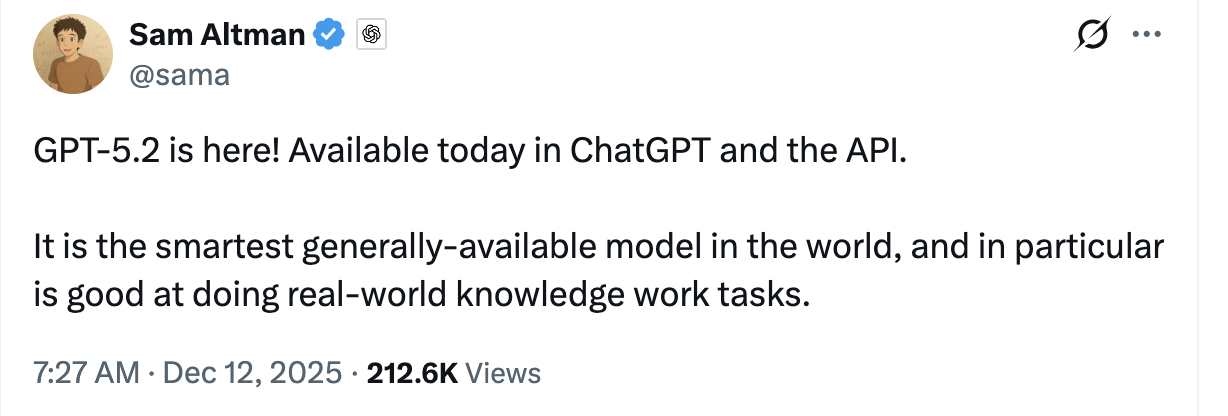
December 12, 2025 (compiled from OpenAI website, CNBC, WIRED, etc.) In an era of accelerating AI model iteration, OpenAI unexpectedly announced the GPT‑5.2 model series on December 11 (U.S. time), a significant update following last month’s GPT‑5 release. This early launch has been described as a direct result of an internal "code red" directive, intended to confront strong competitors such as Google Gemini 3. OpenAI Chief Applications Officer Fidji Simo emphasized on a press call: "GPT‑5.2 is our most advanced model series to date, built for everyday professional work. It shows marked improvements in creating spreadsheets, building presentations, writing code, image perception, long‑context understanding, tool use, and handling complex multi‑step projects." With the rollout now underway, ChatGPT users and developer communities have begun experiencing what is being called the "most powerful model," marking a shift from general‑purpose assistant to professional productivity engine.
Release Background: From "Code Red" to Emergency Iteration
The launch of GPT‑5.2 was not accidental but a strategic response by OpenAI to intensifying market competition. Last week, media reports said OpenAI CEO Sam Altman issued an internal "code red" directive, reallocating company resources toward the ChatGPT product line to accelerate model iteration and improve user experience. Altman told CNBC: "When competitive threats arise, we want to respond quickly and address them." The move was directly triggered by Google’s late‑November release of Gemini 3 Pro, which performed strongly on multimodal tasks and factual accuracy and raised concerns about OpenAI user churn. WIRED reported that although GPT‑5 was released in August, some users criticized its responses as "stupid" and "bland," prompting some to switch to Gemini.
While OpenAI vice president Simo denied this was a "hasty release," stressing GPT‑5.2 had been months in the making, the timing was nevertheless moved up by at least several weeks. Axios noted the update arrived just one month after GPT‑5.1, underscoring the "arms race" nature of the AI space. OpenAI also announced a Sora video‑generation licensing agreement with Disney to leverage Disney characters for richer user interactions and further strengthen its ecosystem. Community reaction was lively: X (formerly Twitter) user @LandoInvests posted, "Just finished work and saw OpenAI drop ChatGPT‑5.2—every week a new AI champion is born!" Another user, @TheDailyPluto, summarized: "The December AI release war is on: GPT‑5.2 Pro, Thinking and Instant variants hit paid plans today."
Core Upgrades: A "Human‑Level" Leap for Professional Tasks
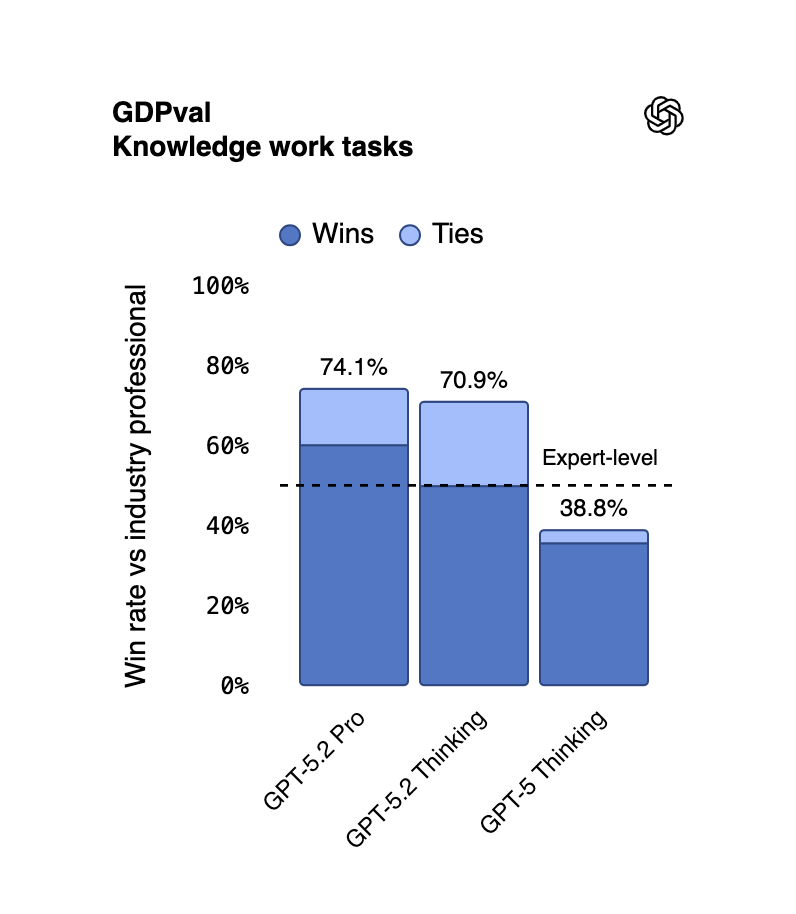
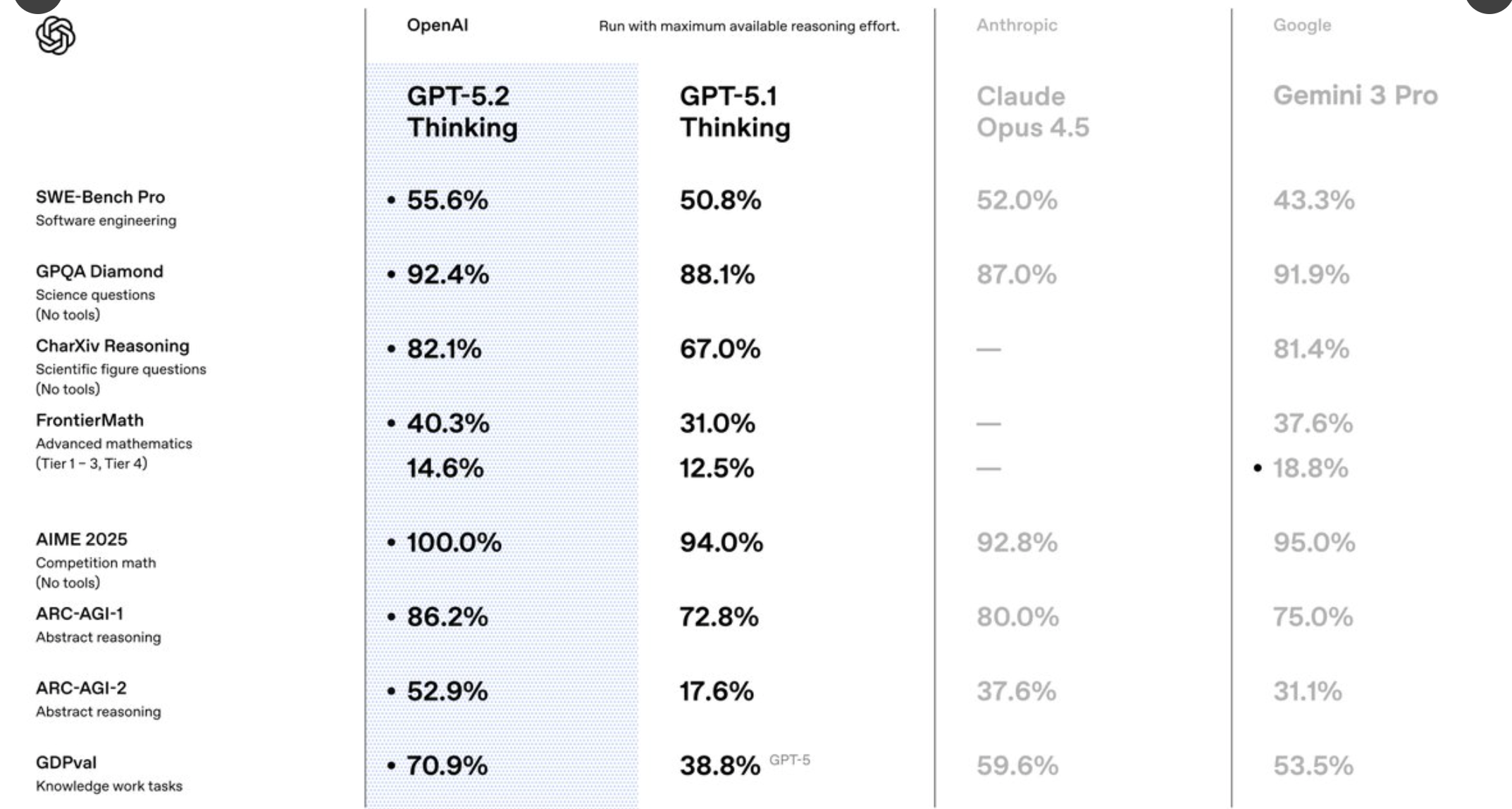
The GPT‑5.2 series includes three variants: Instant (for quick responses), Thinking (deep reasoning, optimized for multi‑step tasks) and Pro (professional‑grade, integrated with advanced tools). OpenAI’s website details benchmark breakthroughs. On the company’s GDPval benchmark, which simulates 44 real‑world professional tasks (e.g., legal briefs, engineering blueprints, care plans), GPT‑5.2 in Thinking mode surpassed human professionals on over 70% of tasks and delivered an 11x speed improvement. On the SWE‑Bench Verified (software engineering benchmark), GPT‑5.2 scored around 80%, slightly ahead of Gemini 3 Pro’s 76.2%; on ARC‑AGI‑2 (general intelligence test) it scored 52.9%, above Gemini’s 45.1%.
Specific improvements include:
- Long‑context and hallucination control: support for longer input sequences and reduced hallucinations (false information generation), raising factual accuracy above GPT‑5.1’s 61.8%.
- Multimodal enhancements: smoother image perception and tool integration, such as auto‑generating and debugging code or extracting data models from photos.
- Professional applications: early testers like Box, Notion and Zoom report GPT‑5.2 unlocks more economic value in collaboration tools, enabling one‑click report generation and workflow optimization.
On safety, OpenAI updated system cards: self‑harm detection accuracy reached 96.3%, and mental‑health related metrics improved across the board. Simo stressed: "We have advanced on every safety dimension, including emotional reliance and mental health." However, critics warn rapid iteration can amplify safety risks, and the company faces several lawsuits alleging a "rush to market."
Availability and Ecosystem Integration: Paid First, Developers Immediately
The ChatGPT rollout of GPT‑5.2 began on December 11, initially covering paid plans (Plus, Pro, Team, Business, Enterprise); free and Go plan users will gain access the following day. OpenAI is using a gradual deployment to ensure stability; if users do not immediately see the new models, they are advised to try again later. API users have immediate access to all variants, supporting seamless developer integration. Pricing remains unchanged: Plus $20/month, Pro $200/month, with enterprise pricing customized.
OpenAI also announced an "adult mode" planned for Q1 2026; originally targeted for December, the launch was delayed to refine age‑estimation algorithms and avoid misclassification. Limited tests have started in some countries, aiming to provide unrestricted features for adult users. On advertising, Simo stated clearly: "No plans for now, but if introduced, it will respect users and the special relationship with ChatGPT."
On X, developer @AILeaksAndNews shared a tutorial for early access to GPT‑5.2 in the Cursor editor: "Add the custom model 'gpt‑5.2‑high' to test—it shows zero requests initially on the page, and usage appears after testing." This reflects community enthusiasm and is expected to accelerate third‑party tool adoption.
Market Impact: An Accelerator for an AI Productivity Revolution
The release of GPT‑5.2 has far‑reaching implications for the industry. VentureBeat called it OpenAI’s largest model upgrade in 2025, aimed at reclaiming the professional market. Engadget argued that while GPT‑5 fell short of expectations, 5.2’s improvements in coding and reasoning may help shed the "bland personality" label. In head‑to‑heads with Gemini 3, GPT‑5.2 leads in math and reasoning, while Gemini excels in certain multimodal measures (e.g., MMMU‑Pro 81% vs. 76%). User surveys indicate heavy ChatGPT users save over 10 hours per week, with average users saving 40–60 minutes per day.
For the China market, this upgrade is likely to further penetrate enterprise applications, including collaborations with Alibaba Cloud and Tencent AI. IDC forecasts the global AI assistant market will exceed $5 trillion by 2026, with professional tools accounting for 40%. Nonetheless, challenges remain: OpenAI must balance innovation with safety and guard against EU data‑privacy scrutiny.
Outlook: From "Assistant" to "Partner"
Sam Altman expressed optimism that with GPT‑5.2, OpenAI expects to emerge from "code red" by January next year. Future models may focus on edge computing and video generation, with the Sora licensing deal potentially playing a key role. Mashable’s guide recommends: "Starting today, paid subscribers can switch models in ChatGPT settings to try the new variants."
The early debut of GPT‑5.2 is not only a technical milestone but also a signal of AI democratization. It reminds us that in a fiercely competitive race, innovation never stops. OpenAI is evolving from a "chatbot" into a "professional partner," and users and developers await the full depth of that transformation.
▶️ Creating content is not easy—please subscribe to our YouTube channel: https://www.youtube.com/@airosetta and like and save! 🙏