
On September 22, 2026, shortly after Anthropic released Opus 5.5, OpenAI officially introduced GPT‑6 Sol and GPT‑6 Luna, further expanding the GPT‑6 lineup. Earlier this month OpenAI released the flagship GPT‑6 Astra; these two new models bring Astra's improvements in reasoning, factuality, coding, computer usage and alignment down to faster, lower‑cost tiers, delivering roughly a 50% API price reduction compared with the corresponding GPT‑5.6 models. The release came about 90 minutes after Anthropic Claude Opus 5.5, reflecting the intensity of the current frontier model competition.
Details
Positioning and capabilities
- GPT‑6 Sol: Aimed at everyday complex tasks and software development, suitable for coding, debugging, refactoring, multi‑step workflows and cross‑tool collaboration. OpenAI says that in internal factuality evaluations its error rate is about half that of the previous GPT‑5.6 Sol, approaching Astra‑level reliability, while also improving coding and computer‑usage capabilities.
- GPT‑6 Luna: The most efficient model in the series, targeted at high‑concurrency, well‑scoped lightweight tasks such as summarization, information extraction, classification and routing. It supports adjustable inference strength to balance quality, speed and cost.
Both models inherit Astra's training‑method improvements, support roughly a 1 million token context window, and are available in ChatGPT Work, Codex and via the API. Plus, Pro, Business, Enterprise and Edu users can access Sol and Luna; Free and Go users can experience Luna on desktop. The regular Chat interface is not initially opened to these models.
Pricing
Official API prices (per million tokens) are:
- GPT‑6 Sol: input $2, output $10 (approximately 50% reduction versus the promotional price for GPT‑5.6 Sol)
- GPT‑6 Luna: input $0.10, output $0.50 (input down ~50%, output down ~58%)
Cache reads receive a substantial discount (around 10% of the input price). OpenAI says cache and inference efficiency improvements allowed it to pass cost savings directly to users. Higher usage limits and lower unit prices are intended to support larger‑scale iteration and Agent workflows.
Benchmark performance
OpenAI's comparisons show Sol achieves equal or better results than some higher‑priced competitors (including prior Anthropic models) on business workflow tests such as AutomationBench at a significantly lower per‑task cost; on software‑engineering tasks like DeepSWE it approaches top scores with much lower cost. Independent evaluations note that the price halving places both models favorably on the intelligence‑vs‑cost Pareto front and reduces hallucination rates, while overall intelligence metrics are broadly similar to the prior generation with mixed wins and losses on some coding Agent indicators. Most data remain vendor‑reported or preliminary third‑party results.
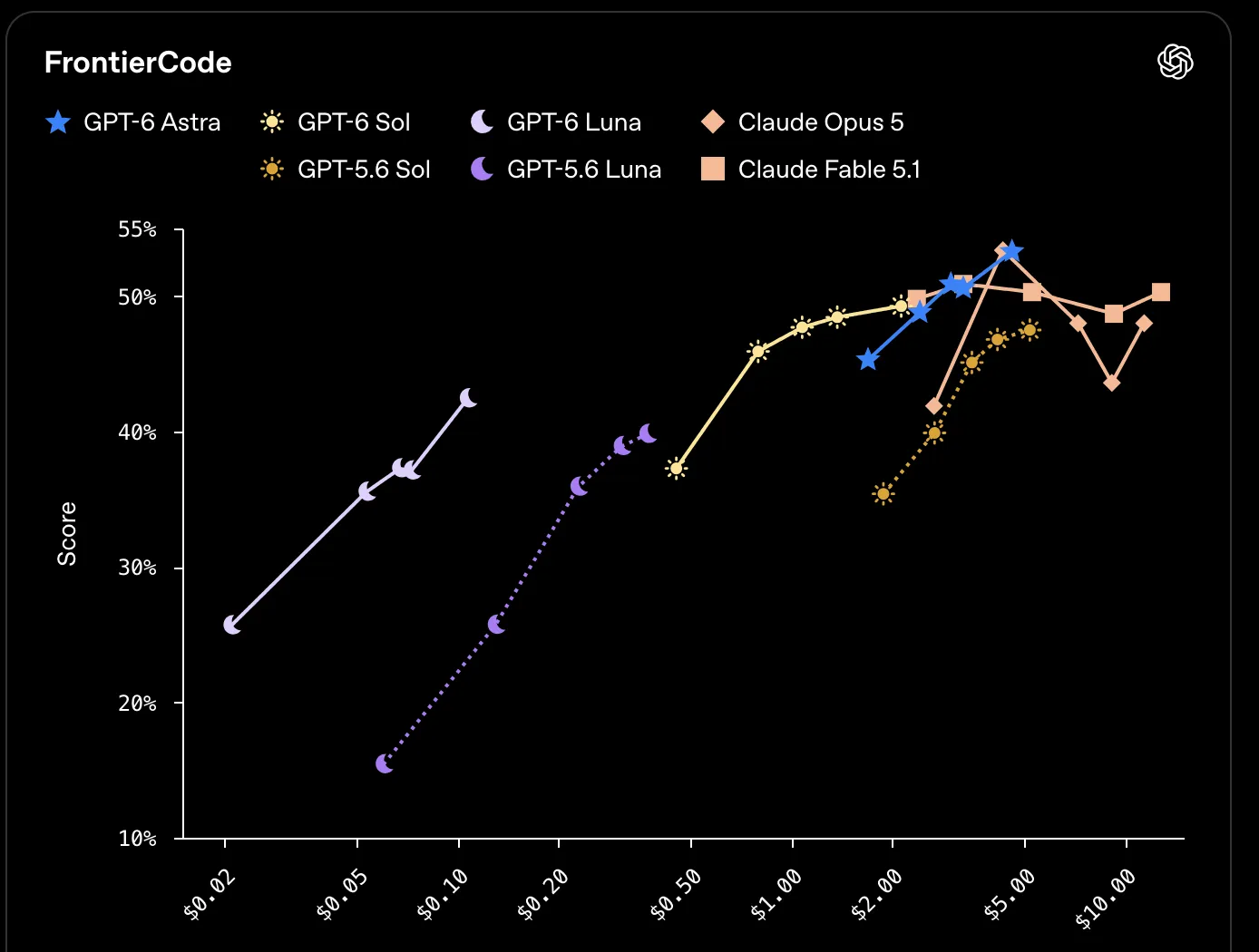
Cost per task
Potential impacts
1. Intensified competition in the mid‑range and value‑for‑money market
Sol and Luna's half‑price strategy directly respond to Anthropic's same‑day Opus 5.5 release (which also cut prices). Together they make "near‑flagship capability at substantially lower cost" an industry default, forcing developers and enterprises to reassess model selection: flagship models for the hardest tasks, mid‑tier models for large‑scale production. The product line further concentrates around Sol and Luna, with the Terra tier not updated in this release.
2. Lowered barriers for Agents and scaled applications
Lower unit prices and higher limits make long‑running Agent loops, large‑scale code processing and high‑concurrency classification/extraction tasks more economically feasible. Combined with cache optimizations, per‑task costs can be further compressed, helping move AI from pilots to everyday production.
3. Factuality and reliability as selling points
OpenAI emphasizes the halved error rate and alignment improvements, reflecting an industry shift toward "fewer hallucinations and more reliable outputs" as a differentiator. For professional work and automation scenarios this carries more practical value than purely chasing benchmark scores.
4. Release cadence and competitive landscape
Nearly concurrent price and capability updates from Anthropic show leading labs are competing for mid‑to‑high‑end market share on a weekly timescale. Users will benefit from faster iteration and lower prices but must also manage migration and re‑evaluation costs from rapid model turnover. Independent reproductions and real‑world workflow data will determine whether Sol and Luna can truly replace some higher‑priced calls in production.
Conclusion
The launch of GPT‑6 Sol and Luna marks OpenAI's effort to systematically push Astra's frontier advances into tiers suitable for large‑scale use and to strengthen cost‑effectiveness with a half‑price strategy. These models aim not for absolute peak performance but for a balance of speed, cost and sufficient intelligence, fitting coding Agents, knowledge work and high‑traffic tasks. Alongside Anthropic's moves the second half of 2026 sees competition shift from "who is strongest" to "who can deliver strong, reliable capability at acceptable cost." The true test will be long‑term developer feedback from production deployments.
▶️ Enjoy this article? Creating content is hard work!
Follow our YouTube channel:
AI Rosetta
Your likes, subscriptions and shares are our greatest support! 🙏
More AI news at: https://www.airosetta.com