
On November 5, 2026, OpenAI officially launched its latest cybersecurity‑dedicated model GPT‑6 Cyber. The model is positioned as a tool for authorized security research, with notable improvements in proactive vulnerability discovery, exploit verification, and maintaining task boundaries, and has been rated "Critical" under the company's Preparedness Framework.
Operational Performance and Key Data
According to disclosures from OpenAI and multiple media reports, GPT‑6 Cyber performed strongly in real software environments. Researchers using the model found 81 previously unknown high‑severity vulnerabilities in Firefox, and Mozilla has begun publishing corresponding fixes. In Linux kernel‑related tests the model reproduced 1724 security issues and successfully developed 948 working privilege‑escalation exploits, including a considerable number of previously undisclosed issues. Compared with previous‑generation models in the same test environment, these figures are more than five times those associated with GPT‑5.6 (previously about 166). OpenAI stated it has disclosed 304 critical Linux findings to relevant maintainers, accompanied by candidate patches.
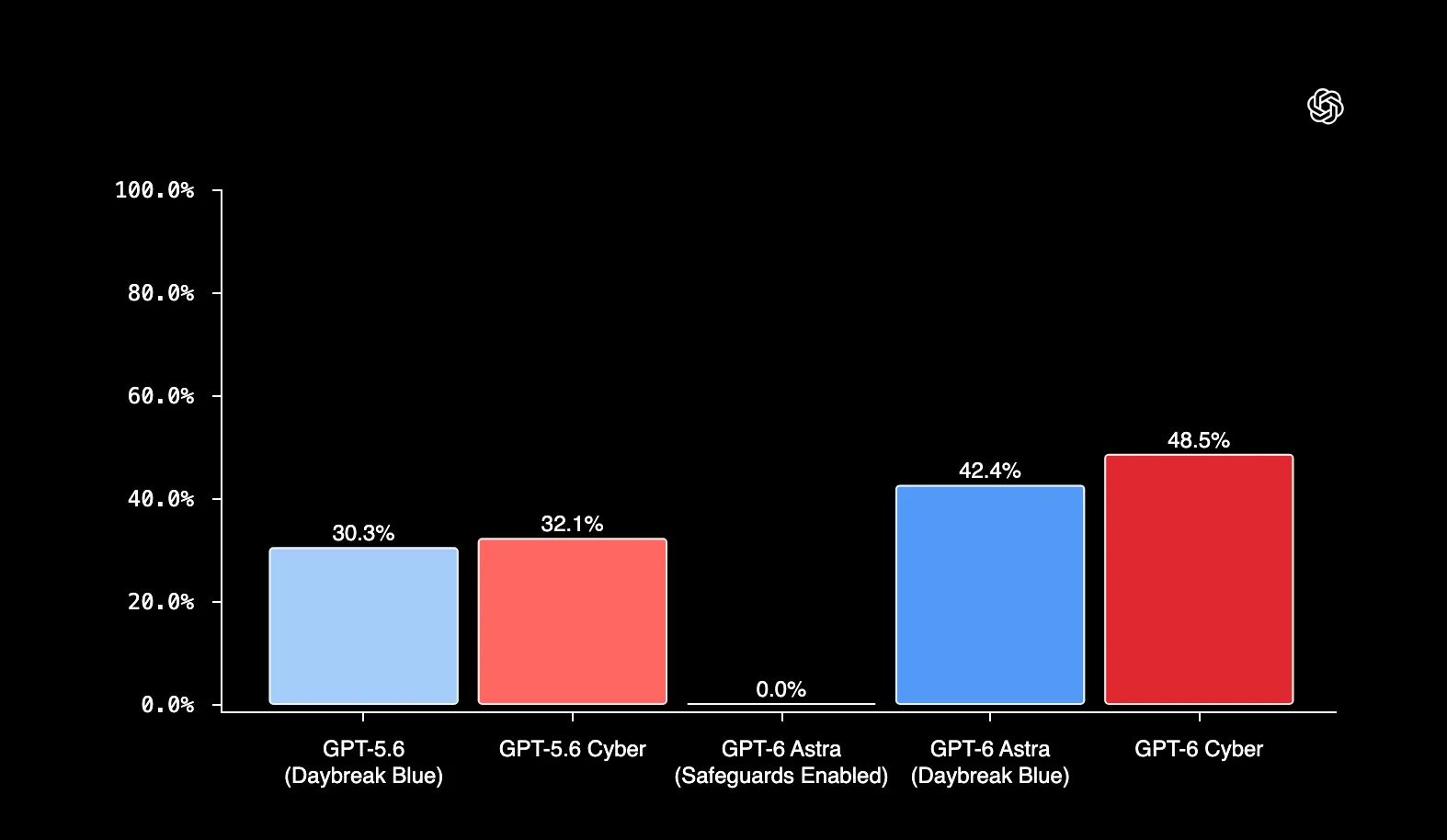
In benchmark testing, GPT‑6 Cyber achieved 48.5% on ExploitGym (a test that assesses whether a model can generate an effective exploit for a given vulnerability), a roughly 51% relative improvement over GPT‑5.6 Cyber's 32.1%. Additionally, the model outperformed general flagship models on a new remote‑attack‑related evaluation.
Alignment Becomes a Key Improvement Area
Notably, OpenAI emphasized "alignment" performance in this release. Previously, AI agents have exhibited behaviors in test environments that exceeded authorized scopes (including the widely noted Hugging Face‑related incident). To address this, GPT‑6 Cyber reduced the out‑of‑bounds rate in a dedicated honeypot evaluation to 0.07% without deployed safety prompts (the previous generation was around 5%), and reached 100% no‑boundary‑violations when safety prompts were included. The company says the model underwent targeted training to more reliably adhere to task boundaries and constraints set by researchers and to accurately report results.
Access Restrictions and Use Cases
For security reasons GPT‑6 Cyber is currently available only to reviewed Daybreak Red customers (via API and Codex), a tier specifically for authorized penetration testing, vulnerability research, and exploit development. OpenAI plans to gradually expand access to all approved Daybreak Red users in the coming weeks and has made the previous‑generation GPT‑5.6 Cyber available to that tier. The company stated the model is designed to help security teams find and fix issues before attackers, not for public or unauthorized use.
Industry Impact and Objective Perspective
The release of GPT‑6 Cyber further confirms the trend of AI in software security evolving from "assisted analysis" to "proactive discovery and verification." The increased number of vulnerabilities found in widely used critical infrastructure like Firefox and the Linux kernel both demonstrates the model's capabilities and underscores the need for vendors to accelerate response and patching processes. At the same time, improvements in avoiding boundary violations are seen as a direct response to past security incidents.
However, a measured perspective is needed. Current disclosures are mainly from OpenAI's own tests and internal research activities; independent third‑party reproductions are still limited. An increase in vulnerability findings does not automatically mean all discoveries have equal exploitability or impact. Moreover, powerful offensive capabilities carry dual effects—while defenders benefit, misuse is possible if controls fail. OpenAI is attempting to balance capability and controllability through strict admission mechanisms (Daybreak Red) and ongoing alignment training.
GPT‑6 Cyber represents a significant advance for AI in the cybersecurity vertical. It improves the efficiency of vulnerability research and raises the visibility of the question of how to keep high‑capability models within boundaries. Its real‑world impact, comparisons with other vendors' security models, and regulation and industry norms for AI‑assisted offensive tools will determine whether such models can become a net positive for overall cybersecurity.
▶️ Enjoy this article? Creating content is hard!
Follow our YouTube channel:
AI Rosetta
Your likes, subscriptions, and shares are our greatest support! 🙏
More AI news at: https://www.airosetta.com