
On April 21, 2026 OpenAI officially released the next‑generation image‑generation model GPT Image 2 (consumer product name ChatGPT Images 2.0), simultaneously rolling it out on ChatGPT, the Codex coding assistant and the developer API. The release comes just four months after its predecessor GPT Image 1.5, marking a strategic acceleration in OpenAI's visual intelligence efforts and announcing the imminent retirement of the DALL‑E series — the company has confirmed that DALL‑E 2/3 will be fully retired on May 12, 2026.
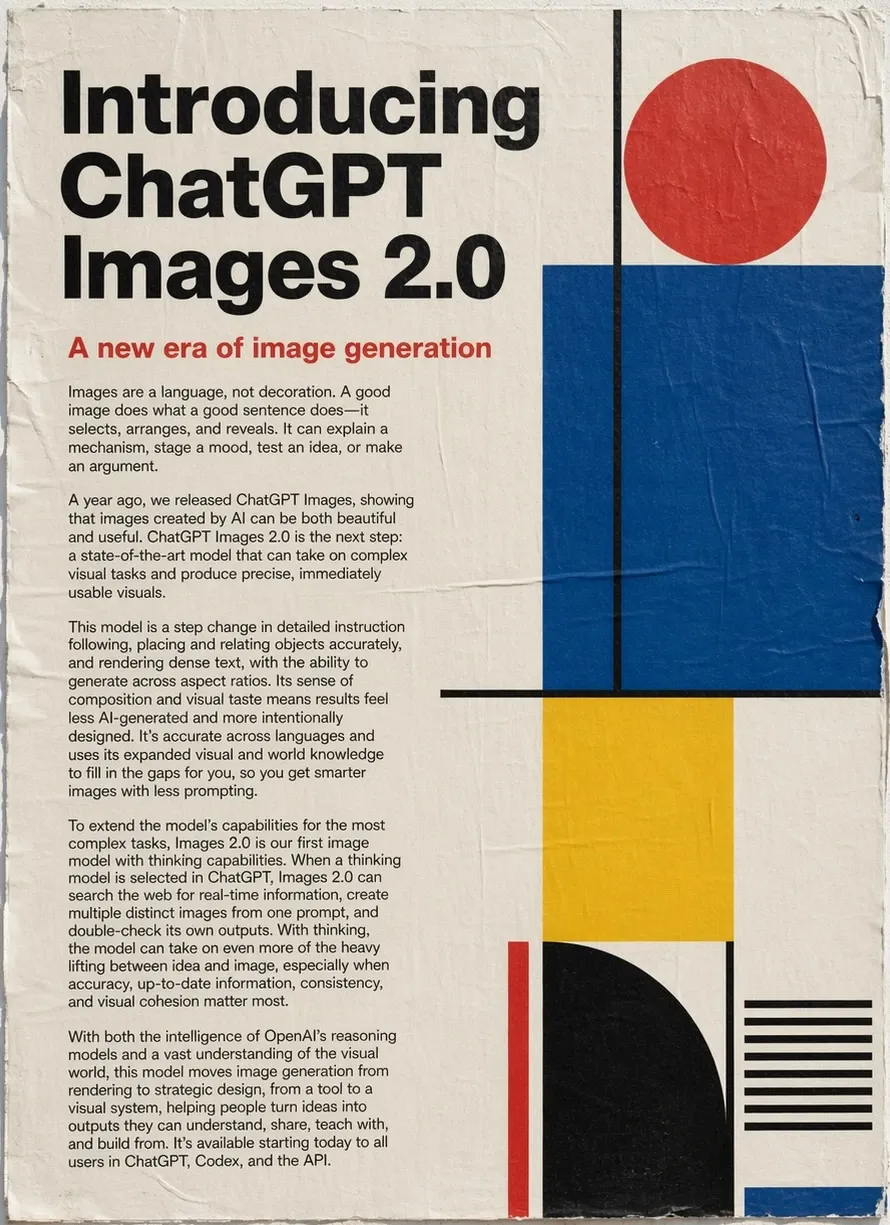
Architectural innovation: from "two‑step" to "single‑step generation"
The fundamental change in GPT Image 2 lies in a reconstructed architecture. According to analyses from the technical community, the model abandons the two‑stage inference pipeline used by the prior generation and moves to a single‑pass generator. The direct benefits of this shift are speed improvements — typical generation time falls to under three seconds — and a tighter coupling between prompt semantics and rendered output. OpenAI describes it as a "completely new architecture," but has not publicly confirmed whether it uses a diffusion model, an autoregressive model, or a hybrid approach.
Five major innovations
1. Text rendering accuracy elevated to production grade
This is GPT Image 2's most disruptive upgrade. The previous model treated text as a "decorative element," often producing misspellings and character merging; the new model achieves roughly 99% accuracy on Latin‑script text and supports complex scenarios such as dense menus, packaging labels, long headlines and UI copy. Notably, its handling of non‑Latin scripts — including Chinese, Japanese, Korean, Hindi and Bengali — is described as "approaching native‑level accuracy." In OpenAI's demos, a composite magazine cover coordinated nine writing systems, each readable to speakers of the corresponding language.
2. "Thinking Mode" enables visual reasoning
Paying subscribers (Plus/Pro/Enterprise) can enable Thinking Mode. In this mode the model goes beyond simple keyword matching: it can fetch real‑time information online (for example, query tomorrow's weather in San Francisco and generate a related infographic); create visual interpreters from uploaded files; "reason about image structure" before generation; and output up to eight images in one prompt while maintaining continuity of characters, objects and style. This allows users to input vague instructions like "recommend activities for tomorrow's San Francisco weather and make a poster" and receive a full workflow output rather than just a static illustration.
3. Native 2K resolution and extreme framing flexibility
The model supports native 2K resolution (double the prior 1K) and can be upgraded to 4K via the API. Aspect ratios range from 3:1 ultra‑wide to 1:3 tall, covering use cases from cinematic storyboards to mobile posters. This improvement addresses previous complaints that the AI stubbornly produced specific aspect ratios.
4. Updated world knowledge and style consistency
OpenAI positions the new model not just as an "image generator" but as a "visual language with perspective." Its knowledge cutoff is updated to December 2025, enabling accurate reproduction of contemporary brand visual systems, typographic trends and photographic styles. In scenarios that require knowing "how the world works" — such as comic storyboards, product photography and architectural drawings — the model demonstrates professional‑level understanding of details like camera models, paper materials and film grain.
5. Natural‑language editing and multi‑image continuity
Users can make localized edits using descriptive language (for example, "move the coffee cup to the left side of the table" or "replace the sky with a sunset") without using masks or regenerating the entire image. The model can also generate multi‑panel comics with consistent characters, full sets of social media assets, or design schemes for different rooms of a house in a single request.
Market positioning and competitive landscape
The timing of GPT Image 2's release is strategically significant. On one hand, OpenAI shut down the Sora video generation product on March 24, freeing GPU capacity that has been reported to be redirected toward image model training; on the other hand, Google's Nano Banana Pro has steadily taken market share since late 2025 and even surpassed GPT Image 1.5 in pure photographic realism.
In side‑by‑side tests, Nano Banana Pro still leads in 4K output and extreme photographic realism, but GPT Image 2 establishes barriers in text fidelity, prompt adherence and integrated reasoning capabilities. OpenAI appears to have chosen a differentiated path: not to be "a better Midjourney," but to build a "visual productivity tool" that embeds into workflows.
Commercial deployment and pricing
The model is fully integrated across all ChatGPT subscription tiers (free users are limited to generating about two images per day) and is available to developers via the gpt-image-2 API, billed by image quality tier and resolution. Industry observers predict initial pricing may be 30%–50% higher than version 1.5, but expect costs to fall over time as computational efficiency improves.
Concerns and challenges
Despite significant breakthroughs, early tests reveal inconsistencies in brand reproduction fidelity — the model's accuracy in reproducing specific corporate visual identities can vary. Additionally, OpenAI's promotional materials deliberately showcased highly realistic AI‑generated fake Chrome screenshots and magazine pages, sparking debate about misinformation risks. The company says it has banned copying living artists' personal styles while permitting reproduction of "broader studio styles."
Conclusion
The release of GPT Image 2 marks a key transition for AI image generation from a "toy" to a "tool." When text rendering is no longer a bottleneck and models can understand "why to compose a scene this way" rather than just correlating pixels, visual AI becomes ready for core industries such as design, publishing, e‑commerce and education. With DALL‑E's retirement and the arrival of GPT Image 2, OpenAI has completed a strategic consolidation of its visual product line — the next question is no longer "can AI produce good images?" but "how will human designers collaborate with this new 'visual thinking' partner?"
▶️ Enjoy this article? Creating takes work!
Follow our YouTube channel:
AI Rosetta
Your likes, subscriptions and shares are our greatest support! 🙏
More AI news at: https://www.airosetta.com