
On March 17, 2026, OpenAI's official website announced the launch of GPT‑5.4 Mini and GPT‑5.4 Nano, two small models that represent the most significant extensions of the GPT‑5.4 series after the flagship. The company’s positioning is clear: both models emphasize low cost and fast invocation, designed for high‑frequency, high‑concurrency, production‑grade Agent scenarios. GPT‑5.4 Mini is available to free and Go users in ChatGPT and can be invoked via the "Thinking" mode; Nano is API‑only, priced as low as $0.20 per million input tokens. OpenAI states these models "bring GPT‑5.4’s powerful capabilities into a faster, cheaper form," approaching flagship performance on benchmarks such as SWE‑Bench Pro and OSWorld‑Verified while delivering over 2x speed improvements, and have been dubbed by the developer community a "nuclear weapon for Agent subtasks" and a "savior for high‑frequency calls."
From GPT‑5.4 to Mini/Nano: OpenAI’s "All Sizes" Strategy
OpenAI released the GPT‑5.4 flagship (Thinking mode) on March 5 this year, and just 12 days later followed rapidly with the smaller models, demonstrating extreme execution of a "tiered deployment" strategy. While GPT‑5.4 focuses on professional, complex tasks, Mini and Nano target massive everyday scenarios: coding assistants, sub‑Agents, data extraction, real‑time multimodal inference, computer automation, and more.
The company emphasizes that both models are optimized for scenarios where latency determines user experience—responsive coding assistants, parallel sub‑Agents, real‑time screenshot analysis, image understanding, etc. Mini supports text+image input, tool invocation, function calling, web search, file search, computer usage, and Skills; Nano focuses on extreme speed and suits classification, data extraction, sorting, and simple sub‑Agent tasks.
Key Highlights: 2x Speed + Near‑Flagship Performance + Extremely Low Cost
GPT‑5.4 Mini is the stronger of the two:
- Comprehensively improved over GPT‑5 Mini across four dimensions: coding, reasoning, multimodal understanding, and tool use
- Inference speed is more than 2x faster than GPT‑5 Mini
- 400k extended context window
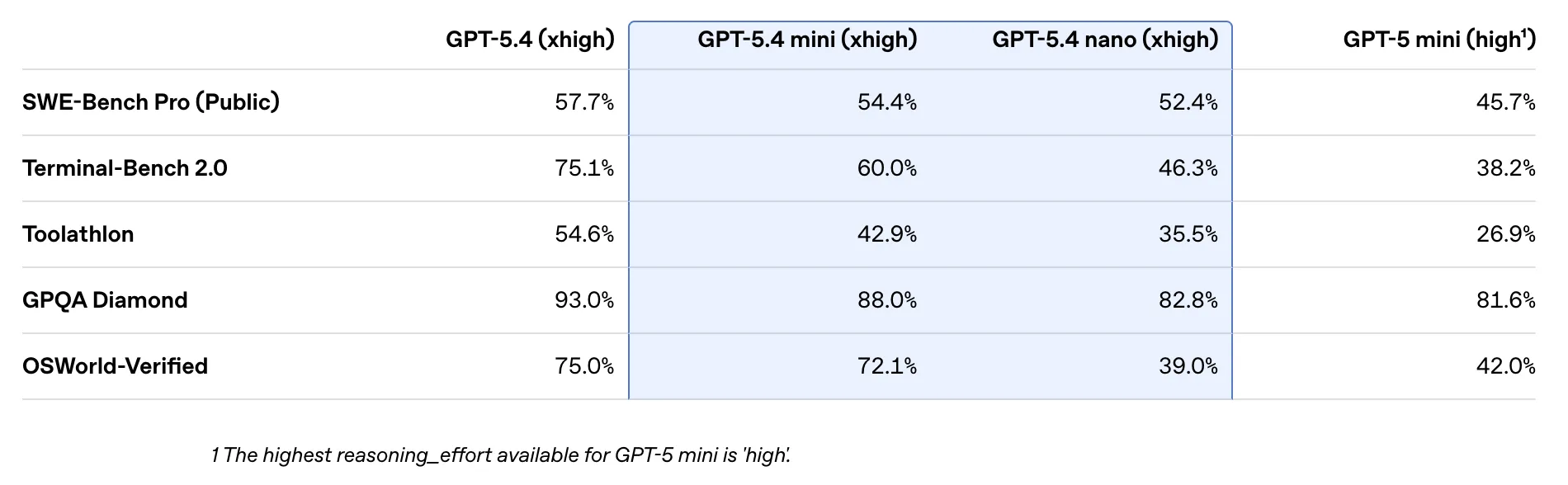
- Near‑flagship results on multiple benchmarks: SWE‑Bench Pro 54.4% (flagship 57.7%), OSWorld‑Verified 72.1% (flagship 75.0%), GPQA Diamond 88.0% (flagship 93.0%)
- Developer tests: in Hebbia document‑analysis scenarios, Mini’s end‑to‑end pass rate and citation accuracy even exceeded the GPT‑5.4 flagship while greatly reducing cost
GPT‑5.4 Nano is the "king of cost‑effectiveness":
- The cheapest model in OpenAI's history
- Designed for simple but high‑frequency tasks: classification, data extraction, sorting, and coding sub‑Agents
- Benchmark performance is lower than Mini but surpasses the previous‑generation GPT‑5 Nano, and latency is extremely low under high concurrency
Pricing (API):
- GPT‑5.4 Mini: $0.75 per million input tokens, $4.50 per million output tokens
- GPT‑5.4 Nano: $0.20 per million input tokens, $1.25 per million output tokens (about 1/12 of the flagship)
- In Codex, Mini only consumes 30% of a GPT‑5.4 quota, allowing developers to handle simple coding tasks at roughly one‑third the cost
This pricing brings "GPT‑5.4‑level intelligence" to the masses and small‑to‑medium enterprises: free users can invoke Mini in ChatGPT via the "Thinking" option; paid users falling into rate limits will automatically fall back to Mini; developers can deploy Nano at scale as sub‑Agents to build low‑cost agentic systems.
Real‑World Performance: A Productivity Revolution for Sub‑Agents and High‑Frequency Calls
OpenAI and early partners have shared numerous measured cases:
- Notion: Uses Mini for page edits and complex formatting tasks with results matching or exceeding GPT‑5.2 while significantly lowering compute costs. Notion AI engineering lead Abhisek Modi said, "Previously only the most expensive models could reliably handle Agent tool calls; now Mini and Nano do so easily, letting users choose intelligence levels precisely as needed."
- Hebbia (financial/legal/research document analysis): CTO Aabhas Sharma reported that Mini "matches or exceeds competitors" on output tasks and citation recall, with higher end‑to‑end pass rates and stronger source attribution at far lower cost than the flagship.
- Coding and Agent workflows: Mini suits responsive coding assistants, codebase navigation, frontend generation, and debug loops; Nano serves perfectly as a "sub‑Agent," executing simple tasks in parallel after a large model plans (e.g., code search, document processing), achieving truly low‑cost multi‑Agent collaboration.
Developer feedback on Hacker News and Reddit indicates Mini averages 180–190 tokens/s on the API, with Nano up to 200 tokens/s; combined with priority services, latency can be as low as 2–3 seconds—far exceeding previous small models and delivering a true "real‑time conversational experience."
Industry Impact: AI Moving from "Luxury" to "Infrastructure"
The release of Mini and Nano comes as global demand for high‑frequency, low‑cost Agents explodes. OpenAI’s move directly lowers the barrier to deploying Agent systems:
- Enterprises can deploy large networks of sub‑Agents, with GPT‑5.4 handling planning and Mini/Nano executing details
- Individual developers and startups can build intelligent applications at very low cost
- Education, office productivity, and automation scenarios will see a new wave of adoption
Compared with competitors, OpenAI’s strategy is the most aggressive: not only do these models approach flagship performance, their pricing is a "dimensionality‑reducing strike." Industry analysts view this as the start of a "tiered intelligence" era—flagships for deep thinking, small models for high‑frequency execution, exponentially improving system cost‑effectiveness.
OpenAI CEO Sam Altman has repeatedly hinted that "smaller, faster, cheaper models will be the mainstream of the future," and Mini and Nano put that vision into practice. Combined with the earlier GPT‑5.4 Thinking release, OpenAI now offers a full tiered lineup: Flagship (depth), Mini (balance), Nano (extreme lightweight), covering needs from free users to enterprises consuming trillions of tokens.
Conclusion: Low‑Cost and High‑Speed, AI Truly "Entering Every Home"
GPT‑5.4 Mini and Nano mean far more than two new models—they turn "GPT‑5.4‑level intelligence" from a luxury for a few into infrastructure available to everyone. Free users can experience near‑flagship thinking in ChatGPT; developers can build complex Agent systems at roughly one‑tenth the previous cost; enterprises can achieve genuinely real‑time, reliable AI automation under high concurrency.
In an era (2026) when compute costs remain high, OpenAI again demonstrates that true technological progress is not just stacking parameters but making powerful intelligence "faster, cheaper, and more ubiquitous." This "low‑cost, high‑speed revolution" is only beginning.
▶️ Enjoy this article? Creating content is hard!
Follow our YouTube channel:
AI Rosetta
Your likes, subscriptions, and shares are our greatest support! 🙏
For more AI news visit: https://www.airosetta.com