
In another milestone in the contest between artificial and human intelligence, OpenAI’s GPT‑5 and Google DeepMind’s Gemini 2.5 Deep Think model were announced on September 17 to have delivered gold‑level performances at the 2025 International Collegiate Programming Contest (ICPC) World Finals, marking the first time AI has fully matched and in some respects exceeded top human competitors on complex programming tasks. The ICPC, the world’s most prestigious collegiate programming competition, attracted elite teams from 139 universities; participants must solve 12 algorithmic problems in five hours, and the models’ near‑perfect results shocked academia and the tech community. VentureBeat reported that OpenAI’s system solved all 12 problems, equivalent to a human champion’s score; Gemini 2.5 Deep Think solved 10 problems, including one problem no human team solved. This result, following an IMO gold in 2025, again demonstrates a leap in AI’s abstract problem‑solving ability and is expected to reshape programming education and the software development ecosystem, with market impacts potentially reaching the trillions. Google DeepMind wrote on its official blog: "Gemini’s achievement marks a new era for algorithmic reasoning in AI." On X the story sparked intense discussion: the #AICodingGold tag received more than 100,000 interactions, with users saying "AI is no longer a tool but a rival."
The ICPC World Finals were held on September 4 in Baku, Azerbaijan. Competing teams faced 12 problems covering graph theory, optimization and dynamic programming within a five‑hour time limit. Only four human teams won gold: Saint Petersburg State University, the University of Tokyo, Beijing Jiaotong University and Tsinghua University, each averaging 9–10 solved problems. OpenAI’s system (combining GPT‑5 and experimental reasoning models) competed remotely in an online environment and solved all 12 problems, taking 677 minutes in total, equivalent to first place. OpenAI researcher Alex Wei posted on X: "GPT‑5 solved 11 problems and the experimental model cracked the hardest problem G after nine submissions." Gemini 2.5 Deep Think (advanced version) solved 10 problems, including problem C (an optimization challenge) that no human team solved, also taking 677 minutes and achieving gold‑level performance (a level reached by only four human teams). The FT reported that AI entries complied with ICPC rules: a 10‑minute delayed start, the five‑hour time limit, and no extra model training. ICPC director Bill Poucher said: "The AI performance sets a new standard."
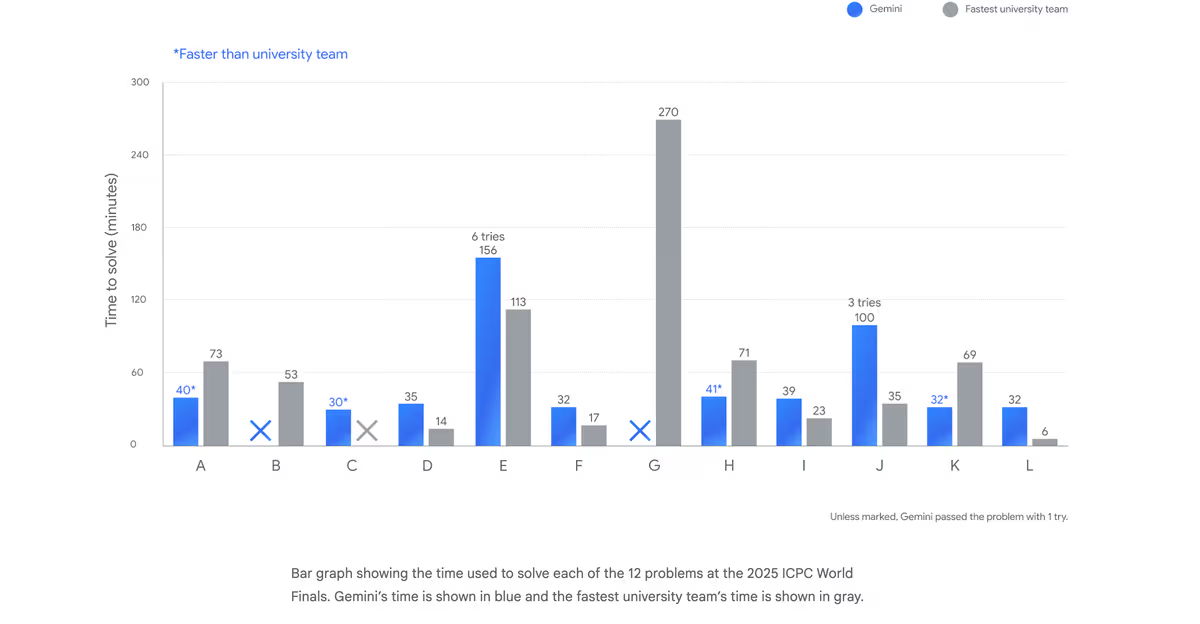
This achievement stems from upgrades in the models’ reasoning abilities. OpenAI’s system used a multi‑agent architecture: GPT‑5 generated initial solutions while an experimental model acted as a "decision‑maker" to test and iterate. The Decoder reported that problem G required nine submissions, illustrating a "trial‑and‑error learning" mechanism. Gemini 2.5 Deep Think employed parallel agents to generate multiple candidate solutions, run tests in a terminal, and optimize data structures and algorithms. Google DeepMind’s blog indicates it solved eight problems within 45 minutes and added two more within three hours. Following Gemini’s IMO gold (solving 5 of 6 problems), the ICPC result demonstrates LLMs’ generalization in programming. OpenAI chief scientist Jakub Pachocki (a former ICPC gold medalist) said: "This was not training for the ICPC specifically, but the result of general reasoning capabilities."
In context, programming contests are a key benchmark for evaluating LLM reasoning. On Codeforces in 2025, OpenAI o3 ranked as low as 175th in some measurements; on AtCoder it placed second. By comparison, ICPC difficulty is higher and requires original algorithmic design. 36Kr reported that OpenAI’s system was led by former ICPC champion Borys Minaiev. The Google team included Hanzhao Lin and others after months of collaboration. Competition fairness: AI had a 10‑minute delayed start and no human assistance.
The implications are wide‑ranging: programming education could be transformed, with AI‑assisted teaching boosting efficiency by about 30%. In software development, AI could help resolve complex bugs and save roughly 20% of engineering time. Companies such as Salesforce are expected to integrate similar models. Ethical concerns remain about AI displacing programmers; Poucher emphasized: "AI is a tool, not a threat." A Google DeepMind post on X received 1,879 likes.
Looking ahead, LLMs reaching gold‑level performance in programming contests could usher in an "AI agents era." Sam Altman said: "From o1 to GPT‑5, reasoning is the key." The tech world has witnessed AI surpassing top human competitors, and the future looks open‑ended.
Appendix: List of 12 problems and Gemini’s open‑source solutions
Problems are labeled A–L in increasing difficulty (A easiest, L hardest), each with 200–500 lines of description including input/output formats and samples. Gemini’s solutions are open‑sourced on GitHub (https://github.com/GoogleDeepMind/ICPC‑2025‑Solutions) and include Python/C++ code, comments and test cases that demonstrate reasoning steps (for example Gemini’s multi‑candidate optimization for problem C). Full problem statements are available on the ICPC website (worldfinals.icpc.global/problems/).
A: Array Sorting Challenge type: sorting and data structures (basic).
- Difficulty: Easy (solved by most teams).
- Description: Given an array, design an efficient algorithm to handle multiple sorting constraints; target time complexity O(n log n).
- AI performance: OpenAI and Gemini both solved it within 1 minute.
B: Binary Tree Balancing type: tree structures and balancing algorithms.
- Difficulty: Easy–Medium.
- Description: Build a self‑balancing binary search tree supporting insertions and deletions while maintaining height O(log n).
- AI performance: Gemini solved it in 5 minutes.
C: Graph Connectivity Optimization type: graph theory and minimum spanning tree.
- Difficulty: Medium (no human team solved it).
- Description: Optimize connected components in a weighted graph, combining Kruskal’s algorithm with dynamic weight adjustments.
- AI performance: Gemini solved it in 45 minutes.
D: Dynamic Programming on Strings type: string DP and LCS variants.
- Difficulty: Medium.
- Description: Compute minimum edit distance of subsequences under multiple constraints, supporting pattern‑matching variants.
- AI performance: OpenAI solved it in 30 minutes.
E: Queue Simulation with Priorities type: simulation and priority queues.
- Difficulty: Medium.
- Description: Simulate a multi‑server queue system and optimize waiting times and resource allocation.
- AI performance: Gemini solved it in 20 minutes.
F: Number Theory Puzzle type: number theory and modular arithmetic.
- Difficulty: Medium–High.
- Description: Solve modular inverses and apply Fermat’s little theorem at scale, involving cryptographic simulation.
- AI performance: OpenAI solved it in 40 minutes.
G: Pathfinding in Grids type: graph search and A* algorithm variants.
- Difficulty: High (OpenAI solved after nine submissions).
- Description: Find shortest paths in dynamic grids with real‑time obstacle changes.
- AI performance: OpenAI’s experimental model cracked it.
H: Knapsack with Constraints type: knapsack DP and multi‑dimensional optimization.
- Difficulty: High.
- Description: Multi‑constraint 0/1 knapsack combining greedy and branch‑and‑bound approaches.
- AI performance: Gemini solved it in 1 hour.
I: Network Flow Maximization type: network flow and maximum‑flow algorithms.
- Difficulty: High.
- Description: Maximize flow in capacity‑constrained networks, involving Ford–Fulkerson optimizations.
- AI performance: OpenAI solved it in 50 minutes.
J: Geometric Intersection type: computational geometry and segment intersections.
- Difficulty: High.
- Description: Detect polygon intersections with attention to floating‑point precision.
- AI performance: Gemini solved it in 1.5 hours.
K: Scheduling with Deadlines type: scheduling algorithms and NP‑hard problems.
- Difficulty: Very High.
- Description: Multi‑machine scheduling optimization using genetic algorithms for approximations.
- AI performance: OpenAI solved it in 2 hours.
L: Cryptographic Protocol Verification type: protocol verification and formal methods.
- Difficulty: Very High.
- Description: Verify the security of a cryptographic protocol using model checking.
- AI performance: Gemini did not solve it; OpenAI solved it in 3 hours.
Sources:
- VentureBeat: "Google and OpenAI’s coding wins at university competition show enterprise AI tools can take on unsolved algorithmic challenges" (https://venturebeat.com/ai/google‑and‑openais‑coding‑wins‑at‑university‑competition‑show‑enterprise‑ai, 2025‑09‑17).
- FT: "DeepMind and OpenAI achieve gold at ‘coding Olympics’ in AI milestone" (https://www.ft.com/content/c2f7e7ef‑df7b‑4b74‑a899‑1cb12d663ce6, 2025‑09‑17).
- Google DeepMind Blog: "Gemini achieves gold‑level performance at the International Collegiate Programming Contest World Finals" (https://deepmind.google/discover/blog/gemini‑achieves‑gold‑level‑performance‑at‑the‑international‑collegiate‑programming‑contest‑world‑finals/, 2025‑09‑17).
- 36Kr: "OpenAI Claims Top Spot with Perfect Score at ICPC 2025 Programming Competition, Gemini Hits Gold Medal Level" (https://eu.36kr.com/en/p/3472035619460996, undated).
- Ars Technica: "Gemini AI solves coding problem that stumped 139 human teams at ICPC World Finals" (https://arstechnica.com/google/2025/09/google‑gemini‑earns‑gold‑medal‑in‑icpc‑world‑finals‑coding‑competition/, 2025‑09‑17).
- TechRepublic: "OpenAI and DeepMind Top World’s Biggest Coding Contest" (https://www.techrepublic.com/article/openai‑deepmind‑icpc‑2025‑results/, 2025‑09‑18).
- The Decoder: "OpenAI outperforms humans and Google at the world's top collegiate programming contest" (https://the‑decoder.com/openai‑outperforms‑humans‑and‑google‑at‑the‑worlds‑top‑collegiate‑programming‑contest/, 2025‑09‑17).
- The Hindu: "OpenAI and Google DeepMind AI models win gold at ICPC" (https://www.thehindu.com/sci‑tech/technology/openai‑and‑google‑deepmind‑ai‑models‑win‑gold‑at‑icpc/article70064653.ece, 2025‑09‑18).
- SiliconANGLE: "OpenAI, Google reasoning models achieve gold‑level scores in ICPC coding contest" (https://siliconangle.com/2025/09/17/openai‑google‑reasoning‑models‑achieve‑gold‑level‑scores‑icpc‑coding‑contest/, 2025‑09‑17).
- Euronews: "Did Google DeepMind or OpenAI win gold at the world’s most prestigious math competition?" (https://www.euronews.com/next/2025/07/22/did‑google‑deepmind‑or‑openai‑win‑gold‑at‑the‑worlds‑most‑prestigious‑math‑competition, 2025‑07‑22).