
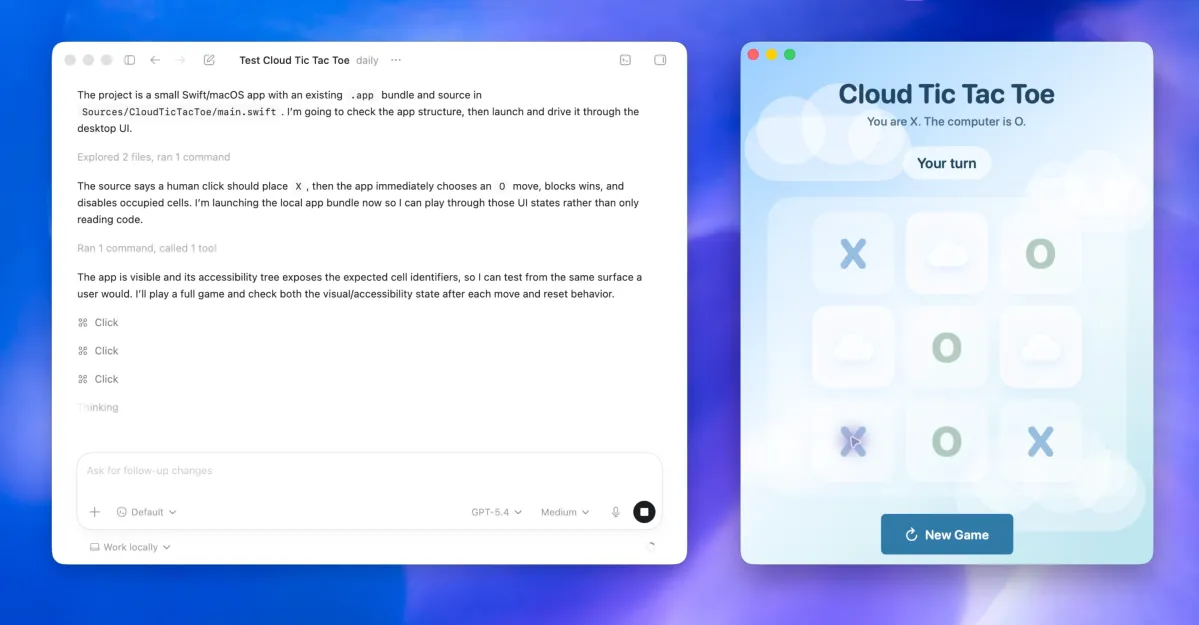
April 16, 2026, OpenAI rolled out a major update to Codex. Viewed as a direct response to Anthropic's Claude Code and the open‑source framework OpenClaw, the new Codex adds native macOS desktop application control, background parallel multi‑agent execution, integrated image generation, native web browsing and an optional memory feature, significantly boosting automation capabilities in real desktop environments. Outlets including The Verge described the update as a "direct strike" at Claude Code, intended to reclaim momentum in the AI desktop‑agent race.
Key innovations: from code generation to desktop‑level autonomous execution
The headline feature of this release is native control of macOS desktop applications. Codex can now run in the background and autonomously operate arbitrary desktop apps (such as Xcode, Figma, browsers, design tools, etc.), performing clicks, text input, screenshots and other actions without manual user intervention. This enables developers to have Codex automatically test front‑end changes, iterate UI designs, or operate software that lacks an exposed API, achieving true WYSIWYG desktop automation.
Another major innovation is parallel multi‑agent execution. Users can run multiple Codex agents concurrently, each responsible for different subtasks and operating independently. For example, one agent can perform code review, another generate UI proposals, and a third synchronize documentation updates. This parallelism greatly improves efficiency for complex workflows and represents a direct advance beyond Claude Code's single‑agent model.
The deep integration of image generation is also noteworthy. Codex now supports gpt‑image‑1.5, enabling a single workflow of "describe requirements → generate image → refine details → export for use," further bridging the gap between code and visual design.
In addition, the update introduces native web browsing: Codex can open pages within the app, where users can annotate or comment directly on the page to guide precise actions. This design improves the accuracy of browsing tasks and helps avoid the common problem of agents "not understanding" page content.
The optional memory feature is another highlight. Currently in preview, users may opt in to let Codex remember past conversation preferences, correction notes and project context, reducing the need for repeated explanations and improving long‑term task efficiency. OpenAI says this feature will be gradually made available to Enterprise, Edu and EU users.
Directly targeting Claude Code and OpenClaw
OpenAI's update has been widely interpreted as a direct response to Anthropic's Claude Code and the open‑source OpenClaw project. Claude Code is known for desktop control and agent capabilities, while OpenClaw gained attention for remote control via messaging apps. The new Codex not only delivers native macOS support but also advances in multi‑agent parallelism, image iteration, and memory features, creating a complete loop of "code generation + desktop execution + multi‑agent collaboration."
Compared with Claude Code, Codex appears to have advantages in parallel multi‑agent execution and integrated image generation; compared with OpenClaw, Codex emphasizes background stability and enterprise‑grade integration. OpenAI explicitly stated: "This is useful for testing front‑end changes, iterating applications, or operating software without exposed APIs." The comment was seen in the industry as a clear challenge.
Privacy and security concerns grow
As capabilities expand, privacy and security risks have drawn attention. The new Codex has stronger desktop control permissions and can autonomously operate applications, files and browsers on a user’s computer, inevitably raising concerns about data leakage, unintended actions and malicious use.
In its update announcement, OpenAI emphasized that all desktop operations occur within strict sandbox environments and that new permission‑review and behavior‑audit mechanisms have been added. Nevertheless, community members and security experts warn that because agents can run in the background and collaborate across multiple agents, any overreach or hallucination could have more serious consequences than with traditional tools. Some enterprise users have said they will require more rigorous security audits and permission controls before deploying in critical production environments.
This issue reflects a broader dilemma in AI agent development: pursuing powerful execution capabilities while balancing convenience with safety boundaries is a challenge all vendors must face. OpenAI says it will continue to refine safety mechanisms based on user feedback and will provide finer‑grained permission controls and audit logs in future releases.
Industry impact: competition in AI desktop automation intensifies
Codex's update directly impacts the AI agent ecosystem:
- For Anthropic: Claude Code had an early lead in desktop control; OpenAI’s rapid follow‑up with native macOS support is likely to further intensify the competition between the two major players in the AI agent arena.
- For the open‑source community: Projects like OpenClaw face greater pressure but may also find new opportunities for development through compatibility work or adversarial innovation with Codex.
- For developers: Productivity will improve significantly. Many repetitive tasks in traditional development workflows can be automated, shortening iteration cycles. Small and medium‑sized businesses and individual developers will be able to deploy high‑performance desktop agents with lower barriers.
- For browsers and operating systems: AI agents are beginning to penetrate desktop environments more deeply, blurring the boundaries between browsers, operating systems and intelligent assistants; AI could become a true "operating‑system‑level" partner.
Challenges and outlook
Despite the notable innovations, the new Codex remains in an early stage. Some users report occasional coordination issues in complex multi‑agent scenarios, and the stability of the memory feature and privacy protections require ongoing improvement. Privacy and security remain particularly prominent concerns—powerful desktop control capabilities bring convenience while amplifying potential risks.
OpenAI says it will iterate quickly based on feedback and plans to expand support to more operating systems and enterprise scenarios in the coming months. This upgrade represents not only a technical advance but an important step in the evolution of AI from "conversational assistants" to "desktop intelligent agents." The competition with Anthropic's Claude Code is accelerating industry efforts to explore safer, more efficient AI agent infrastructure.
As AI capabilities rapidly enter everyday workflows, Codex’s update reminds us that the real productivity revolution depends not on model size alone but on whether AI can truly integrate with users’ operating systems and workflows. Continued investment by Google, Anthropic, OpenAI and others in this track will help define the future shape of AI agents.
From pure code generation to autonomous desktop control and multi‑agent collaboration, the evolution of OpenAI Codex clearly traces the growth trajectory of AI agents. With broader OS support and enterprise features on the horizon, this technology could become an indispensable "intelligent partner" for developers’ daily work.
▶️ Enjoy this article? Creating content is hard!
Follow our YouTube channel:
AI Rosetta
Your likes, subscriptions and shares are our greatest support! 🙏
More AI news at: https://www.airosetta.com