
On July 9, 2026, after addressing U.S. government security concerns, OpenAI officially launched the ChatGPT 5.6 series in three editions — Sol (flagship), Terra (balanced) and Luna (lightweight) — marking a new iteration cycle for the GPT family. The release quickly drew industry attention and sets up renewed competition with Anthropic's Claude Fable 5, SpaceXAI's Grok 4.5 and the forthcoming Google Gemini 3.5 Pro. Leading LLMs are competing again, driving continued advances in coding, agents and knowledge work.
ChatGPT 5.6 Series: Tiered Design to Meet Diverse Needs
OpenAI adopted a clear tiering strategy for this release, with each edition focusing on different use cases:
- Sol (flagship): Positioned for high‑end, complex tasks; excels at deep reasoning, coding, security analysis and scientific research. It performs strongly on benchmarks such as SWE‑Bench Pro and supports very long contexts and multi‑agent coordination.
- Terra (balanced): The go‑to for everyday work, balancing performance and cost — suited for office productivity and general knowledge queries.
- Luna (lightweight): Optimized for speed and price, targeting high‑frequency simple interactions, mobile scenarios and bulk processing.
All three editions support cached pricing, a maximum inference effort mode and an Ultra mode (multi‑agent coordination), significantly improving practical usability. Sol will be initially available via limited API access before being rolled out more broadly on the ChatGPT platform.
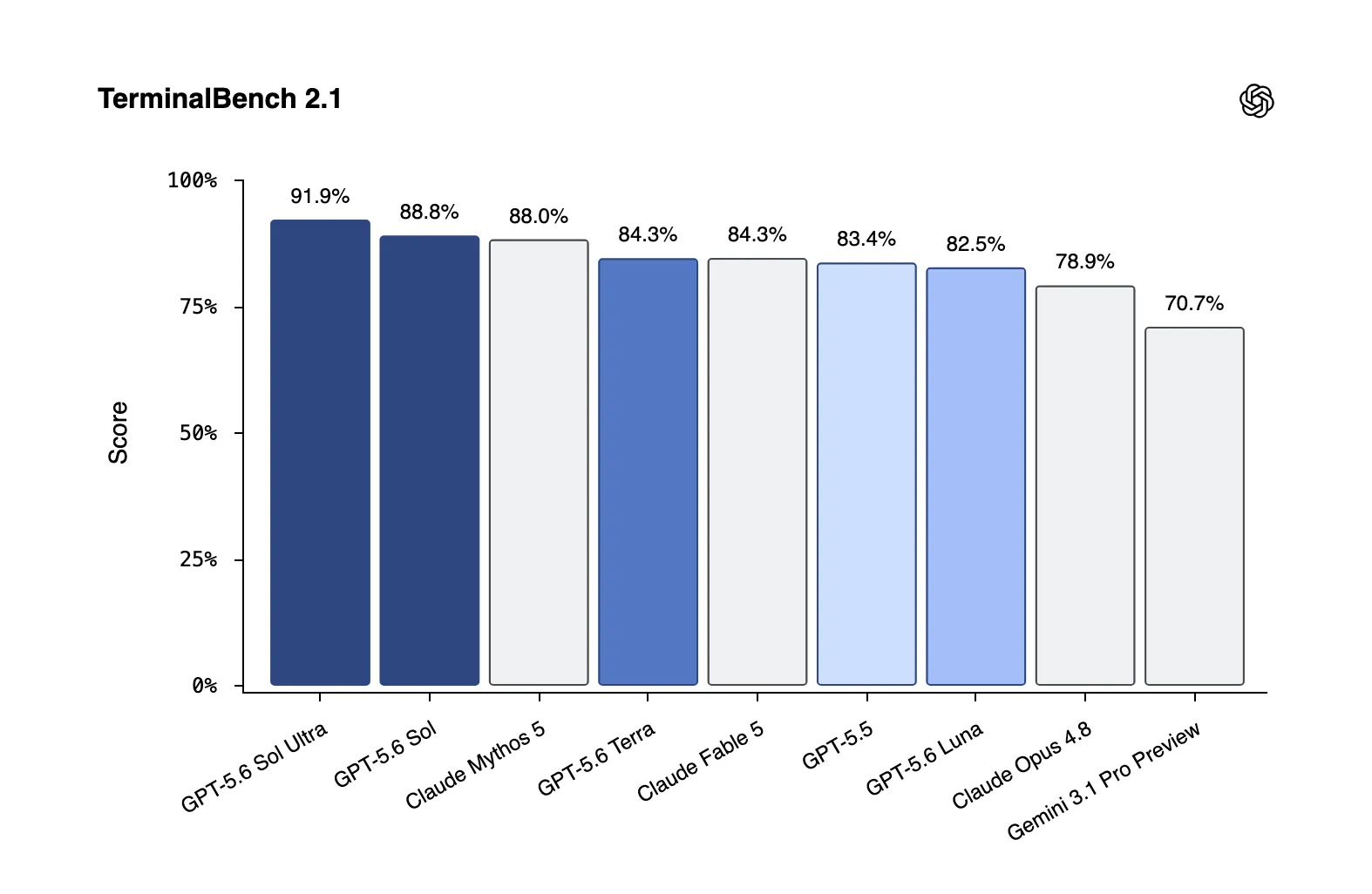
Performance Deep Dive: Strengths by Area
1. Coding and Agent Capabilities
- ChatGPT 5.6 Sol: Leads on SWE‑Bench Pro resolution rates; shows strong multi‑step planning and tool‑calling in agentic tasks. In Ultra mode it can coordinate multiple sub‑agents to complete complex projects.
- Claude Fable 5: Excels at long‑context coding and precise execution, with smooth tool use; praised by developers for strong execution capabilities.
- Grok 4.5: Stands out for coding efficiency; token consumption is reported to be about one quarter of Opus 4.8, making it suitable for rapid iteration and real‑time agent scenarios.
- Gemini 3.5 Pro (upcoming): Expected to lead in multimodal and search integration, with robust long‑context handling.
2. Reasoning and Knowledge Work
- Sol performs strongly on deep mathematics, scientific reasoning and complex problem decomposition.
- Fable 5 maintains advantages in logical coherence and creative writing.
- Grok 4.5 is stronger in real‑time knowledge updates and engineering practicality.
- The Gemini series has historically excelled at search and multimodal understanding; 3.5 Pro is expected to further strengthen those areas.
3. Speed and Efficiency
- Luna delivers the fastest response times, suited for high‑frequency daily use.
- Grok 4.5 leads on token efficiency, offering strong cost performance.
- Fable 5 and Sol keep latency controllable on complex tasks but consume more resources.
Overall, the ChatGPT 5.6 series achieves broad coverage through tiering, while competitors retain distinct strengths, forming a competitive landscape of “Sol/Fable high‑end rivalry, Grok value breakout, Gemini multimodal focus.”
Pricing Strategy: Cost Optimization Becomes a Key Variable
- ChatGPT 5.6 series: Sol is priced higher (input $5 per million tokens, output $30 per million); Terra and Luna are more budget‑friendly, with Luna especially suitable for large‑scale deployments.
- Claude Fable 5: Positioned at a relatively high price point, aimed at professional users demanding top quality.
- Grok 4.5: Input $2 per million tokens, output $6 per million tokens, offering a notable price advantage and considered the most cost‑effective option.
- Gemini 3.5 Pro: Google is expected to keep pricing in line with Gemini 3.1 Pro while using variants like Gemini 3.5 flash to remain competitive on price.
Price differences will directly influence enterprise deployment choices. Grok 4.5's low‑price strategy may attract many developers, while OpenAI's tiering addresses varied budget needs.
Use Case Analysis: Fit for Purpose Decides Winners
1. Coding and Software Development
- Sol and Fable 5 are suited for large project architecture and complex debugging.
- Grok 4.5, with its efficiency advantage, becomes the choice for rapid prototyping and everyday development.
- Luna fits simple scripts and auxiliary coding tasks.
2. Office Productivity and Knowledge Work
- Terra and Gemini perform well in document handling, data analysis and search integration.
- Fable 5 is stronger for long‑form understanding and creative writing.
3. Agentic and Automated Workflows
- Sol's Ultra mode and Grok 4.5's real‑time abilities both offer advantages for building autonomous agents.
- Fable 5 leads in tool‑calling precision.
4. Consumer Daily Use
- Luna and Gemini's low‑barrier features suit general users.
- Voice and multimodal interaction will become important differentiators.
Strengths and Weaknesses: No Absolute Winner
ChatGPT 5.6 Sol:
- Strengths: Strong overall performance, leading multi‑agent coordination, mature ecosystem.
- Weaknesses: Higher price and initial access limits.
Claude Fable 5:
- Strengths: Excellent execution and long‑context handling, high safety.
- Weaknesses: Higher cost and somewhat slower in certain scenarios.
Grok 4.5:
- Strengths: Very high cost‑performance, outstanding coding efficiency, strong potential for vertical integration.
- Weaknesses: Lags in some creative and complex reasoning scenarios.
Gemini 3.5 Pro:
- Strengths: Strong multimodal and search capabilities, cost control, Google ecosystem support.
- Weaknesses: Specific performance metrics await formal release for verification.
In summary, no single model can dominate all scenarios. Enterprises tend to adopt mixed use (model routing), while individual developers prioritize cost‑effectiveness and ease of use.
Industry Implications: AI Competition Enters a "Scenario + Cost" Era
The launch of ChatGPT 5.6 reignites the head‑to‑head LLM battle. Future competition will shift from raw parameter scale to:
- Scenario fit: Who best serves specific industries and tasks.
- Cost efficiency: Who can deliver lower inference costs while preserving performance.
- Ecological integration: Depth of integration with tools, platforms and enterprise data.
- Safety and reliability: Core thresholds for enterprise deployment.
The arrival of ChatGPT 5.6's three editions, alongside Claude Fable 5, Grok 4.5 and Gemini 3.5 Pro, will accelerate the transition of AI from labs to wide industry adoption. Regardless of who leads at any moment, users and the broader industry stand to benefit.
▶️ Enjoyed this article? Content creation is hard work!
Subscribe to our YouTube channel:
AI Rosetta
Your likes, subscriptions and shares are our greatest support! 🙏
For more AI news visit: https://www.airosetta.com