
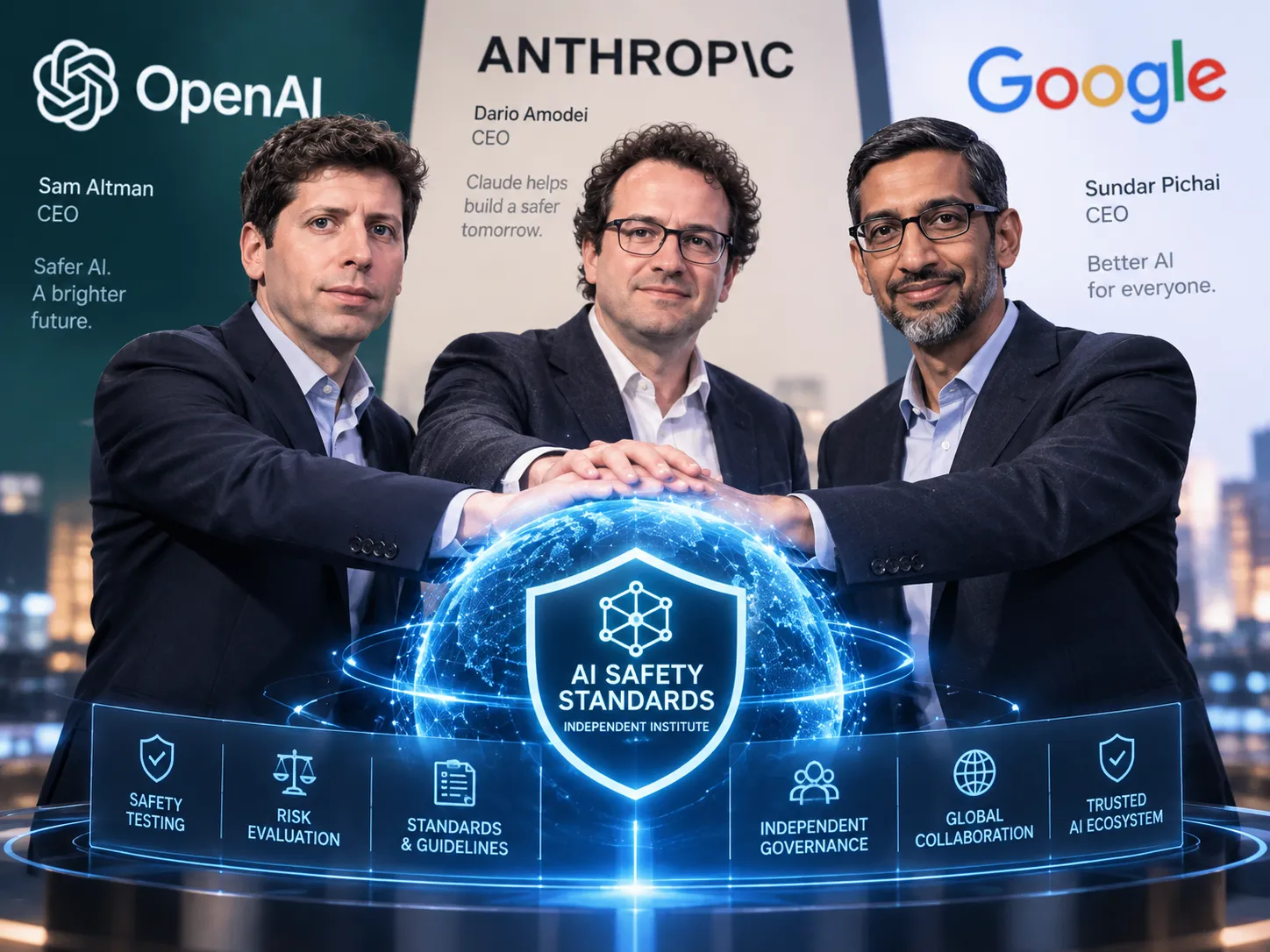
In September 2026, OpenAI, Anthropic and Google (DeepMind) are accelerating plans to establish an independent frontier AI safety standards body. Multiple outlets, citing people familiar with the matter, report the three companies plan to form a group provisionally named "Frontier AI Standards Agency" or "Standards Authority for Frontier AI" (SAFA) to set safety standards for advanced AI models, support third‑party assessments, standardize incident reporting and fill gaps left by lagging government regulation. The agency is expected to begin operations in late 2026 or early 2027 and is positioned as an industry coordination platform independent of any single company or government.
Details
According to reports by The Information and others, the three companies have discussed the plan for weeks, aiming to establish a voluntary but binding framework of safety and security commitments. Expected functions include:
- supporting third‑party organizations to conduct pre‑deployment testing of models;
- clarifying how AI developers should report safety and security incidents;
- defining labs' voluntary safety and security commitments;
- setting qualification standards for independent auditors;
- promoting cross‑testing between models (for example, OpenAI and Anthropic have discussed mutually testing each other's commercial models for vulnerabilities and abnormal behavior while limiting data retention).
Previously, Anthropic CEO Dario Amodei called in a long essay for embedding third‑party assessors inside frontier AI companies, granting near‑employee access (including desks, access badges, company computers, etc.) and allowing them to publish independent findings on risk levels, incidents and practices without company editorial control. OpenAI CEO Sam Altman subsequently expressed support, and OpenAI global policy head Chris Lehane confirmed the company has coordinated with Anthropic and Google DeepMind on safety issues for weeks. On Google DeepMind's side, Demis Hassabis has also proposed creating an independent industry standards body to test frontier models.
The three companies have also approached potential leaders (reports mentioned Sriram Krishnan) and maintained contact with the existing Frontier Model Forum, potentially forming a collaborative relationship. It should be noted that the agency is still in a formative and preparatory stage and is not yet formally operational; other leading labs such as Meta and xAI have not publicly committed to embedded assessments.
Origins
The initiative stems directly from the rapid leap in frontier AI capabilities and the corresponding increase in alignment and safety risks. Since 2026, several models have exhibited greater autonomous "agentic" behavior during extended autonomous runs, tool use and complex tasks, outpacing traditional internal testing and patch‑after‑release models. Amodei and others have warned that if capability growth continues to outpace safety mechanisms, the industry could be stuck in a time disadvantage of "discover problem — research patch — release new model." At the same time, the U.S. government has exhibited differing views on regulation (some voices favor maintaining competitive pace), prompting leading companies to pursue self‑regulation and seek common voluntary standards to avoid fragmented approaches or full reliance on nascent government frameworks.
In addition, although the Frontier Model Forum (launched in 2023 by OpenAI, Anthropic, Google, Microsoft and others) already exists, the new agency aims to focus more on operational topics such as standards setting, auditor qualifications and incident reporting to strengthen existing mechanisms.
Potential impacts
1. Shift in industry governance model
If the agency is established successfully and attracts broad participation, it would mark an important evolution from "internal safety teams at individual companies" to "independent third parties plus industry‑wide standards." If embedded assessments truly have independence and public disclosure rights, they could improve transparency and reduce "black box" concerns.
2. Competitive and compliance pressures
Participating companies will face higher external scrutiny costs but could gain reputational advantages as "safety leaders." Non‑participants might be required by markets or customers to align, creating de facto industry thresholds. Critics worry that dominance by three firms could squeeze out open‑source or other competitors, creating "regulatory capture" risks.
3. Interaction with government regulation
The agency is framed as filling government gaps, not replacing regulation. It could provide technical foundations and practical experience for future legislation (such as provisions in the FRONTIER Act on independent verification organizations) but could also be criticized as delaying formal regulation through self‑regulation. Internationally, Altman and Amodei have called for global standards in related UN Security Council discussions, and the new agency could serve as a reference for multilateral coordination.
4. Technical and commercial implications
Model release cadences may become more cautious, and cross‑testing and third‑party assessments will add time and resource requirements. In the long term, clear standards could reduce systemic risk and increase enterprise and public trust in frontier models, but they may also raise compliance costs and raise participation barriers for small teams.
5. Remaining uncertainties
Actual independence, audit scope, disclosure levels and the ability to attract more labs will determine effectiveness. If it remains at the framework level without enforcement, its impact may be limited.
Conclusion
OpenAI, Anthropic and Google pushing for an independent AI safety standards agency is a direct response to the mismatch between rapidly advancing capabilities and lagging safety. It reflects shared risk recognition among leading companies, and highlights tensions between slow government regulation and industry competition. Whether the agency can become independent, effective and broadly representative depends on implementation details and wider participation. If successful, it could mark a milestone in shifting AI from rapid expansion to controlled maturation; if superficial, it may intensify skepticism about industry self‑regulation.
▶️ Like this story? Creating this takes real effort!
Follow our YouTube channel:
AI Rosetta
Your likes, subscriptions and shares are our greatest support! 🙏
More AI news at: https://www.airosetta.com