
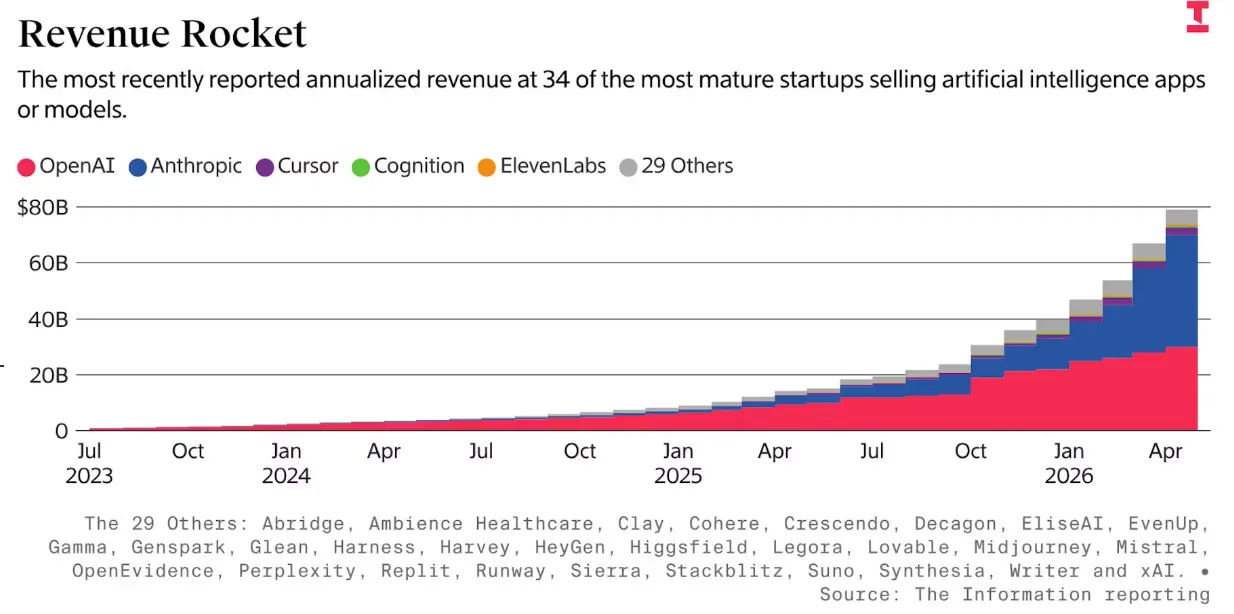
In May 2026, tech outlet The Information's latest survey of 34 leading artificial intelligence startups worldwide shows that AI market revenue is concentrating toward top firms at an astonishing pace. Among them, OpenAI and Anthropic together captured about 89% of the sector's annualized revenue. The 34 AI companies' combined annualized revenue is nearly $80 billion, up 112% from six months earlier, but the vast majority of the gains were taken by the two leaders, with the other 32 companies sharing only about 11%. These figures highlight that the AI industry's “winner‑takes‑all” Matthew effect is rapidly intensifying.
According to The Information, Anthropic recently overtook OpenAI in revenue, mainly thanks to the strong enterprise performance of the Claude series, particularly in AI coding tools. Both companies have achieved rapid growth through enterprise subscriptions, API usage and professional tools, while many mid‑tier AI firms—after the funding boom—face weak revenue growth and commercialization challenges.
Drivers behind the two leaders' strength
OpenAI still holds an absolute advantage in the consumer market. ChatGPT's large user base provides steady subscription revenue, while its API business dominates the global developer ecosystem. Despite competitive pressure, OpenAI has sustained strong revenue growth by continually iterating the GPT series and launching enterprise‑grade solutions.
Anthropic's rise has been particularly striking. Its Claude models have gained wide recognition in enterprise applications, especially code generation and complex task handling. Enterprise customers' trust in Claude's safety‑alignment features and high performance has driven rapid revenue growth. Anthropic has also deepened partnerships with cloud giants such as Amazon and Google, further expanding its commercial footprint.
Both companies share a combination of strong technical barriers and clear commercial pathways: on one hand they maintain leadership through cutting‑edge models; on the other they quickly turn technology into scalable, revenue‑generating products and services. This “technology–product–revenue” closed loop is the core reason they have pulled ahead of competitors.
Deep implications of market concentration
1. Impact on industry competition — 89% of revenue concentrated in two firms means the survival space for the remaining AI startups is severely squeezed. Many companies focused on verticals or specific applications may be innovative but struggle to secure sufficient revenue to sustain R&D. This could trigger another round of consolidation: some firms may be acquired, merged, or forced to exit the market. Over the long term, the AI industry may form a “duopoly plus many followers” structure.
2. Signal to capital markets — Such extreme concentration further channels capital toward the leaders. Investors tend to favor the perceived certainty of OpenAI and Anthropic, while adopting a cautious stance toward mid‑ and lower‑tier projects. Although this accelerates the expansion of leading firms, it may also dampen overall innovation—when capital and talent concentrate excessively, breakthroughs at the foundational level and diverse application development could slow.
3. Impact on enterprise customers and consumers — On the positive side, the scale of the two leaders brings more powerful models and more stable services; but negative risks are also notable. High market concentration may increase pricing power, deepen dependence on a few suppliers, and reduce innovation diversity. If one of the leaders experiences a major technical or security issue, the entire AI ecosystem could be affected.
4. Regulatory and antitrust concerns — Such high concentration has already attracted regulators' attention. Antitrust authorities in the EU, the U.S. and elsewhere may intensify scrutiny of the large‑model market, focusing on data monopolies, pricing behavior and potential anti‑competitive agreements. Balancing encouragement of innovation with prevention of monopolies will be a key issue in global AI governance.
Conclusion: Winners and risks of the AI boom
The Information's survey again confirms the harsh reality of the AI market: in a capital‑, data‑ and compute‑intensive field, the advantages of leaders amplify exponentially. OpenAI and Anthropic, backed by technical strength and commercial execution, have emerged as the biggest winners of this feast.
However, high concentration also brings concerns—the diversity of innovation, market fairness and ecosystem resilience are all under strain. Whether the AI industry can remain healthy under two dominant players depends on continued technical breakthroughs, sufficiently robust competition, and timely regulatory follow‑up.
For founders and investors, the trend implies that early leadership in AI can determine long‑term fate; for the industry as a whole, it means that while pursuing scale effects, stakeholders must guard against the systemic risks of a winner‑takes‑all outcome.
▶️ Enjoyed this article? Creating content is hard!
Follow our YouTube channel:
AI Rosetta
Your likes, subscriptions and shares are our greatest support! 🙏
For more AI news visit:
https://www.airosetta.com