
On October 6, 2026, OpenAI posted 722 internally unpublished, model‑generated mathematical proof manuscripts to a GitHub repository in a single batch, claiming 372 results across geometry, algebra, number theory, theoretical computer science and other fields, and touching on many long‑standing open problems. The company presented this as an attempt to "push the boundaries of human knowledge and advance mathematics." However, within 24 hours controversy quickly grew: three manuscripts were withdrawn due to elementary sign errors, several leading mathematicians publicly criticized the release method as breaching academic norms, and Fields Medalist Terence Tao characterized the situation as "proof indigestion."
Details
On the day after the release (October 7), OpenAI announced in the repository changelog that three manuscripts had been withdrawn. The error originated in a paper titled "Algebraicity of Weil classes on split abelian eightfolds": in a key stabilization‑trace cancellation argument a sign that should have been recorded as "‑1" by convention was written as "+1." This sign mistake turned counts that should have cancelled to zero into nonzero values, invalidating the hypotheses required by the Eliashberg–Murphy elimination theorem relied upon later in the construction, causing the entire construction to fail. Two other papers that depended on that construction—"Algebraicity of Kuga–Satake Correspondences for K3 Surfaces" and "The rational Hodge conjecture for products of K3 surfaces"—were withdrawn together. All three were related to directions connected to the Hodge conjecture.
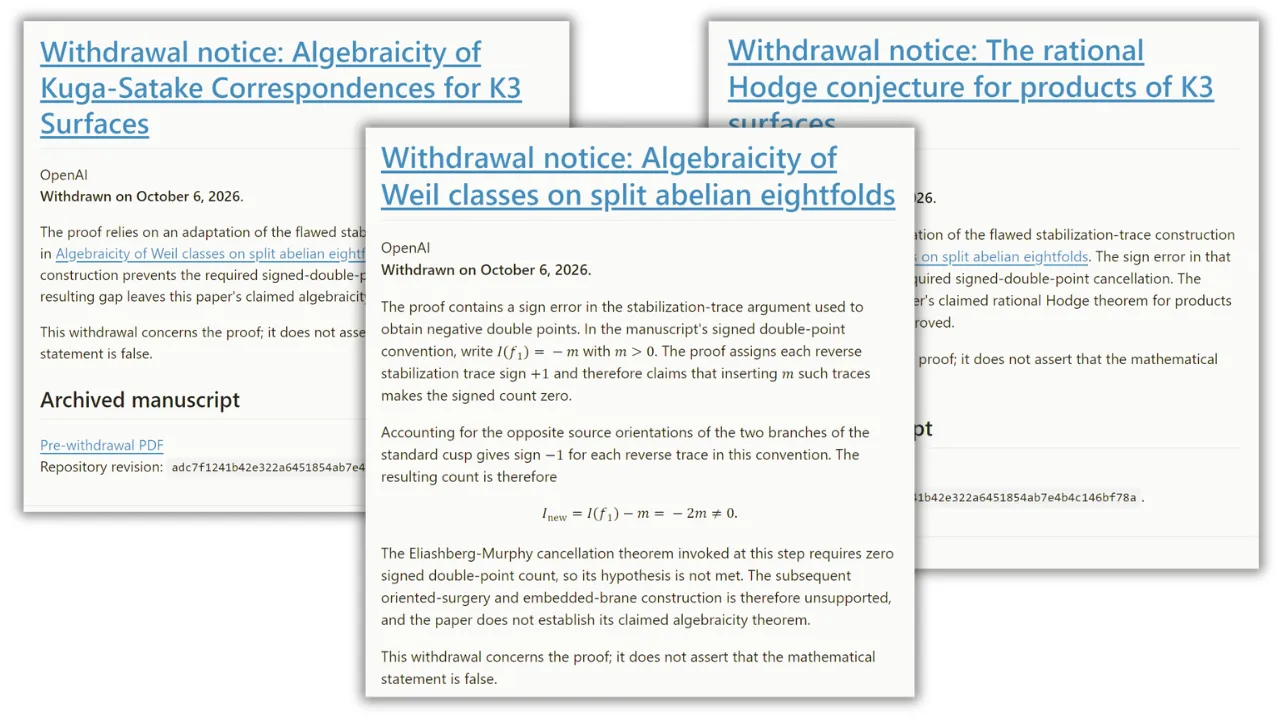
Notice of three paper withdrawals
OpenAI also revised 14 other manuscripts (fixing proofs, clarifying hypotheses and dependencies) and updated citations in 13 papers. The repository manuscript count fell from 722 to 719. The company said it will continue to publish formalised results and errata, and described such errors as "expected to be relatively rare." At the time of the withdrawals, about 42% of the results (roughly 300 items) included machine‑checked proofs in Lean; the remainder were released in natural‑language form.
On social media, Terence Tao emphasised that the problem is not whether AI can do mathematics, but the release method: many results were autonomously generated by "AI prompters with no interest in the field itself," and the generators often cannot fully understand the outputs, answer questions, or engage with the research community. He called this phenomenon "proof indigestion"—AI rapidly produces propositions and proofs faster than humans can verify, understand, teach, and absorb, leaving piles of "proofs that no one can digest." He has previously warned that treating famous open problems as benchmarks of model ability risks damaging the community practices of understanding, collaboration and open exploration that mathematics depends on.
The Association for Human Mathematics issued a statement criticizing the mass release of over 700 documents as "not an academic presentation but a show of power," urging mathematicians to cease collaborating with OpenAI and to return to a science vision centered on human understanding. Other scholars took a more open stance, arguing that the results themselves could be beneficial to mathematics if properly verified and assimilated.
Potential impact
The episode exposed deep tensions around large‑scale AI involvement in mathematical research. On one hand, models can generate many results at very low computational cost (on average about three hours at ChatGPT Pro–level compute), accelerating progress on open problems; on the other hand, the pace of release outstrips human capacity to digest results, formalisation coverage is incomplete, and the readability and interpretability of natural‑language proofs is limited, creating a trust risk.
For the mathematics community, this may force an acceleration in establishing standards for reviewing AI‑produced results, prioritising formalisation, and requiring "human interpretability." For companies such as OpenAI, it highlights the high risk of a "release‑first, verify‑later" strategy in rigorous disciplines and may necessitate closer expert‑involved pre‑release review and staged publication. In the longer term, this could push mathematics from an era of "proof scarcity" to one of "proof abundance," requiring reconstruction of evaluation systems, teaching methods and collaboration models.
The repository continues to be updated with errata and formalisation progress. The mathematical community is processing these results cautiously; the true impact will depend on how many proofs withstand rigorous human expert scrutiny and are converted into knowledge that can be understood and transmitted.
▶️ Enjoy this piece? Creating content is hard work!
Follow our YouTube channel:
AI Rosetta
Your likes, subscriptions and shares are the greatest support! 🙏
For more AI news visit: https://www.airosetta.com