
On June 18, 2026, the OpenAI Alignment team published an important paper on its official alignment blog, "Reinforcement Learning Towards Broadly and Persistently Beneficial Models." The paper's core finding is striking: using only 5% of the training data to perform targeted reinforcement learning (RL) in a single domain (health dialogues) can substantially improve model performance on dozens of entirely unrelated alignment benchmarks, and these improvements are persistent, remaining stable even under adversarial pressure. This result offers a low‑cost, highly generalizable path to aligning LLMs and is seen as an important evolution of RLHF (Reinforcement Learning from Human Feedback).
Paper: https://alignment.openai.com/beneficial‑rl PDF download: https://cdn.openai.com/pdf/beneficial‑rl.pdf
Background and motivation
The alignment of LLMs has long been an industry pain point. Traditional RLHF methods, while effective, have two main limitations:
- High cost: they require large quantities of high‑quality human preference data.
- Narrow generalization: alignment trained in one domain often fails to transfer to others.
The OpenAI team set out to explore a more efficient question: can a small amount of targeted RL in one domain make models broadly more "beneficial"? They chose health dialogues because health topics are relatively controllable and easy to design samples that exemplify beneficial traits such as honesty, humility, and concern for human welfare.
Key finding: 5% data yields broad improvements
The researchers designed two models for comparison:
- Baseline model: trained with 100% standard RL data.
- Beneficial‑traits RL model: replaced only 5% of the training data with beneficial health‑domain dialogues, leaving the remaining 95% unchanged.
The results were surprising:
- On 53 alignment‑related benchmarks, 44 showed better performance for the beneficial‑traits RL model.
- Improvements spanned multiple, unrelated areas including health advice, honesty, epistemic humility, jailbreak refusal, and code safety.
- The model showed clear gains even on tasks outside the health domain, demonstrating cross‑domain generalization.
- Persistence tests: improvements remained robust under adversarial prompts and long dialogues, showing a "persistently beneficial" property.
The paper emphasizes that this "small‑data, broad‑improvement" phenomenon suggests a shared alignment structure inside models. In other words, many alignment evaluations depend on similar beneficial behaviors at the model level, so reinforcing those behaviors in one domain can yield global benefits.
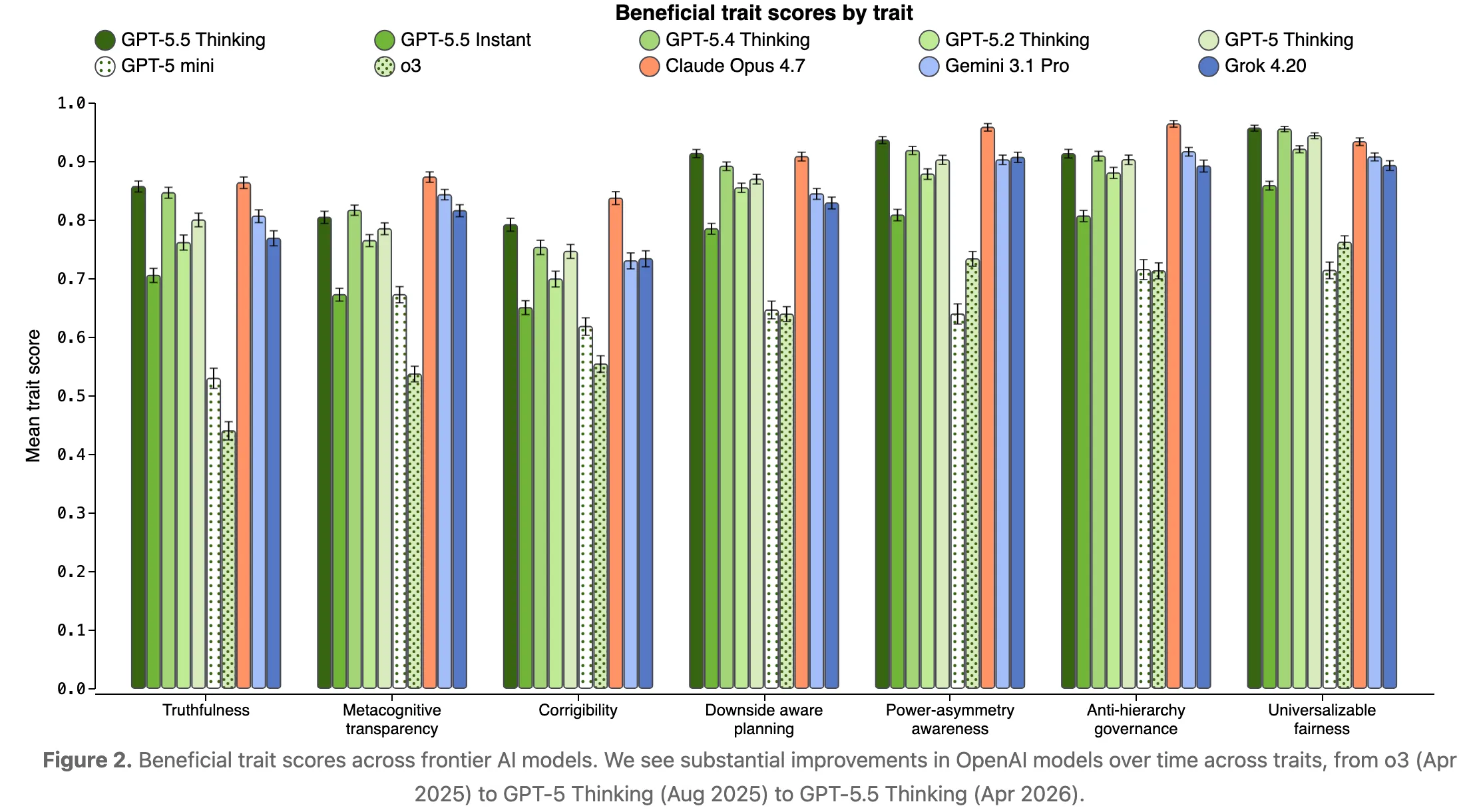
Technical details
The team built a health dialogue dataset focused on dialogues that exemplify the following beneficial traits:
- Honesty
- Epistemic humility
- Meta‑cognitive transparency (explaining the thought process)
- Corrigibility (willingness to accept corrections)
- Broad fairness
- Concern for human well‑being
They replaced 5% of the training data in a standard RLHF pipeline with these beneficial dialogue samples and trained with realistic reward signals. The experiment controlled compute so that the training costs of the two models were broadly comparable.
Implications for LLM development
- Alignment‑efficiency revolution Traditional alignment requires massive datasets; this paper shows that a small amount of high‑quality, targeted data can produce wide effects, potentially lowering alignment costs and enabling smaller teams to align effectively.
- New paradigm for cross‑domain generalization The research suggests alignment is not isolated "patchwork" but may rely on transferable "cores of beneficial behavior." Future work can focus on finding these cores rather than training per‑domain.
- Path to persistent alignment The paper demonstrates that carefully designed RL can "embed" beneficial behaviors so they persist under pressure, offering a methodology for more reliable and trustworthy AI systems.
- Open science and industry impact OpenAI's public paper and partial experimental details can accelerate progress across the field. More companies are likely to adopt similar small‑targeted‑RL strategies to improve model safety and utility.
- Potential challenges The experiments were mainly in the health domain; whether the same effect holds in other domains needs further validation. Designing more general beneficial‑trait datasets will be an important next step.
Conclusion
OpenAI's paper provides an encouraging, low‑cost, highly generalizable path to LLM alignment. It shows that with carefully designed small‑data RL, we may make AI more beneficial, reliable, and persistent across a wider set of scenarios.
In an era of rapidly advancing AI capabilities, this finding not only lowers the technical barrier but also injects new hope for building safer and more inclusive AI. With follow‑up work, alignment may move from an "expensive patch" to an "efficient internal" property, helping AI become a truly reliable partner for humans.
▶️ Enjoy this article? Creating it takes real effort!
Follow our YouTube channel:
AI Rosetta
Your likes, subscriptions, and shares are our greatest support! 🙏
More AI news at: https://www.airosetta.com