
In early September 2026, teams including Google Research, HHMI Janelia and the University of Cambridge officially open‑sourced the complete connectome of the adult male fruit fly central nervous system (MaleCNS v1.0). The dataset contains approximately 166,000–167,000 neurons and over 120 million synaptic connections, and is one of the most complete publicly available whole‑brain wiring maps for Drosophila to date. Released under a CC‑BY license, the data portal FlyWire Codex quickly reached thousands of downloads per day.
What began as a major neuroscience achievement was, within a week or two, playfully repurposed by the global developer community, triggering a highly topical wave of derivative development projects.
How did the craze start?
After the open release, developers rapidly loaded the real fruit fly connectivity data into simplified neural‑dynamics simulators, mapped external signals (game visuals, candlestick charts, audio, screen content, etc.) to stimuli for sensory neurons, and decoded activity of specific neurons into action outputs (steering, moving forward, firing, trade commands, etc.). Many projects used the latest large models (e.g., GPT‑6 Astra) to assist coding, reducing development cycles from days to hours.
Typical derivative directions include:
- Game control: hooking the fly connectome into Doom (Doomfly), Minecraft, Super Mario 64, Beat Saber and others, letting neural activity directly drive character movement, shooting, jumping.
- Real‑world/simulated tasks: parallel parking, solving a Rubik’s cube, following music to perform “Y.M.C.A.” moves, writing Japanese hiragana, character recognition (OCR), etc.
- Economic and social experiments: starting with $100 on Coinbase to trade Bitcoin (Stonkfly), swiping short videos (FLYTOK, with artificially injected dopamine signals to induce “addiction”), writing LinkedIn posts, and even tongue‑in‑cheek projects joking about “deciding interest rates.”
- More serious simulations: such as Fruit Fly Laboratory, which runs published LIF (leaky integrate‑and‑fire) models on the real FlyWire connectome to reproduce escape responses, emphasizing “no LLMs, pure connectome + differential equations → spikes.”
Most of these projects appear open‑source on GitHub and social media; videos spread quickly on X, TikTok and other platforms, generating a collective meme that “cyber fruit flies are busier than people.”
Scientific and technological significance
This craze is not pure entertainment. It has provided direct validation of:
- The operability of open connectomes: real biological wiring data can be downloaded, simulated and produce controllable outputs, lowering the barrier to whole‑brain simulation.
- The relationship between structure and behavior: even with greatly simplified dynamics, a fixed connectome can still give rise to some reactive and learning‑like behaviors (more evident when coupled with reward signals).
- The maturity of the toolchain: modern AI programming assistants plus open neural simulation libraries enable non‑specialists to rapidly set up experiments.
Scientists generally find this interesting and see it as a demonstration of open science’s power, but emphasize that most projects are far from true fruit fly behavior—more like “using real wiring as a computational toy” than strict biological replication.
The five most popular digital fruit fly derivative projects
This wave is mainly based on MaleCNS v1.0, open‑sourced on September 3, 2026 (complete connectome of the adult male fruit fly central nervous system, approx. 166,700 neurons). Below are some of the most discussed and widely shared representative projects (roughly ordered by influence):
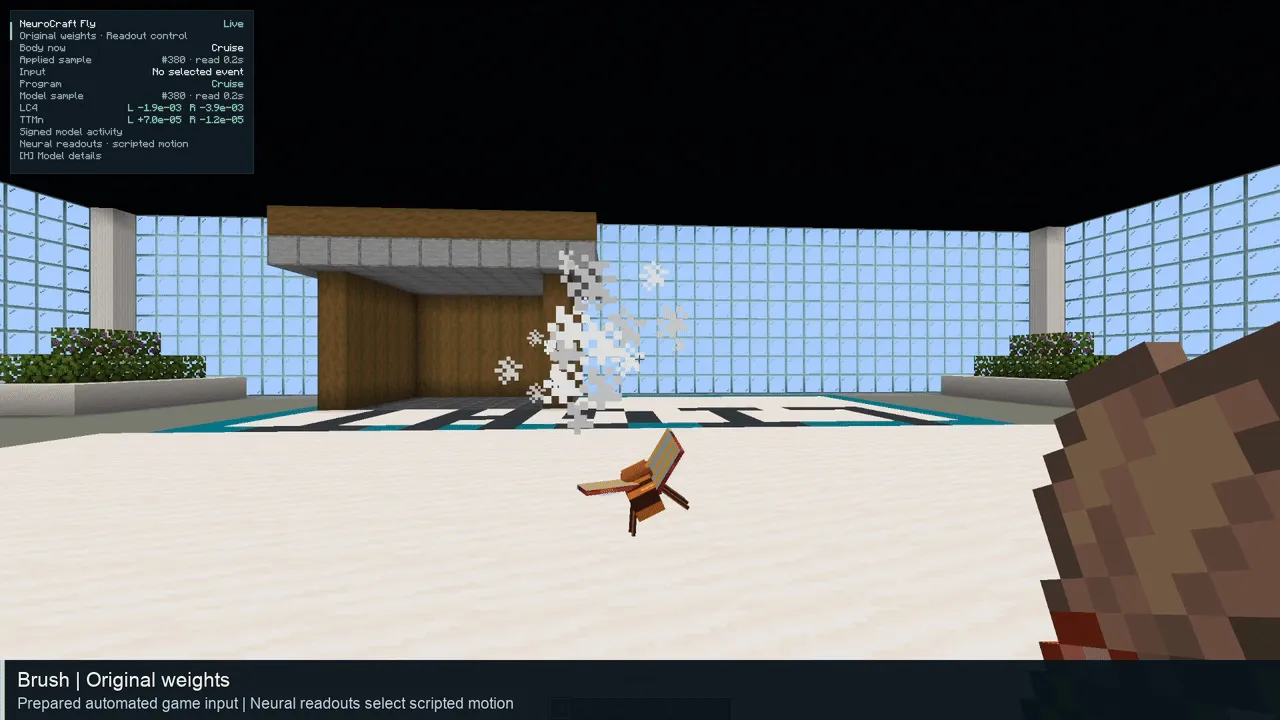
1. NeuroCraft Fly (Minecraft fly)
- Author: Evan Sinclair Smith, a graduate student at Georgia Tech (@evnsnclr)
- Link: https://github.com/evnsnclr/neurocraft‑fly‑public
- Summary: The earliest project to ignite the craze. It runs the full MaleCNS connectome inside Minecraft, using simulated neural activity to drive virtual fly behaviors such as moving, grooming, foraging and fleeing. With GPT‑6 Astra assistance the project was completed rapidly, and the video quickly surpassed one million views, becoming the starting point for many imitators.
2. DOOMFLY
- Author: Alex Wormuth (@nftechie / Coinbase engineer)
- Link: https://github.com/nftechie/doomfly
- Summary: One of the most technically complete and best‑documented projects. It maps game frames to visual neurons and decodes neural activity into steering, forward motion and firing. The project attempts to incorporate dopamine rewards and plasticity rules, and publishes negative validation results (it has not truly learned to “survive”). It is fully open‑source and adopts a relatively rigorous scientific approach.
3. Stonkfly (Bitcoin‑trading fly)
- Author: Also Alex Wormuth
- Summary: An extension of DOOMFLY. It uses candlestick/price data as visual input, lets the fly brain decide buy, sell or hold, and delivers dopamine stimulation on profitable trades. Starting with $100 on Coinbase for real or simulated trading, it became one of the most outlandish yet widely noticed economic experiments.
4. Super Mario 64 / Fly64
- Author: Jessica Paquette and others
- Summary: Connects the fly connectome to Super Mario 64 to control jumps and movement. Developers say they largely relied on large models for “vibe coding,” the code style is casual, and the project’s wide circulation further demonstrated that “anyone can quickly create a derivative.”
5. Other high‑profile creative projects (tie)
- Parallel‑parking fly (Mark Unthank et al.): after hundreds of failed attempts the fly learned to back into a parking spot, illustrating a playful “training + feedback” experiment.
- Beat Saber / FLYTOK / Rubik’s cube / hiragana writing etc.: rhythm games, short‑video addiction simulations, cube solving and script learning, further turning digital fruit flies into internet meme generators.
Reference hub: https://github.com/cobanov/awesome‑fly (a curated list of many related projects).
Relation to Eon Systems’ digital fruit fly project
In fact, earlier this March Eon Systems officially released its digital fruit fly project, but the open‑source project that sparked the current craze is indirectly related and not the same project.
- Eon Systems (March 2026): based on an earlier female FlyWire connectome (about 125,000–139,000 neurons), using a Leaky Integrate‑and‑Fire model and connecting to MuJoCo/NeuroMechFly physical bodies to achieve crawling, turning, antenna grooming and proboscis extension. This work emphasized “structure as intelligence,” achieved relatively close‑to‑natural embodied behaviors, and sparked discussions about consciousness upload. It belongs to a more serious whole‑brain embodied‑simulation effort.
- Current craze (from September 2026): based on the newly released MaleCNS v1.0 (male, includes the ventral nerve cord and more complete sensorimotor pathways). It is mainly driven by independent developers and hobbyists using simplified dynamics plus mappings to games and external signals, with goals of creativity, validating operability and entertainment rather than strict biological reproduction.
Both efforts share the idea of using real fruit fly connectomes with simple neuron models; Eon’s was earlier and more focused on scientific embodied closed loops, while the September wave is a large‑scale grassroots remix following the MaleCNS release. The Eon team has followed and joked about this “flyslop” phenomenon themselves.
Summary and observations
The core of the digital fruit fly remix craze is the explosion that occurs when top‑tier neuroscience data meets extreme openness and AI‑assisted development tools. It has turned a previously high‑barrier whole‑brain connectome into a downloadable, editable, remixable computational object, spawning many imaginative projects and accelerating public recognition of the connectome‑as‑computational‑platform idea.
In the short term, this looks like a blend of technical revelry and science communication; in the medium to long term, it may drive broader interest in interpretable, low‑power, structure‑based neuromorphic computing and in how embodied intelligence emerges from structure. Valuable follow‑up work will return to rigorous dynamical modeling, closed‑loop behavioral validation and cross‑scale mapping.
Interest remains high and new projects continue to appear. If you are interested in specific open repositories or particular experiment types (game control, trading, OCR, etc.), you can dive deeper into a chosen direction.
▶️ Enjoy this content? Creating it is hard work!
Subscribe to our YouTube channel:
AI Rosetta
Your likes, subscriptions and shares are our greatest support! 🙏
For more AI news visit: https://www.airosetta.com