
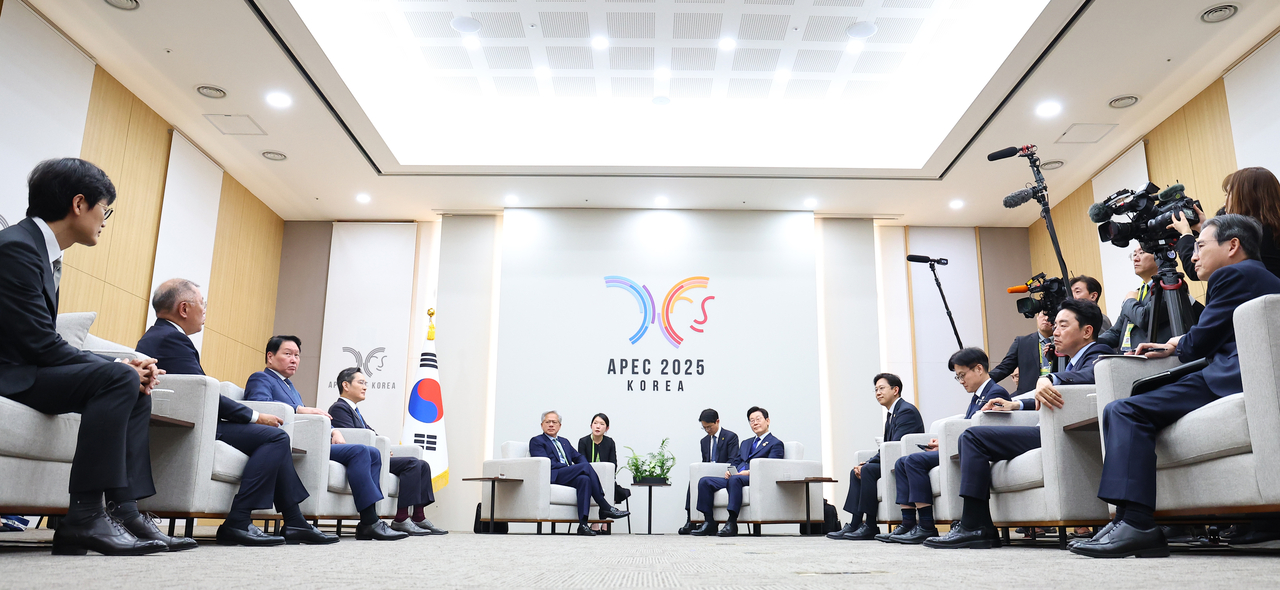
On October 31, 2025, at the APEC CEO Summit in Gyeongju, South Korea, NVIDIA CEO Jensen Huang announced a "historic" plan: the company will deploy more than 260,000 GPUs in South Korea to build the world's largest AI infrastructure cluster. The initiative is led by the South Korean government in close partnership with Samsung Electronics, SK Group, Hyundai Motor Group, LG and Naver, with total investment expected to reach tens of billions of U.S. dollars, aiming to raise South Korea's AI compute from the current 65,000 GPUs to over 300,000. Jensen Huang told reporters at the summit: "South Korea is the perfect intersection of semiconductors and AI; this supercomputing center will ignite an Asian AI revolution, driving a comprehensive leap from chip manufacturing to intelligent applications." The announcement immediately energized markets, with NVIDIA shares rising 2.8% intraday, the KOSPI up 0.5%, and Samsung and SK shares up 3.2% and 2.9%, respectively.
Background: a key part of South Korea's "national AI strategy"
The South Korean government views AI as a "core national capability," having already invested more than 1 trillion won (about $750 million) in AI R&D in 2024. Huang's announcement came at the height of the APEC summit; South Korean President Lee Jae‑myung attended and met with Huang, stressing that "AI is the engine of future economic growth." According to Yonhap, the collaboration stems from a preliminary agreement earlier in 2025 between NVIDIA and the Ministry of Trade, Industry and Energy, aiming to respond to U.S.‑China AI competition and strengthen South Korea's role in global supply chains.
The supercomputing center will be deployed in phases: the first phase (2026) will focus on Samsung's AI factories using NVIDIA Blackwell B200 GPUs to support high‑performance computing and model training; the second phase (2027) will expand to SK Group's cloud infrastructure, Hyundai's smart vehicle R&D, and AI cloud platforms for LG and Naver. Samsung Electronics said it will procure a 50,000‑GPU cluster to enhance AI optimization for mobile and server chips; SK plans to build a "sovereign AI cloud" serving government and enterprise; Hyundai will integrate GPUs for L4 autonomous driving testing; Naver and LG will deploy 60,000 GPUs combined to support AI content generation and smart home services. Huang revealed the center will use NVIDIA's Grace Blackwell supercomputer architecture, with each unit weighing up to 2 tons and peak performance reaching several million PFLOPS (petaflops, i.e., 10^15 floating‑point operations per second), far exceeding current top‑10 global supercomputers.
The scale is unprecedented: 260,000 GPUs equals four times South Korea's existing AI compute and has been likened to building an "Asian Frontier supercomputer." Data Center Dynamics (DCD) analysts say the project will require roughly an additional 1% of South Korea's power capacity and will necessitate new liquid‑cooling facilities to handle high energy demands. Huang emphasized that NVIDIA will provide full‑stack support, including the CUDA software stack and NIM microservices, to ensure seamless access for Korean developers. President Lee said the partnership will "accelerate South Korea's transformation from a semiconductor powerhouse into an AI stronghold," and plans to establish a national AI research institute.
Technical details: Blackwell architecture powering an "AI black hole"
The core technology is NVIDIA's Blackwell B200 GPU, offering per‑GPU performance of 20 PFLOPS, supporting FP4 precision training, with a power draw of around 700W. The supercomputing center will use NVLink 5.0 interconnects with up to 1.8TB/s bandwidth to enable seamless coordination among 260,000 GPUs. In a YouTube livestream, Huang demonstrated that the cluster could train the Llama‑70B model in one hour, at a speed four times that of the H100. Combined with domestic components such as Samsung HBM3e memory, the system will optimize applications in AI‑driven drug discovery, autonomous driving and semiconductor design. In addition, the Korea Institute of Science and Technology Information (KISTI) will partner with NVIDIA to leverage the Hangang supercomputer for quantum computing research and physics‑informed AI models.
Officials from the Ministry of Trade, Industry and Energy say the center will serve national AI programs, including 5G/6G networks and smart city pilots. Quiver Quant reported the project is expected to create 50,000 high‑tech jobs and contribute roughly 1.2% to GDP growth. Samsung Chairman Lee Jae‑yong commented: "NVIDIA's GPUs will be the core engine of our AI factories, helping Korea's semiconductor industry move from manufacturing to intelligence."
Global impact: Korea's AI rise and NVIDIA's "Asian stronghold"
For South Korea, this is a strategic move in semiconductor revitalization. As the global memory leader, Samsung faces U.S.‑China trade frictions, and this partnership will strengthen its AI chip autonomy. Hyundai can accelerate EV battery AI optimization, and SK's sovereign cloud will reduce reliance on AWS. The Washington Post analyzed that the move elevates South Korea from an "AI follower" to an "Asian AI power," competing with Japan and Taiwan. Korean research institutes will receive 50,000 GPUs to support local LLM training, improving Korean‑language and industrial applications.
For NVIDIA, the initiative marks a milestone in its Asian strategy. Huang said South Korea is the "heart of the AI supply chain," and the project could account for about 15% of the company's 2026 revenue. Geopolitical risks remain: U.S. export controls could delay GPU supply, and South Korea must balance relations between the U.S. and China. President Lee said after the meeting: "This partnership is not just technological cooperation but the starting point for South Korea to reshape the global AI map."
Outlook: the global ripple of South Korea's "AI moment"
Huang's announcement is both a technological collaboration and a snapshot of geopolitical contestation. Commentators such as Evrim Ağacı called the "historic partnership" a reshaping of Asia's AI landscape, potentially making Korea the "next Silicon Valley." With 260,000 GPUs coming online, Korea's AI ecosystem is set to shift from "chip manufacturing" toward "intelligent applications," benefiting global supply chains. NVIDIA's "super engine" plan signals a new chapter in the democratization of compute in the AI era, though energy challenges are nontrivial: the data center will consume about 1% of Korea's power and will require green technologies to mitigate impact. In the future, the center could spawn a Korean "Silicon Valley," driving global leadership in AI‑driven drug discovery and autonomous driving. South Korea's "AI moment" has begun.