
On March 16, 2026, at GTC 2026 in San Jose, California, NVIDIA CEO Jensen Huang unveiled DLSS 5 in his keynote, calling it the most significant graphics breakthrough since the company introduced real‑time ray tracing in 2018. DLSS 5 introduces a real‑time neural rendering model that uses generative AI to inject authentic lighting and material detail directly into pixels, dramatically improving image quality while maintaining high frame rates. NVIDIA's press release and live demos showed DLSS 5 shifting from "performance‑first" to "visual‑fidelity‑first," a moment Huang described as the "GPT moment for graphics." The technology is scheduled to roll out in autumn 2026, with initial support for titles such as Aion 2, Assassin's Creed: Shadows, and Resident Evil: Requiem, and first compatibility with the RTX 50‑series. The announcement quickly became a focal point for the global gaming and graphics industries, marking a new phase in AI for real‑time rendering.
Core Technology of DLSS 5: Generative AI‑Driven Neural Rendering
Compared with the previous DLSS 4.5 (second‑generation Transformer super‑resolution + dynamic multi‑frame generation), DLSS 5's key innovation is the deep integration of generative AI with traditional 3D rendering. Prior DLSS versions relied primarily on AI upscaling and frame generation to boost performance; DLSS 5 goes further by allowing AI to "create" scene detail.
Main technical highlights:
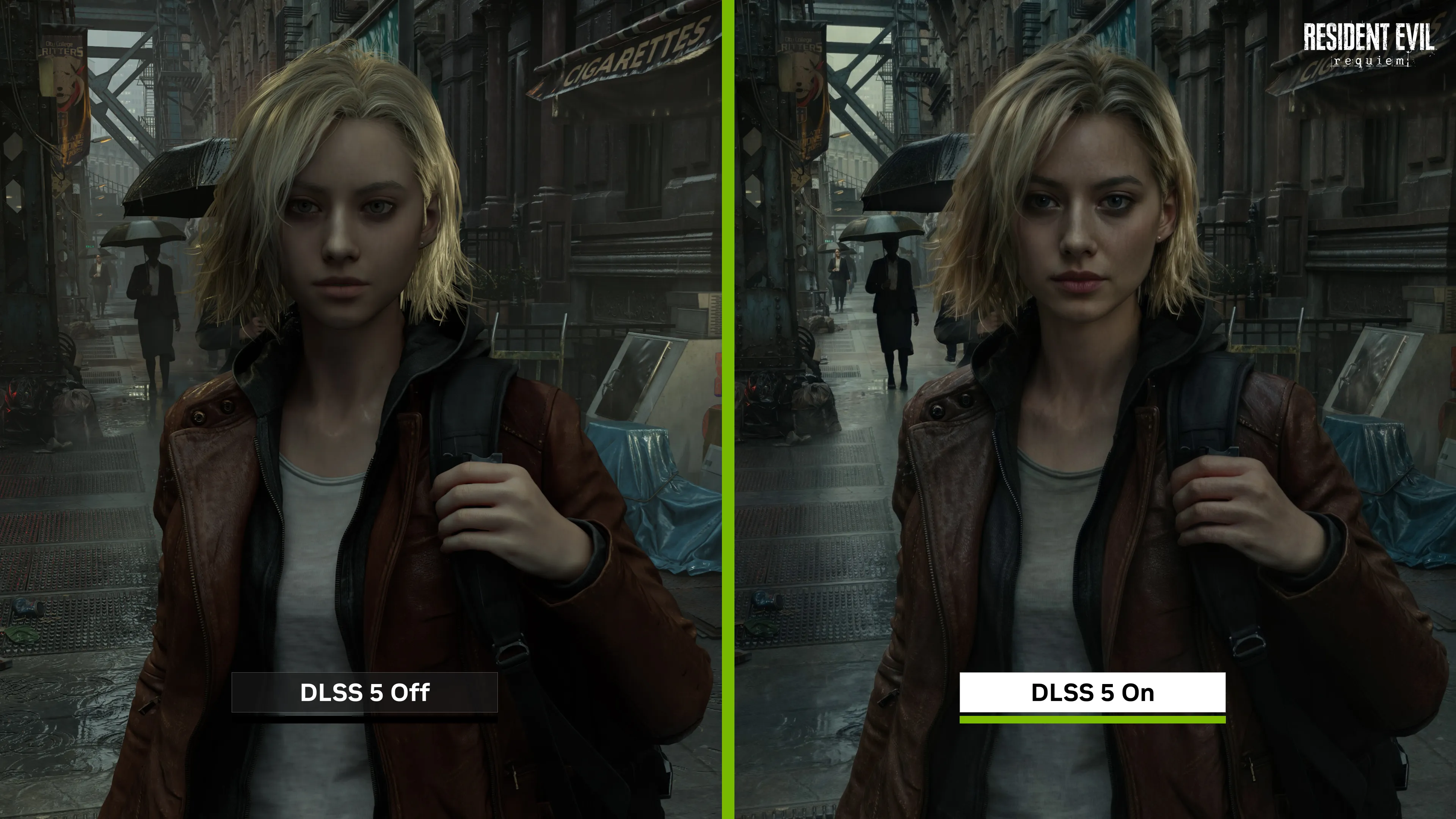
- Real‑time neural rendering model DLSS 5 introduces a generative AI model in the rendering pipeline that can predict and fill pixel‑level detail in real time. It does more than denoise or generate frames; it injects authentic lighting, material reflections, and environmental interactions into each pixel. In NVIDIA's demo, enabling DLSS 5 in Resident Evil: Requiem's path‑traced mode noticeably improved light transitions, metal reflections, and water refraction, bringing visual fidelity close to cinematic rendering while requiring only a fraction of the compute of traditional path tracing.
- Generative AI fill mechanism The model can "predict" parts of the scene that are not fully rendered (such as distant detail, complex shadows, and dynamic object interactions) and generate high‑quality pixels. This is more efficient than traditional ray tracing because the AI does not need to compute every light path per pixel. NVIDIA described this as the AI performing "millions of additional calculations on behalf of the GPU," enabling 4K path‑traced games to reach 240+ FPS on RTX 50‑series cards.
- Dynamic multi‑frame generation improvements Building on DLSS 4.5's dynamic multi‑frame generation, DLSS 5 can adjust the number of generated frames in real time according to display refresh rates (up to a 6X mode). In demos of Assassin's Creed: Shadows, DLSS 5 dynamically switched frame‑generation multipliers to deliver a smooth 240Hz+ experience while maintaining very high image quality.
- Compatibility and optimization DLSS 5 is optimized for the Blackwell architecture (RTX 50‑series) but is also downward compatible with some RTX 40‑series cards. The initial supported game list includes titles from Bethesda, CAPCOM, Hotta Studio, NetEase, NCSOFT, S‑GAME, Tencent, Ubisoft, and Warner Bros., with staggered rollouts expected in the autumn.
NVIDIA emphasized that DLSS 5 is currently an early preview and that the models remain under optimization, with the final release planned to ship in autumn 2026 alongside multiple game launches.
Comparison with predecessors: From a performance tool to a visual revolution
The DLSS family has evolved since its 2018 debut:
- DLSS 1/2: Basic upscaling focused on improving performance.
- DLSS 3/4: Introduced frame generation, delivering major performance gains.
- DLSS 4.5 (early 2026): Dynamic multi‑frame generation + second‑generation Transformer model.
- DLSS 5: First use of generative AI to enhance visual fidelity, shifting focus from "faster" to "more beautiful."
Side‑by‑side demos showed that enabling DLSS 5 yielded clear improvements in lighting, materials, and detail richness compared with DLSS 4.5, particularly in complex scenes such as rainy cities and forest lighting. Media outlets like Digital Foundry called it "one of the most stunning graphics demos I've seen in a long time."
Far‑reaching impact on the games industry
The release of DLSS 5 will have multiple effects on the gaming ecosystem:
- Quality and performance gains: Developers can devote more compute to true ray tracing and complex scenes instead of raw resolution, allowing players to enjoy near‑cinematic visuals at 4K high refresh rates.
- Lower hardware barriers: High‑end RTX 50‑series hardware will run top‑tier visual settings smoothly, accelerating adoption of AI rendering technologies.
- Improved development efficiency: Generative AI fill can reduce manual modeling and lighting tuning, shortening production cycles.
- Industry competitive landscape: AMD's FSR and Intel's XeSS will face increased pressure, likely accelerating their respective AI super‑sampling iterations.
Multiple game studios have already confirmed DLSS 5 support; initial titles include Aion 2, Assassin's Creed: Shadows, and Resident Evil: Requiem, with plans to expand to more AAA games.
Technical limitations and outlook
Despite its progress, DLSS 5 remains in early stages:
- Current demos are "development snapshots"; the final version will require further optimization to reduce artifacts.
- Main compatibility targets the RTX 50‑series, with limited support for older cards.
- Generative AI may introduce new types of artifacts that will require ongoing tuning.
NVIDIA said it plans to extend DLSS 5 to professional visualization, film rendering, and the metaverse, aiming to make real‑time rendering "as cinematic as film."
Conclusion: A 'GPT moment' for graphics rendering
At GTC 2026, NVIDIA's DLSS 5 marked another leap in graphics with generative AI and neural rendering, elevating AI from a performance tool to a creator of visuals. As game imagery approaches film quality in 2026, DLSS 5 shows that AI is not just an accelerator but a core force reshaping visual experiences. When DLSS 5 is fully deployed, players will experience the transformative "next‑generation graphics" first‑hand.
▶️ Like this article? Creating it is hard work!
Follow our YouTube channel:
AI Rosetta
Your likes, subscriptions and shares are our greatest support!🙏
More AI news at: https://www.airosetta.com