
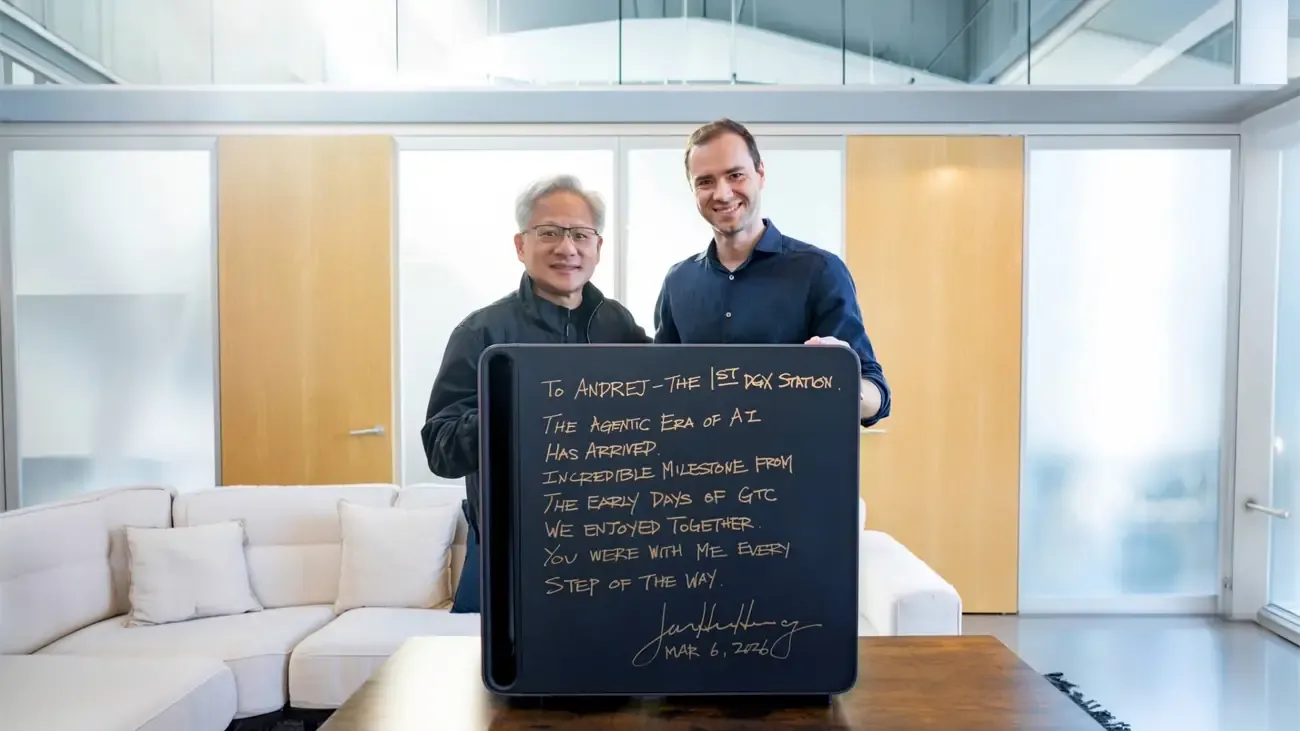
In March 2026, NVIDIA quietly completed a milestone delivery around the GTC conference: the brand‑new DGX Station (GB300 edition) first system was officially handed to renowned AI scientist Andrej Karpathy. This was not only the first physical delivery of NVIDIA's desktop AI supercomputer, but also marked a major leap in taking the "AI factory" from the data center to the desktop. Karpathy, an early core member of OpenAI and a legendary figure in computer vision and reinforcement learning often hailed as an "AI luminary," receiving this machine is highly symbolic—NVIDIA is putting cutting‑edge trillion‑parameter model training and agent development directly on top developers' desks.
NVIDIA's official blog and partner Dell Technologies both confirmed that the first Dell Pro Max with GB300 (the DGX Station custom edition) was delivered on March 6 to Karpathy's Palo Alto lab. The system is equipped with NVIDIA's latest GB300 Grace Blackwell Ultra superchip and features 775GB of unified coherent memory (supporting FP4 precision). A single machine can run generative AI models and autonomous agents of up to one trillion parameters locally. NVIDIA CEO Jensen Huang said in internal communications: "We are recreating the 2016 moment when the DGX‑1 was delivered to OpenAI, but this time we are putting a supercomputer directly on developers' desks."
DGX Station Key Specs: an AI Superfactory on the Desktop
Unlike previous rack‑style DGX models, the new DGX Station adopts a compact desktop form factor while delivering compute comparable to a small data center. Core specifications are as follows (based on NVIDIA and Dell technical specifications):
- Compute: NVIDIA GB300 Grace Blackwell Ultra superchip (tightly coupled Grace CPU + Blackwell GPU)
- Unified memory: 775GB high‑bandwidth coherent memory (supports FP4/FP8/FP16/BF16 and other precisions)
- AI performance: Single‑node FP8 performance reaching tens of PFLOPS (peak depends on OEM configuration), supports local training and inference for trillion‑parameter models
- Storage: Enterprise‑grade NVMe SSD array (capacity OEM‑configurable, typically starting at multiple TB)
- Interconnect: NVLink high‑speed interconnect, supports multi‑node cluster expansion (up to 4 DGX Stations in a unified cluster)
- Power & cooling: Liquid cooling or high‑performance air cooling options, single‑node power kept at reasonable desktop levels
- Software stack: Native integration with NVIDIA NemoClaw open agent framework, NeMo model training tools, CUDA 12.x and the latest AI Enterprise suite
NVIDIA emphasizes that the DGX Station's breakthrough is its unified memory architecture: CPU and GPU share the same address space, eliminating traditional PCIe data‑movement bottlenecks and enabling efficient local operation of trillion‑parameter models. After receiving the machine, Karpathy posted: "This system lets me rapidly iterate on cutting‑edge agent models locally without waiting in cloud queues."
Pricing and Availability: High‑End Customization, OEM Channel Launch
Specific pricing has not been uniformly announced by NVIDIA and will be set by OEM partners ASUS, Dell, HP, Gigabyte, MSI, Supermicro. Based on industry sources and early order information:
- Base configuration (single GB300 node): estimated starting at $400,000–$600,000 (roughly RMB 2.8–4.2 million)
- High‑end cluster (2–4 interconnected nodes): single‑cluster pricing may exceed $1.5 million
This price range is comparable to previous DGX H100/H200 desktop variants but represents a qualitative leap in performance (notably memory capacity and model scale). Dell has opened preorders for the Dell Pro Max with GB300, with expected volume shipments beginning in spring 2026; other OEMs will follow in Q2. NVIDIA is also launching DGX Spark (a smaller model, around the $40,000 level) as an entry option for individual developers and small teams.
NVIDIA is offering a GTC limited‑time promotion: purchasing two or more DGX Spark units on‑site qualifies for exclusive discounts and allows immediate pickup at the GTC "Build‑A‑Claw" booth. These pricing strategies aim to move top‑tier AI compute from "data‑center exclusive" to "developer desktop".
Background: A Decade of Evolution from DGX‑1 to Desktop AI Supercomputers
Looking back, the NVIDIA DGX series has been a benchmark for AI compute evolution:
- 2016: The first DGX‑1 was personally delivered by Jensen Huang to the newly formed OpenAI, helping kick off the ChatGPT era.
- 2024–2025: DGX H100/H200 became standard configurations for large‑model training.
- 2026: DGX Station/GB300 brings the "AI factory" to the desktop, enabling top developers like Karpathy to validate trillion‑parameter agents and cutting‑edge models locally.
Karpathy receiving the first unit carries strong symbolic weight. He led several pioneering efforts during his time at OpenAI, and this delivery is seen as NVIDIA's tribute to an AI pioneer. Industry analysts believe the move will accelerate agentic AI from cloud to local deployment, reduce developers' reliance on cloud services, and promote the adoption of open agent frameworks like NemoClaw.
Industry Impact: The Desktop AI Compute Revolution Begins
The arrival of DGX Station directly drives three major changes:
- Developer productivity jump: Run trillion‑parameter models locally without cloud queues and high costs.
- Downsizing enterprise AI factories: SMBs can deploy cutting‑edge AI on desktops without building large data centers.
- Agent ecosystem boom: Coupled with NemoClaw, developers can locally train and deploy autonomous agents, accelerating an "one person, one agent" era.
At the same time, the competitive landscape is shifting. OEMs like Dell and ASUS are seizing the high‑end desktop AI market with customized DGX Station offerings, while cloud providers such as OpenAI and Anthropic face potential local compute offload pressures.
Conclusion: AI Supercomputing Truly Reaches the Desktop
From the 2016 DGX‑1 delivery to OpenAI to the 2026 DGX Station handoff to Karpathy, NVIDIA has fulfilled its decade‑long promise to "bring supercomputing to the desktop." The new DGX Station is more than hardware; it is a key step in making trillion‑parameter capabilities accessible beyond the cloud.
For ordinary developers, this means trillion‑parameter capabilities once only achievable in the cloud can now be controlled from a desktop; for the industry, it signals the formal start of the desktop AI compute revolution.
As more OEM models ship and the NemoClaw ecosystem matures, DGX Station is poised to lead AI into a genuine "desktop era." The moment the first unit was delivered to AI luminary Karpathy will likely become another iconic snapshot in AI history.
▶️ Enjoy this piece? Creating it was hard work!
Follow our YouTube channel:
AI Rosetta
Your likes, subscriptions and shares are our greatest support! 🙏
More AI news at: https://www.airosetta.com