
Introduction: From data centers to the desktop, NVIDIA reshapes the AI hardware landscape
On October 15, 2025, NVIDIA officially began selling its latest product, the DGX Spark. Hailed as "the world’s smallest AI supercomputer," this desktop device stunned the industry with its compact design and strong performance. According to an NVIDIA newsroom announcement, the product's starting price is $3,999 (approximately RMB 28,000), intended to bring data center–class AI computing to developers, researchers and small businesses on their desktops. NVIDIA founder and CEO Jensen Huang personally delivered the first units to SpaceX chief engineer Elon Musk; the gesture not only echoes the 2016 DGX‑1 delivery history but also symbolizes AI’s shift from an elite tool toward broader adoption.
This launch is the result of NVIDIA’s continued innovation in AI hardware rather than a sudden move. The product first appeared at CES 2025 under the codename "Project Digits" and had originally been scheduled for a May release before optimizations pushed availability to October. Ars Technica noted that DGX Spark marks a migration of AI compute from the cloud to edge devices, reducing developers’ dependence on cloud services. TIME named it one of the "Best Inventions of 2025," highlighting its role in democratizing AI, while The Verge said the device could accelerate adoption of personal AI agents and local model training.
Product details: compact design with strong performance
At the heart of the DGX Spark is the NVIDIA GB10 Grace Blackwell Superchip, which integrates a 20‑core Arm CPU (10 Cortex‑X925 cores and 10 Cortex‑A725 cores) and delivers roughly 1 petaflop of AI performance. The device is equipped with 128GB of unified CPU–GPU coherent memory, supports local inference for models up to 20 billion parameters, and can fine‑tune models up to 7 billion parameters. Its dimensions are just 6 in × 6 in × 2 in, weighing about 2.6 lbs (≈1.2 kg), with a power draw of 170W and USB‑C power delivery, making it convenient for desktop or office deployment. NVIDIA notes that using NVIDIA ConnectX‑7 200Gb/s networking, two DGX Spark units can be linked to handle models of up to 40.5 billion parameters, further extending capability.
On the software side, DGX Spark ships with DGX OS based on Ubuntu Linux and the full NVIDIA AI software stack, including NVIDIA NIM microservices, frameworks and pretrained models. PCMag reported that the listed price excludes local taxes and the final cost may be slightly higher, and that its 273GB/s memory bandwidth is well suited to prototyping and experimentation rather than high‑throughput production inference. Compared with an RTX Pro 6000 Blackwell workstation GPU, its raw performance is roughly four times slower, but portability and integration are key advantages. Tom's Hardware said the delay from the originally planned May launch was used to optimize the software ecosystem and ensure an out‑of‑the‑box experience.
Sales channels include NVIDIA’s official store and partners such as Dell, HP, Lenovo, ASUS and Acer. Micro Center’s unboxing videos highlight its gold finish and efficient cooling design, noting its "book‑sized" portability. In‑depth reviews on YouTube further validate its performance when running tools like SGLang and Ollama, making it suitable for distributed inference experiments.
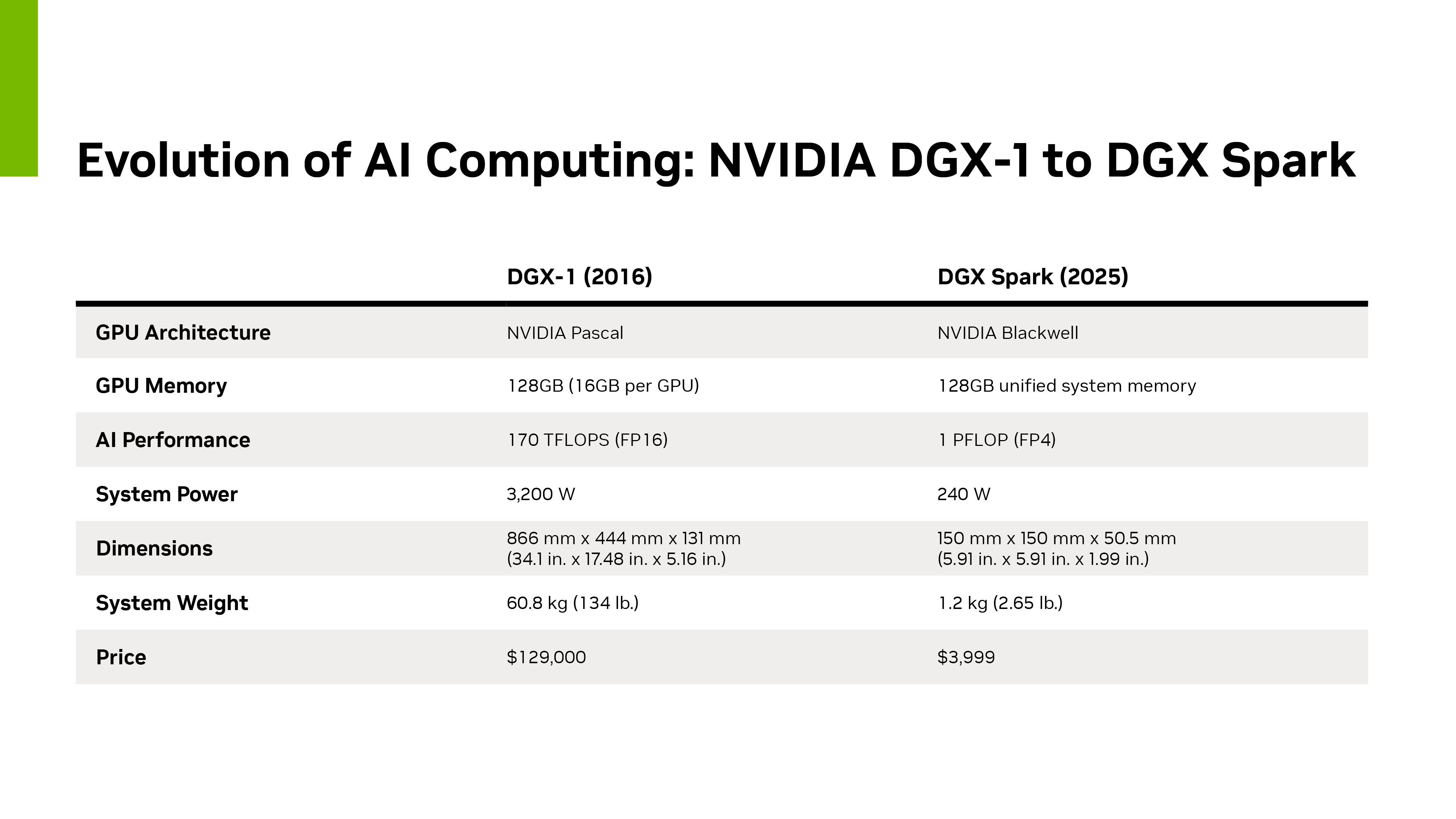
Background and strategic significance: returning to AI’s origins and driving a developer revolution
The DGX Spark launch stems from NVIDIA’s pursuit of AI accessibility. In 2016, Jensen Huang delivered the first DGX‑1 to the OpenAI team, including Elon Musk, an event that helped catalyze subsequent developments such as ChatGPT. Today, DGX Spark continues that mission, aiming to "put an AI supercomputer on every developer’s desk." Dataconomy analysts say the device addresses cloud‑dependence pain points such as data leakage risks and unpredictable costs by offering a secure, localized solution.
Strategically, NVIDIA is expanding its full‑stack ecosystem from data centers to desktops. Yahoo Finance reported that Google, Meta, Microsoft and Hugging Face participated in early testing, and Kyunghyun Cho of NYU’s Center for Global Frontiers called it "peta‑scale computing at the desktop level." Social posts indicate Musk remarked, after receiving the device, that he would "join the data center," hinting at potential use at SpaceX. Among developer communities, many view DGX Spark as a spark for an AI revolution, likely to accelerate startups and academic research.
Potential impact and challenges: opportunities and practical considerations
DGX Spark is expected to reshape AI development and spur edge AI innovation. Evaluations by LMSYS Org show it is suitable for running models such as DeepSeek and supports techniques like prefill‑decode separation and expert parallelism. WinBuzzer noted that while the $3,999 price is higher than some initial expectations, it is far below the $129,000 price of the 2016 DGX‑1, lowering the barrier to entry. However, challenges remain: memory bandwidth limits make it less suitable for high‑throughput production; scaling requires additional hardware, increasing cost; and power and cooling requirements mean an appropriate office environment is necessary.
CNET reported that the device will benefit students and independent developers and help shift AI from the cloud toward local deployment. Stock Titan emphasized that its efficient design aligns with sustainable computing trends.
Conclusion: igniting the spark of AI’s future
The launch of DGX Spark marks another NVIDIA breakthrough in AI hardware. It not only continues the DGX legacy but also democratizes supercomputing at the personal level. As Jensen Huang said, it will "ignite the next wave of breakthroughs." As more developers adopt the device, DGX Spark could become a catalyst for accelerating the transition from research to application.