
Known as the “Oscars” of artificial intelligence, the 39th Conference on Neural Information Processing Systems (NeurIPS 2025) was held December 2–8 in San Diego and Mexico City, attracting more than 25,000 researchers, industry leaders and developers. The conference received roughly 20,000 submissions and accepted 5,858 papers, for a historic low acceptance rate of about 25%. Statistics show that institutions from the United States and China dominated the program: about 2,450 papers from the US and 2,370 from China, a gap of under 5%, together accounting for nearly 90% of cutting‑edge AI research worldwide. Among the top 50 contributing institutions, US corporate labs (such as Google DeepMind, Meta and Microsoft) lead, while China is strong in academia and government institutions (including Tsinghua University, the Chinese Academy of Sciences, Peking University and Shanghai Jiao Tong University). This “two‑power rivalry” appears not only in paper counts but also in the Best Paper Awards: of four Best Paper Awards, two were led by Chinese teams, one was a China‑US collaboration, and one was US‑led. The Test of Time Award honored the 2015 classic “Faster R‑CNN,” whose authors include Chinese researchers Kaiming He and Jian Sun, underscoring China’s deep roots in computer vision. The awards and highlights at NeurIPS 2025 reflect AI’s shift from a “scale competition” toward “deep reasoning and sustainable innovation,” and suggest that China and the US running neck‑and‑neck will reshape the global tech ecosystem.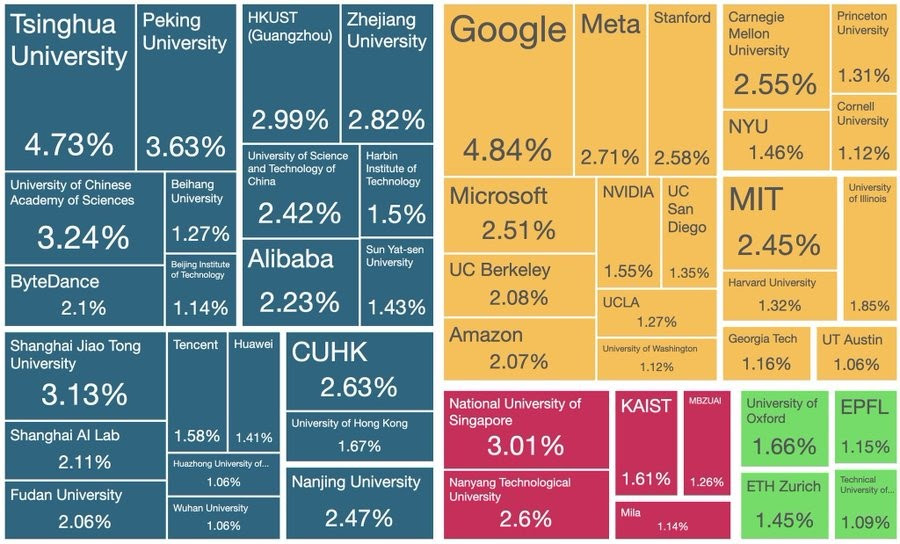
NeurIPS, the flagship conference in machine learning and neural networks since 1987, has become a bellwether for AI innovation. The 2025 conference introduced a new Position Paper Track to encourage discussion of AI’s societal impacts; submissions to this track surged by 30%. Topics emphasized large language models (LLMs), multimodal learning, reinforcement learning (RL) and diffusion models. Among accepted papers, LLM‑related work comprised up to 35%, and papers on reasoning and evaluation made up 13%. Award selection involved hundreds of reviewers and strict criteria—originality, reproducibility and impact. The conference website published the winners on November 26, sparking wide discussion. Below we analyze the major awards and their technical significance.
The Best Paper Awards are NeurIPS’s crown; in 2025 four papers were honored, covering generative AI theory, RL, and LLM architecture innovations. One Chinese team’s paper, “Gated Attention for Large Language Models: Non‑linearity, Sparsity, and Attention Sink Free,” authored by Zihan Qiu and colleagues from Alibaba’s Qwen team, won one award. The paper addresses attention mechanism weaknesses in LLMs by adding a head‑specific sigmoid gate after Scaled Dot‑Product Attention (SDPA), introducing nonlinearity and sparsity to improve model stability, learning‑rate tolerance and long‑context performance. Experiments compared 30 variants of 15B Mixture‑of‑Experts models and a 1.7B dense model trained on a 3.5 trillion‑token corpus; results show the gated mechanism yields 5–10% improvements and offers a theoretical explanation of its nonlinear effect on low‑rank mappings and query‑dependent sparse gating modulation of SDPA outputs. Reviewers praised the work for “a simple modification that achieves systematic gains,” framing it as more than an architectural tweak but as a theoretical contribution to the “attention sink” problem. As the sole Chinese Best Paper, the award highlights Alibaba’s global competitiveness in foundational models.
Another Best Paper, “Artificial Hivemind: The Open‑Ended Homogeneity of Language Models (and Beyond),” by Liwei Jiang and collaborators from the University of Washington, Carnegie Mellon University and the Allen Institute, shows that LLMs tend to homogenize in open‑ended generation tasks: different models produce similar outputs and lack human‑like diversity, raising concerns about “thought assimilation.” The team introduced the Infinity‑Chat dataset to measure diversity at scale for open prompts and demonstrated that training‑data bias is a root cause. Reviewers noted the paper “exposes LLM vulnerabilities and provides new tools for diversity evaluation.” This China‑US collaborative work (including authors with Chinese backgrounds) emphasizes AI ethics and affects safety evaluation of generative content.
The third Best Paper, “Why Diffusion Models Don’t Memorize: The Role of Implicit Dynamical Regularization in Training,” investigates the generalization mechanisms of diffusion models. The authors analyze training dynamics and show that implicit regularization prevents overfitting and ensures models do not “memorize” training examples. Published on OpenReview, reviewers highlighted its theoretical depth: “it provides a mathematical explanation for diffusion model robustness.” A significant portion of the authors are from China, reflecting Chinese contributions to generative model theory.
The fourth Best Paper, “Does Reinforcement Learning Really Incentivize Reasoning Capacity in LLMs Beyond the Base Model?,” questions RL’s role in improving LLM reasoning. Through experiments, the authors show RL tends to amplify the base model’s abilities rather than create novel reasoning pathways. Reviewers said it “challenges the RL myth and pushes toward more efficient training.” This US‑led study has prompted a reevaluation of RL paradigms.
The Test of Time Award honored the 2015 paper “Faster R‑CNN: Towards Real‑Time Object Detection with Region Proposal Networks,” by Shaoqing Ren, Kaiming He, Ross Girshick and Jian Sun. The paper introduced the Region Proposal Network (RPN) to achieve real‑time detection at about 5 fps and laid the foundation for modern computer vision. A decade later, its influence exceeds ten thousand citations and it spurred follow‑on work such as YOLO. Reviewers emphasized: “The shift from proposal‑based to end‑to‑end training defined the detection era.” As a classic led by Chinese researchers, the award recognizes its major contribution.
NeurIPS 2025 also introduced the Sejnowski‑Hinton Prize to honor work bridging biological brains and AI; the inaugural prize went to an RL study simulating cortical tactile computation. The Datasets & Benchmarks track’s best paper examined diversity in creative content.
Several factors explain China and the US predominance. The US advantage lies in its corporate ecosystem: Google DeepMind, Meta and Microsoft labs contributed over 40% of papers and possess massive compute resources (e.g., NVIDIA Blackwell GPUs) and interdisciplinary talent. Silicon Valley’s “talent magnet” draws global experts; the 2025 median AI PhD salary exceeded $300,000. China relies on academic and government synergy: institutions such as Tsinghua benefit from national “Double First Class” support, and Chinese inventors account for a large share of AI patents. Government investment exceeded 100 billion yuan to advance the “New Generation AI” initiative and cultivate local talent. Submission data show China’s papers have an average citation rate of 2.8 versus 4.2 for the US, but China’s volume is growing faster. Joint drivers include the AI “scale laws”: China and the US control about 70% of global investment and 61% of talent. Europe’s fragmentation—only one European institution in the top 50—highlights the strategic advantage of national coordination in China and the US.
The downstream impact will reshape the global AI map. First, competition will intensify: China and the US running in parallel may produce a “dual‑track” ecosystem, with US companies leading applications and Chinese academia leading theory. China’s 50% share of awards suggests open‑source models like Qwen could erode Llama’s market. Second, global collaboration opportunities remain: the conference’s dual‑city format symbolized inclusivity, and 20% of papers were China‑US coauthored. Yet decoupling risks rise—US chip export restrictions could slow Chinese progress. Lessons for other countries: Singapore (NUS, NTU) and the UAE (MBZUAI) in the top 50 show targeted investment can accelerate catch‑up. Europe should consolidate resources to avoid fragmentation. In the long run, awards are driving AI ethics—papers on homogenization warn of diminishing diversity of thought.
NeurIPS 2025 was not only an academic feast but also a mirror of a “China‑US moment” in AI. In the “agency era,” these awards foreshadow a convergence of reasoning and generative models that will drive trillion‑dollar industries. As a global AI beacon, NeurIPS reminds us that innovation is measured not only by quantity but also by quality and responsibility—China and the US leading together could become a starting point for global mutual benefit.