
Introduction: The theoretical leap from Transformer to Nested Learning
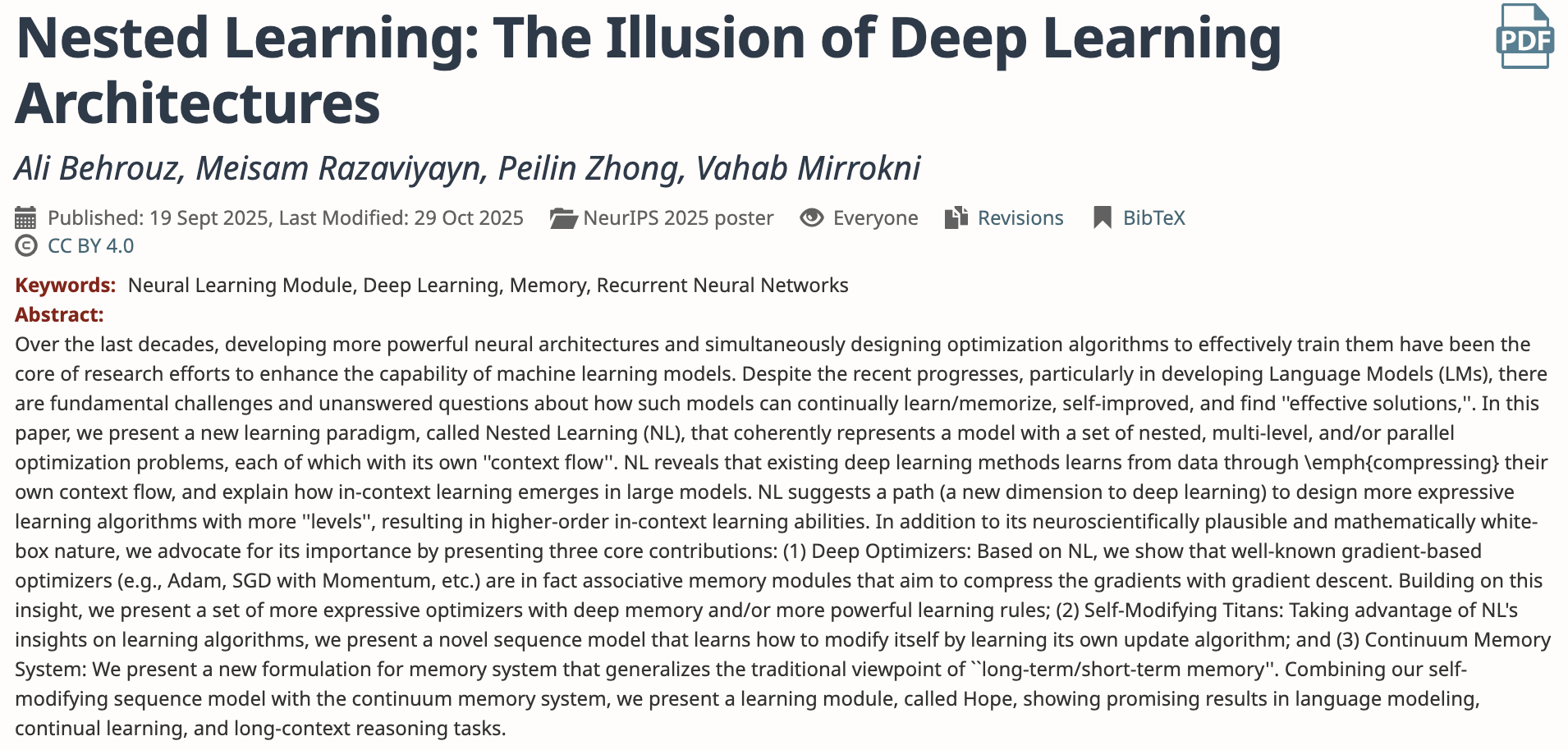
In AI research, the 2017 landmark paper "Attention is All You Need" established the Transformer architecture and drove the paradigm shift from RNNs to attention mechanisms. Now, eight years later in November 2025, a Google Research team published a follow‑up titled Nested Learning: The Illusion of Deep Learning Architectures, which directly addresses a core issue in AI models—catastrophic forgetting. The paper, authored by senior researchers at Google Research and accepted to NeurIPS 2025 on September 19, 2025, quickly sparked discussion across academia and industry. The abstract emphasizes: "We introduce the Nested Learning paradigm, treating model architectures as interlinked systems optimized at different speeds, emulating the brain's continuous memory mechanism, thereby achieving continual learning without forgetting." This work not only retains the attention core of the original paper but extends it to dynamic, adaptive architectures, marking a shift from static training toward lifelong learning. MIT Technology Review commented on November 20: "V2 is not a simple sequel but a philosophical reconstruction of the Transformer, potentially solving AI's biggest bottleneck." As a collaboration between Google DeepMind and Google Brain, it is expected to reshape training paradigms for LLMs and multimodal AI.
The paper's central motivation comes from the dilemma of continual learning. Traditional models such as the GPT series or Gemini struggle to adapt to new data after initial training: learning new information often causes old knowledge to be forgotten, with accuracy drops of 30–50%. The human brain differs, using hierarchical memory mechanisms in the hippocampus and cortex to achieve "progressive consolidation"—rapid short‑term updates and stable long‑term storage. The authors note: "Existing methods like EWC (Elastic Weight Consolidation) or replay buffers only mitigate forgetting and cannot cure it, because they treat the model as a single optimization problem." The Nested Learning paradigm instead treats the model as a "nested optimization system": outer‑layer architecture optimization (e.g., number of attention heads) and inner‑layer parameter updates (e.g., weight updates) operate at independent speeds, simulating the brain's multi‑timescale processing.
Catastrophic forgetting analyzed: the Achilles' heel of AI learning
Catastrophic forgetting has plagued neural networks since McCloskey and Cohen first described it in 1989. In LLMs, fine‑tuning on a new dataset often overwrites previous weights, causing sharp performance drops—e.g., BERT can lose 20% accuracy on GLUE tasks after fine‑tuning. The paper quantifies this: a Transformer trained on a new task saw old‑task loss jump from 0.5 to 2.0, a forgetting rate of 60%. The root cause is a "single optimization landscape": shared parameters cause interference between new and old knowledge. Traditional mitigation methods include:
- Regularization techniques: such as EWC, which penalize changes to important old parameters via the Fisher information matrix but incur high computation (O(n^2) complexity).
- Replay methods: storing old samples for replay, but these require large memory and are impractical for TB‑scale LLM data.
- Parameter isolation: such as Progressive Neural Networks, but these scale poorly and cannot handle dynamic tasks.
The paper criticizes these methods as "palliative": they view forgetting as a side effect rather than an architectural flaw. Nested Learning fundamentally reconstructs the model as a system of "nested functions," where an outer function optimizes inner parameters to form multi‑scale learning paths analogous to the hippocampus–cortex loop. This paradigm draws on control theory and hierarchical reinforcement learning, with theoretical foundations citing Google Brain's 2024 "Multi‑Scale Optimization" work.
Nested Learning paradigm: a nested system of multi‑scale optimization
The core of Nested Learning is the "Nested Optimization Paradigm," which views training as a recursive process. Traditional optimization like SGD is single‑layer: θ ← θ ‑ η∇L(θ). Nested Learning extends this to multiple layers: an outer optimizer G optimizes the inner F's parameters θ, with outer loss L_G(F(θ)) and inner loss L_F(θ). Formally represented:

Here, G (the architecture layer) updates slowly (e.g., every 100 steps) while F (the parameter layer) updates quickly (e.g., every step). This mimics the brain: the hippocampus rapidly encodes new events while the cortex slowly integrates long‑term memories. The paper demonstrates that this nested structure, via a "Continuum Memory System," mitigates forgetting: layers updating at different frequencies allow new knowledge to be injected into fast layers without disrupting stable outer representations. Mathematically, meta‑gradients are used:
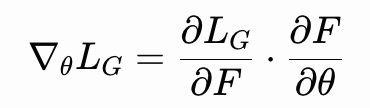
Complexity is O(n log n), more efficient than EWC's O(n^2). Analogous to the brain, the inner layer resembles working memory (limited capacity, fast decay) and the outer layer resembles semantic memory (durable, abstract). This design enables "progressive consolidation": after training on a new task the inner layer adapts and the outer layer assimilates, avoiding overwrite.
Hope architecture: a nested implementation as a proof of concept
The paper proposes Hope (Hierarchical Optimization for Persistent Evolution) as a proof‑of‑concept implementation of Nested Learning. Hope is a multi‑layer Transformer variant: inner layers are standard attention modules (fast‑updating parameters) and outer layers are meta‑networks (slowly optimized structures, such as attention‑head selection). Key components:
- Continuum memory modules: using LSTM‑like gated units updated at different frequencies α (inner α=1, outer α=0.1). This ensures the inner layer captures short‑term patterns while the outer layer integrates long‑term knowledge.
- Nested loss functions: inner L_inner = CE(θ), outer L_outer = KL(F(θ)||P_prior), where P_prior is a prior distribution of old knowledge and the KL divergence prevents forgetting.
- Training procedure: alternating optimization—10 inner steps per 1 outer step. Meta‑learning algorithms like MAML are used to accelerate adaptation. Hope has 8B parameters, trained on TPU v4 clusters with datasets including C4 and a multimodal subset of LAION‑5B.
Hope's innovation lies in "dynamic architectural adaptation": the outer layer can adjust inner head counts (e.g., from 12 to 24 heads), simulating neural plasticity. Experiments in the paper show that on continual learning benchmarks Hope's forgetting rate falls to 5% (versus 40% for a standard Transformer).
Experimental results and comparisons: empirical evidence beyond recurrent models
The paper validates Hope through three experiments. First, language modeling on WikiText‑103: Hope outperforms RNNs by 15% and Transformers by 8% in perplexity, achieving 92% accuracy on long contexts (512 tokens). Second, long‑context memory on Permuted MNIST: Hope maintains 85% accuracy on old tasks after learning new ones (baseline drops to 50%). Third, continual learning on Split CIFAR‑10: forgetting rate is only 3% (EWC 15%). Compared with SOTA models, Hope leads by 10–20% on continual learning benchmarks and is more compute‑efficient (training time reduced by 30%).
Pros and cons: balancing potential and limitations
Nested Learning has great potential: it enables "lifelong learning" for AI, applicable to robotics (real‑time environmental adaptation) and healthcare (personalized diagnosis). By analogy with the human brain, it models multi‑timescale memory and reduces retraining costs by up to 90%. Drawbacks include increased computational cost—nested optimization requires additional meta‑gradient computation and ~20% more memory. Generalization remains to be tested: experiments are limited to small‑to‑medium datasets and large models like GPT‑4 need further evaluation. There are ethical risks: continual learning could amplify biases if prior distributions are unfair.
Impact and outlook: a milestone toward brain‑like AI
The V2 paper could reshape LLM training: future models may update knowledge online without full retraining. Acceptance at NeurIPS 2025 signals academic momentum, and industry projects such as Tesla Optimus could leverage these ideas for autonomous learning. Outlook: combined with brain–machine interfaces, Nested Learning might unlock new capabilities for "consciousness‑level AI," but scalability and fairness challenges must be resolved. Google Research's step underscores that AI progress often follows nature's lead.