
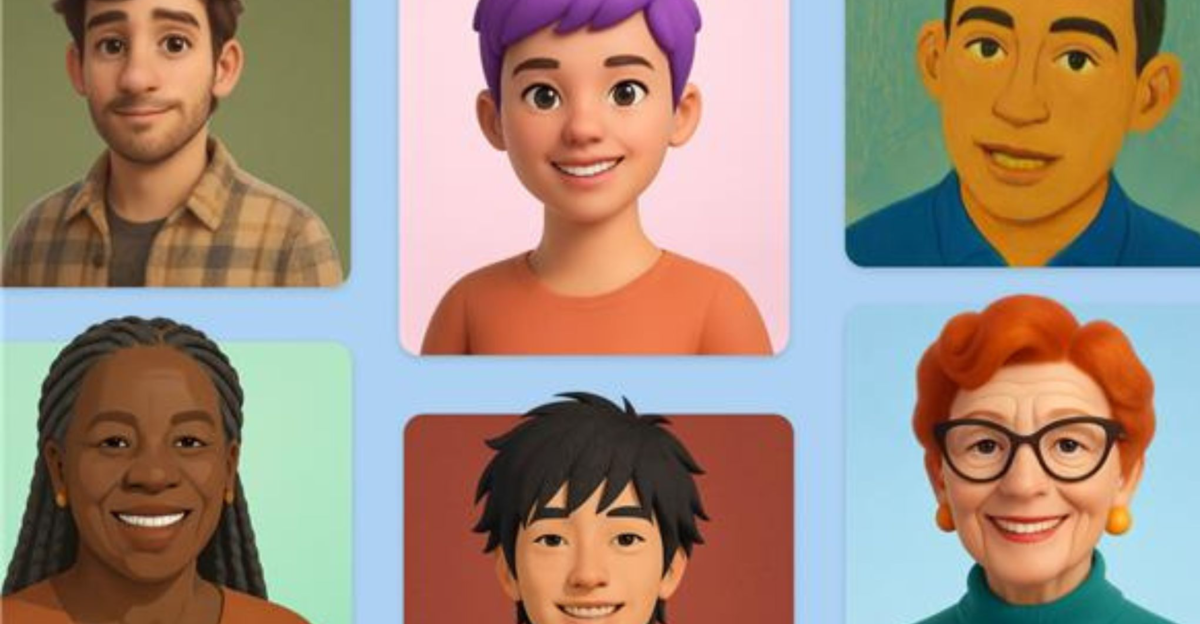
Sept. 24, 2025 — Microsoft has released an experiment called "Portraits" in Copilot Labs that gives Copilot a visible, animated "face" users can speak with directly through the interface. In demos Microsoft showed several portrait styles: some frowning, nodding, and answering with synchronized lip movement, while others were more cartoonish and colorful, aimed at making the AI assistant appear more approachable.
This experiment is not a simple swap of static avatars: portraits adjust expressions and eye gaze based on conversational emotion, use lip‑sync and micro‑expressions when speaking, and allow background and lighting tweaks in settings. Microsoft classifies these portraits as Copilot Labs' experimental tools, currently rolling out to a subset of users; the interface still preserves traditional text and voice input options.
Microsoft has not disclosed full implementation details, but descriptions indicate the system combines its generative models' facial‑action predictions, real‑time speech‑to‑lip mapping, and controls for expression intensity. The team emphasized avoiding direct cloning of real people's appearances: avatars are generated from synthetic samples and parameterized controls rather than extracted from or fine‑tuned on specific real‑person videos.
Microsoft also provided usage and privacy guidance: generated portraits can be turned off and users can choose not to enable a face‑based conversation interface; Microsoft will further adjust the experience and safety policies as it gathers feedback. The Verge reported that even so, such "talking faces" can trigger public sensitivities around deepfakes and realism ethics — as AI faces become more lifelike, interface design, usage limits, and transparent labeling become especially important.
On the product side, Portraits aims to improve the first impression of human‑AI interaction. Microsoft believes that compared with plain text or machine voices, avatars with emotional and visual feedback make complex instruction exchanges more intuitive. For example, in teaching, customer service, or assistive dialogue scenarios, avatars can use eye contact and expressions to cue users to key points or reinforce response tone across multi‑turn Q&A with nonverbal signals.
But live testing also revealed issues: expression transitions can appear stiff or out of sync during camera angle changes or network hiccups; some synthetic expressions fall into the "uncanny valley," undermining trust. The Verge wrote that Microsoft is iteratively refining details and encourages testers to report "unnatural" expression and timing problems.
Microsoft is not alone: multiple companies are exploring interactive models that combine visual personas with voice and text. Microsoft distinguishes itself by placing Portraits in Copilot Labs as an explicitly experimental feature; whether it will be widely rolled out next depends on technical maturity and the progress of regulatory and ethical review.
For younger users, an avatar‑ized Copilot has the potential to turn a cold AI into a "digital companion" — aligning with social and anthropomorphic usage habits; but it also requires vendors to carefully balance realism, personalization, and transparency in design. Microsoft said it will adjust the product roadmap based on fall 2025 test feedback and publish more details.