
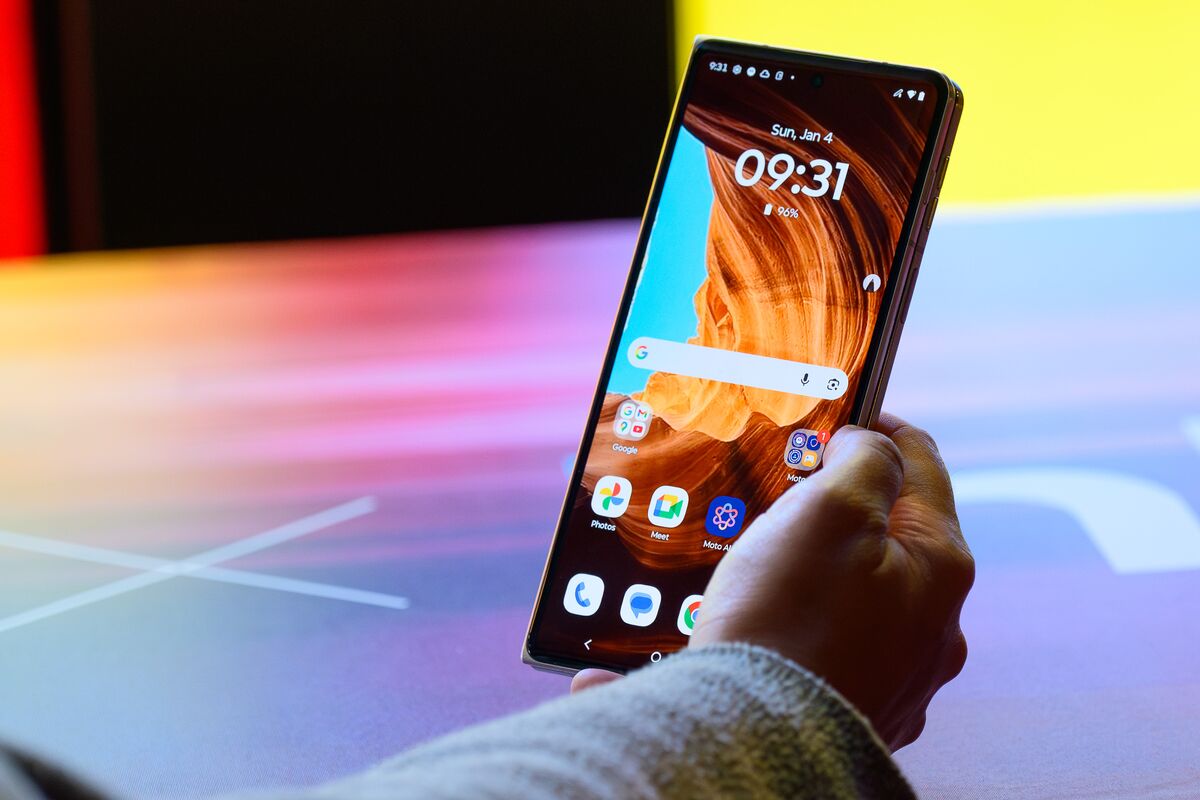
On January 7, 2026, Motorola unveiled two directional concept products at a media and partner showcase: its first book‑style foldable phone—internally referred to as the "Razr Fold" concept—and a wearable concept centered on on‑device AI interaction.
The presentation emphasized a shift in design philosophy. Over recent years Motorola has focused on clamshell foldables, favoring thinness and retro styling; the new book‑style fold signals a move toward larger displays aimed at productivity and multitasking. Official footage and prototype details concentrated on crease control, the hinge mechanism and screen‑to‑body ratio: when unfolded the display approaches the visual area of a small tablet, better suited for split‑screen multitasking, video editing and social content creation.
In terms of exterior design, Motorola retains Razr family design cues while adjusting body thickness and bezel treatment to balance grip and portability. Engineers demonstrated seamless app migration from the outer to the inner display and smooth multi‑window operation in the unfolded state; the camera module is placed in a vertical strip on the rear, highlighting photographic stability and video‑creation capabilities in a tablet‑like form factor.
The wearable AI concept is not a conventional smartwatch or band but an interaction concept built around real‑time AI inference and sensor fusion: the company demonstrated driving a generative AI assistant via voice and short gestures, performing offline speech recognition and low‑latency responses locally, and using the wearable as a "proximate AI node" to offload tasks from the host device and reduce immediate cloud dependence. Motorola says the concept explores "bringing AI closer to users and making devices more human‑aware in a compact form."
Bloomberg noted these two announcements are seen as a direct challenge to Samsung in the foldable market. Motorola hopes to attract users seeking larger‑screen experiences by offering a differentiated lineup—both pocketable clamshells and more productivity‑oriented book‑style devices. No concrete mass‑production dates or pricing were provided; Motorola said it will "work to advance production and coordinate supply‑chain partners as soon as possible."
The selling points aimed at young creators and tech enthusiasts are clear: a larger internal foldable display, convenient split‑screen creation, and low‑latency social and control experiences enabled by wearable AI. Industry observers commented after the event that Motorola's shift is both an evolution of product strategy and a bet on a future of device‑and‑AI collaboration—if the company can balance battery life, hinge durability and local AI compute, it may gain more attention within the second tier of the foldable market.
Motorola, which is part of Lenovo Group Ltd., used this product and experimental‑concept reveal to show concurrent investment in hardware form factors and AI interaction. The January 7 presentation read more like a concept declaration: the brand is moving from a single design icon toward a richer exploration of form factors, and the market and consumers will be watching for when these concepts become purchasable products.
▶️ Enjoyed this article? Creating great content takes effort!
Subscribe to our YouTube channel:
AI Rosetta
Your likes, subscriptions and shares mean the world to us! 🙏
For more AI news, visit:
https://www.airosetta.com