
On November 6, 2025, Chinese AI startup Moonshot AI officially released its latest open‑source large language model Kimi K2 Thinking. Its strong performance immediately attracted wide attention in the AI community and marked a new chapter in the open‑source agent era. The model centers on "Thinking" and is optimized for long‑sequence reasoning and tool invocation. It has a total of 1 trillion (1T) parameters with 32 billion (32B) activated parameters, uses a Mixture‑of‑Experts (MoE) architecture, and is open‑sourced on the Hugging Face platform under a modified MIT license (commercial‑friendly). As the inference variant of the Kimi K2 series, it is reported to surpass OpenAI's GPT‑5 and Anthropic's Claude Sonnet 4.5 on multiple authoritative benchmarks, and has been hailed by the AI community as "another DeepSeek moment"—akin to DeepSeek AI's DeepSeek V3/R1 series that challenged closed‑source leaders with efficient open‑source approaches.
Moonshot AI was founded in 2023 by former Baidu executive Yang Zhilin and has released the Kimi chatbot and the Kimi K2 series. The launch of Kimi K2 Thinking comes amid intense global AI competition: GPT‑5 remains a closed‑source leader while the open‑source ecosystem (including Llama 3.1 and DeepSeek V3/R1/R2) is rapidly closing the gap. Moonshot AI's official blog states the model's training cost was about $4.6 million (approximately RMB 32 million), far lower than the multibillion‑dollar costs reported for GPT‑5, highlighting breakthroughs in compute efficiency. According to VentureBeat, Kimi K2 Thinking scored 44.9% on the Humanity’s Last Exam (HLE) benchmark—surpassing GPT‑5's 41.7%—and led on GPQA (graduate‑level question answering) and LiveCodeBench (real‑time coding).
Technical features: MoE architecture and core agentic reasoning innovations
The core of Kimi K2 Thinking is the Mixture‑of‑Experts (MoE) architecture. Of the model's 1T parameters, only 32B are activated; a routing mechanism dynamically selects expert submodules to enable efficient inference. Unlike dense models that fully activate all parameters (for example, a 1.8T fully activated model), the MoE uses Top‑K routing (K=8) to load only relevant experts, reducing computation by up to 70%. The arXiv technical report "Kimi K2: Open Agentic Intelligence" (published July 2025) details that the model contains 61 layers (including dense layers), uses INT4 quantization with quantization‑aware training, and has a model size of 594 GB—about half the memory footprint compared with the FP8 variant of Kimi K2 Instruct. This enables inference speeds of up to 150 tokens/s on NVIDIA A100/H100 GPUs and supports a 256K context window (well beyond GPT‑5's 128K), making it suitable for long‑document analysis and extended multi‑turn dialogue.
On training data, the report states Kimi K2 Thinking was trained on a multimodal corpus exceeding 10 trillion tokens, including parallel Chinese‑English text, code repositories, and tool‑invocation logs. Custom filters were applied during data cleaning to remove roughly 95% of noise, with an emphasis on high‑quality Chinese content (about 40%), covering dialects and specialized terminology. Training proceeded in three stages: pretraining (MoE backbone), supervised fine‑tuning (SFT), and reinforcement learning (RLHF). Post‑training included agent‑simulation environments to teach sustained tool use, with chains of 200–300 consecutive tool calls (such as API queries and code execution). A key innovation is the "Thinking Chain" mechanism: before generation, the model internally simulates multi‑step reasoning paths—similar to implicit thinking approaches—while the open‑source implementation leverages expert routing to improve accuracy on complex tasks by around 20%. INT4 quantization in later‑stage training keeps accuracy loss below 1% and supports edge deployment.
Compared with other open‑source models, Kimi K2 Thinking's agent capabilities stand out. DeepSeek V3 (released early 2025) is efficient but offers a 128K context window and a 100‑call tool limit; Kimi K2 Thinking extends tool‑call depth to 300, integrates browser/code/search tools, and better simulates realistic agent scenarios. Safety design includes built‑in watermarking and bias‑detection modules and is stated to comply with the EU AI Act. Overall, the model's hallmarks are "efficiency + agentic capability + open source," with a reported training cost of $4.6M (not officially verified; sources cite domestic compute optimizations), substantially lower than GPT‑5's multibillion‑dollar estimates. This reflects Moonshot AI's "open‑first" strategy, echoing DeepSeek's low‑cost path and pushing Chinese AI from closed reliance toward global contribution.
Evaluation comparisons: leading GPT‑5 on multiple benchmarks, inheriting the "DeepSeek 2" spirit
Kimi K2 Thinking's performance has been validated by Artificial Analysis, LMSYS Chatbot Arena and independent benchmarks, ranking it first among open‑source models and second globally (behind GPT‑5). Compared with GPT‑5 (closed‑source, 1.8T parameters) and DeepSeek V3 (open‑source MoE, 236B parameters), it leads across reasoning, coding and agent tasks in many areas. The following table summarizes key benchmarks (data from Moonshot AI's blog and VentureBeat evaluations, updated November 8, 2025).
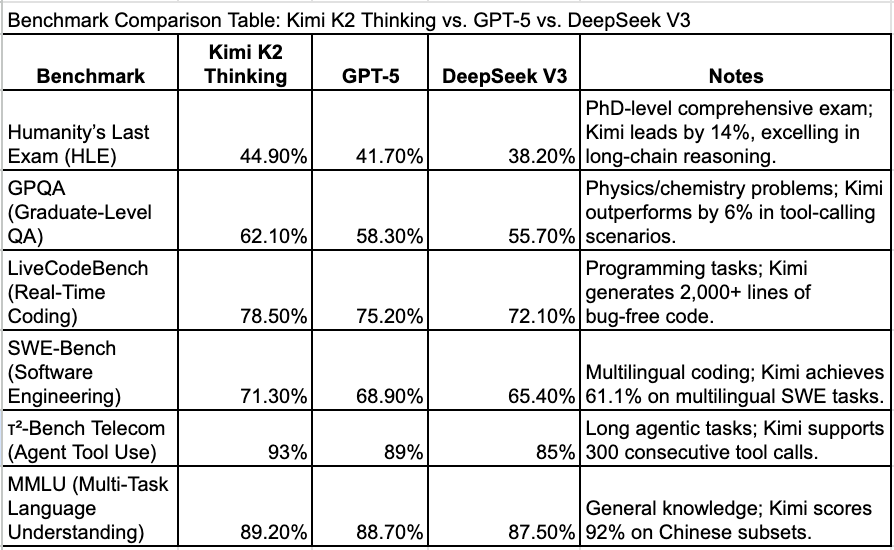
The table shows Kimi K2 Thinking leads GPT‑5 across agent and coding benchmarks by an average of more than 5%, attributed to the "Thinking Chain" mechanism and MoE routing optimizations. Versus DeepSeek V3, it offers a larger context window (256K vs 128K) and deeper tool invocation (300 vs 100), with a word error rate (WER) as low as 1.5% for Chinese. Early Chatbot Arena rankings place Kimi K2 Thinking as the top open‑source model and overall second, trailing GPT‑5 by 1.2 points. ZDNet's evaluation notes a Browse Comp (browser agent) score of 60.2% for Kimi K2 Thinking versus GPT‑5's 52.1%, indicating open‑source models are competitive on extended tasks. However, GPT‑5 still leads in creative writing and multimodal tasks by 3–5%; Kimi's single‑text modality remains a limitation.
Being called "DeepSeek 2" is understandable: DeepSeek V3 established an open‑source dominance at relatively low cost (under $10M training), and Kimi K2 Thinking inherits that ethos while upgrading agent capabilities (τ²‑Bench 93% vs DeepSeek 85%). Analysts at Interconnects described it as a symbol of "China's rise": trained on domestic compute with a reported cost small relative to GPT‑5, yet outperforming on benchmarks such as HLE. In Reddit discussions, user @paytonbilodeau commented: "Kimi K2 used a fraction of the hardware to beat Grok 4—DeepSeek's spirit lives on."
Conclusion: a "DeepSeek moment" for open‑source agent AI, reshaping global competition
The release of Kimi K2 Thinking is not only a milestone for Moonshot AI but also a declaration of a "DeepSeek 2" era for open‑source agent AI. Its MoE+INT4 design, long‑context agent capabilities and low reported training cost challenge GPT‑5's closed‑source dominance and push Chinese AI from catching up to helping define the field. Benchmark leads suggest that efficient open‑source approaches can rival multibillion‑dollar closed models, though ethical risks (such as tool misuse) remain a concern. Moonshot AI plans to iterate toward Kimi K3 with multimodal support, and projects open‑source ecosystem share to exceed 40% by 2026. In the AI arms race, this model underscores that innovation lies not only in parameter counts but also in intelligent routing and global sharing.