
On April 20, 2026, leading Chinese AI startup Moonshot AI formally released and open‑sourced its latest flagship model, Kimi K2.6. As the third major iteration of the K2 series, this model shifts its core breakthroughs away from general conversational metrics toward long‑horizon coding, agent‑swarm collaboration and system‑level engineering, aiming to serve as an "OS for agents." K2.6 is now available on kimi.com, the latest Kimi app, the Kimi API and the Kimi Code programming assistant, and is open to all users.
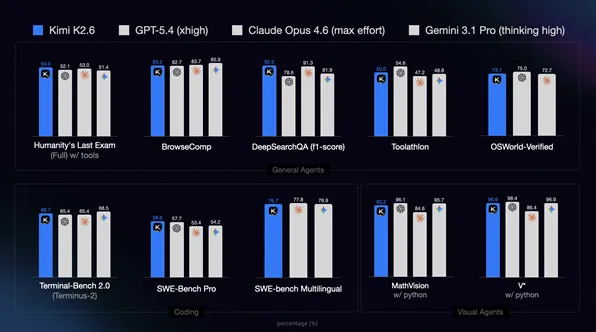
Multiple benchmarks place it in the top tier
In authoritative evaluations that measure comprehensive model capability, Kimi K2.6 has demonstrated the robustness to contend directly with leading closed‑source models. According to the developer, the model achieved industry‑leading results on several benchmarks, including the full doctoral‑level "Humanity's Last Exam," the SWE‑Bench Pro that assesses real software engineering capability, and DeepSearchQA that tests agent retrieval depth—performing on par with or better than closed competitors such as GPT‑5.4, Claude Opus 4.6 and Gemini 3.1 Pro.
This performance indicates that open‑source large models are progressively closing the gap with top closed systems on core capabilities. Moonshot AI founder Yang Zhilin previously noted at the Zhongguancun Forum annual meeting that the essence of large models is converting energy into intelligence, and that scalable development should prioritize efficiency rather than brute‑force compute. The release of K2.6 realizes that idea by optimizing architecture and training efficiency to maximize intelligence under limited resources.
Long‑range coding: from "code completion" to a "system‑level engineering partner"
Code capability is the central focus of this iteration and the most distinguishing label of K2.6. Moonshot AI calls it "the strongest code model to date." Its breakthroughs lie not only in the quality of single‑shot generations but also in long‑term stability and complex system optimization.
In tests, K2.6 demonstrated remarkable endurance: it can sustain continuous coding for 13 hours and write or modify more than 4,000 lines in a single task. In a compelling case, the model autonomously performed a deep refactor of the eight‑year‑old, near‑performance‑limit open‑source trading engine exchange‑core over 13 continuous hours, iterating 12 optimization strategies, making more than 1,000 tool calls and precisely changing over 4,000 lines of code. The result raised median throughput from 0.43 MT/s to 1.24 MT/s (a 185% increase) and peak throughput from 1.23 MT/s to 2.86 MT/s (a 133% increase).
Internal evaluations show that on the Kimi Code Bench rigorous coding benchmark, K2.6 scores roughly 20% higher than its predecessor K2.5.
Agent swarms: from "digital assistants" to "digital teams"
If long‑range coding is a breakthrough in solo capability, the agent‑swarm architecture represents a systemic leap in collaborative scale. The model expands the Agent Swarm size from K2.5's 100 sub‑agents and 1,500 steps to 300 sub‑agents and 4,000 cooperation steps, enabling far greater parallelized task processing.
The architectural upgrade allows K2.6 to dynamically break down complex tasks and autonomously spawn specialized agents to run in parallel, completing end‑to‑end multi‑output deliveries—ranging from document analysis and web pages to PPTs and spreadsheets—in a single run. For example, the agent swarm executed five quantitative strategies across 100 global semiconductor targets, delivering detailed modeling tables and full McKinsey‑style presentation decks; in another case it converted an astrophysics paper into a structured dataset with over 20,000 records and 14 professional charts.
More forward‑looking is its "always‑on" autonomous operation. When integrated with proactive agent frameworks such as OpenClaw and Hermes Agent, K2.6‑based agents ran autonomously for five continuous days, handling monitoring, incident response and system operations—demonstrating durable context retention and end‑to‑end execution from alert receipt to full resolution. Internal Claw Bench tests show K2.6 achieves a roughly 10% overall improvement over K2.5, with clear advantages in workflows requiring long unattended runtime.
Code‑driven design and a skills ecosystem
Another innovation in K2.6 is the deep fusion of code and visual capability to enable "code‑driven design." The model can accurately convert images and video assets into code, building visually focused hero sections and scroll‑triggered animations to deliver design‑forward, production‑quality web applications. Moonshot AI created the Kimi Design Bench to evaluate this capability across visual input, landing‑page construction, full‑stack app development and general web development; compared with Google AI Studio's Gemini 3, K2.6‑based agents show a clear lead.
Additionally, K2.6 introduces a "Skill" mechanism. After users upload high‑quality Office documents, the model understands their structure and style and generates reusable document‑creation skills; the system also includes hundreds of official recommended skills, such as skill packs that produce professionally typeset research reports with one click. This design substantially reduces the cost of rebuilding complex workflows.
Open‑source strategy and ecosystem layout
Notably, K2.6 is open‑sourced under a Modified MIT license, offering a differentiated system‑level solution to the industry. Amid intense iterations from OpenAI and Anthropic, this path of "breaking through via engineering capabilities" reflects a shift by domestic models from general‑capability competition toward competition on deployable capability.
Moonshot AI also announced a limited "Claw group" trial to let multiple agents and humans operate as true collaborators: users can connect always‑on agents from any device, any vendor and running any model, with K2.6 acting as the coordinator. This arrangement signals an evolution of AI collaboration ecosystems from single‑model calls toward multi‑agent, cross‑platform, persistent operation.
Following the K2.6 launch, Moonshot AI has also seen positive market reactions. Market sources report Kimi's valuation increased fourfold in three months to $18 billion, and a new $1 billion funding round is underway. In the AGI industrialization race, K2.6 is attempting to carve a differentiated competitive path centered on long‑term stability and system‑level architecture.
▶️ Enjoyed this article? Creating great content takes effort!
Subscribe to our YouTube channel:
AI Rosetta
Your likes, subscriptions and shares mean the world to us! 🙏
For more AI news, visit:
https://www.airosetta.com