

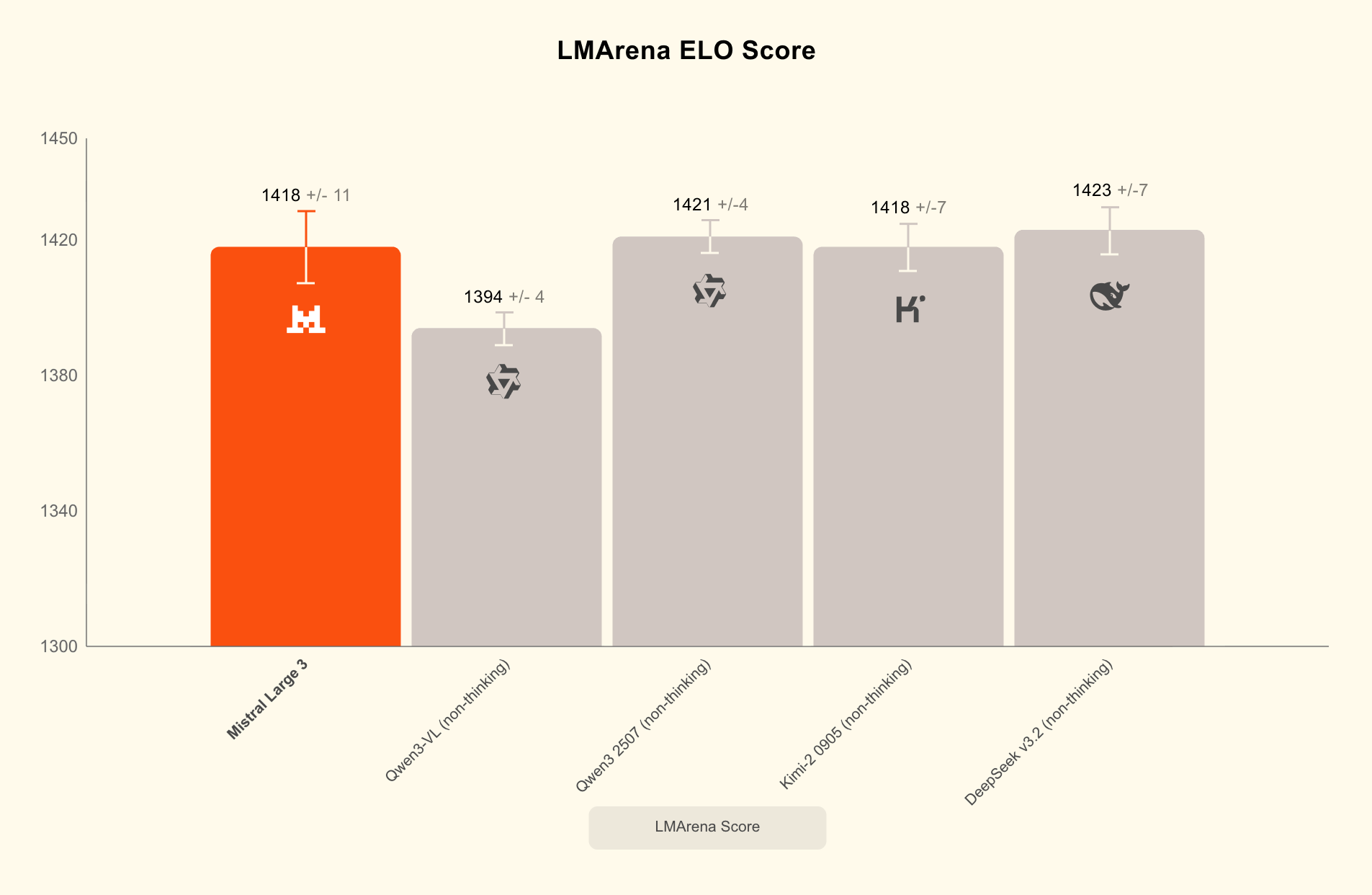
At the close of 2025, as major U.S. and Chinese large language models released updates, a third force—French AI startup Mistral AI—on Dec 2 launched the Mistral 3 model family. The release includes the flagship Mistral Large 3—a sparse mixture‑of‑experts (MoE) model with 675 billion total parameters—and nine efficient Ministral 3 small models spanning 3B, 8B and 14B parameter scales. The models are open‑sourced under the Apache 2.0 license, support multimodal (text+vision) and multilingual processing, and are designed to bridge the gap between open AI for enterprise and edge deployments. Mistral says Large 3 ranks second among open‑source non‑inference models on the LMArena leaderboard (sixth overall), delivering performance approaching OpenAI's GPT‑4o and Google’s Gemini 2 while costing about 80% of those alternatives. The move not only highlights Europe’s AI independence but could disrupt industries reliant on closed‑source APIs, drawing broad coverage from outlets such as VentureBeat and CNBC.
Mistral’s strategy stems from a dual focus on scale and efficiency. Founded in 2023 by former DeepMind and Meta researchers, the company raised $2.7 billion within two years and reached a valuation of $13.7 billion—placing it among Europe’s tech unicorns. Unlike U.S. giants, Mistral emphasizes an "open‑first" approach to avoid black‑box dependence. The Mistral 3 family is the embodiment of that strategy: Large 3 uses a fine‑grained MoE architecture, with 675 billion total parameters and 41 billion active parameters, supports a 256K context window and visual understanding, and is optimized for document analysis, coding, content generation and agent workflows. Training consumed 3,000 NVIDIA H200 GPUs and focused on non‑English and non‑Chinese multilingual data to ensure global applicability—what the company calls bringing "frontier AI" to billions of non‑English native speakers. The Ministral 3 line targets edge computing and offers Base (pretraining), Instruct (chat‑optimized) and Reasoning (logic‑optimized) variants that can run offline on a single GPU, a laptop, a robot or a drone, with context windows of 128K–256K. While the small models lag closed‑source rivals on initial benchmarks, Mistral stresses they can, after fine‑tuning, "match or exceed" GPT‑4o in enterprise scenarios.
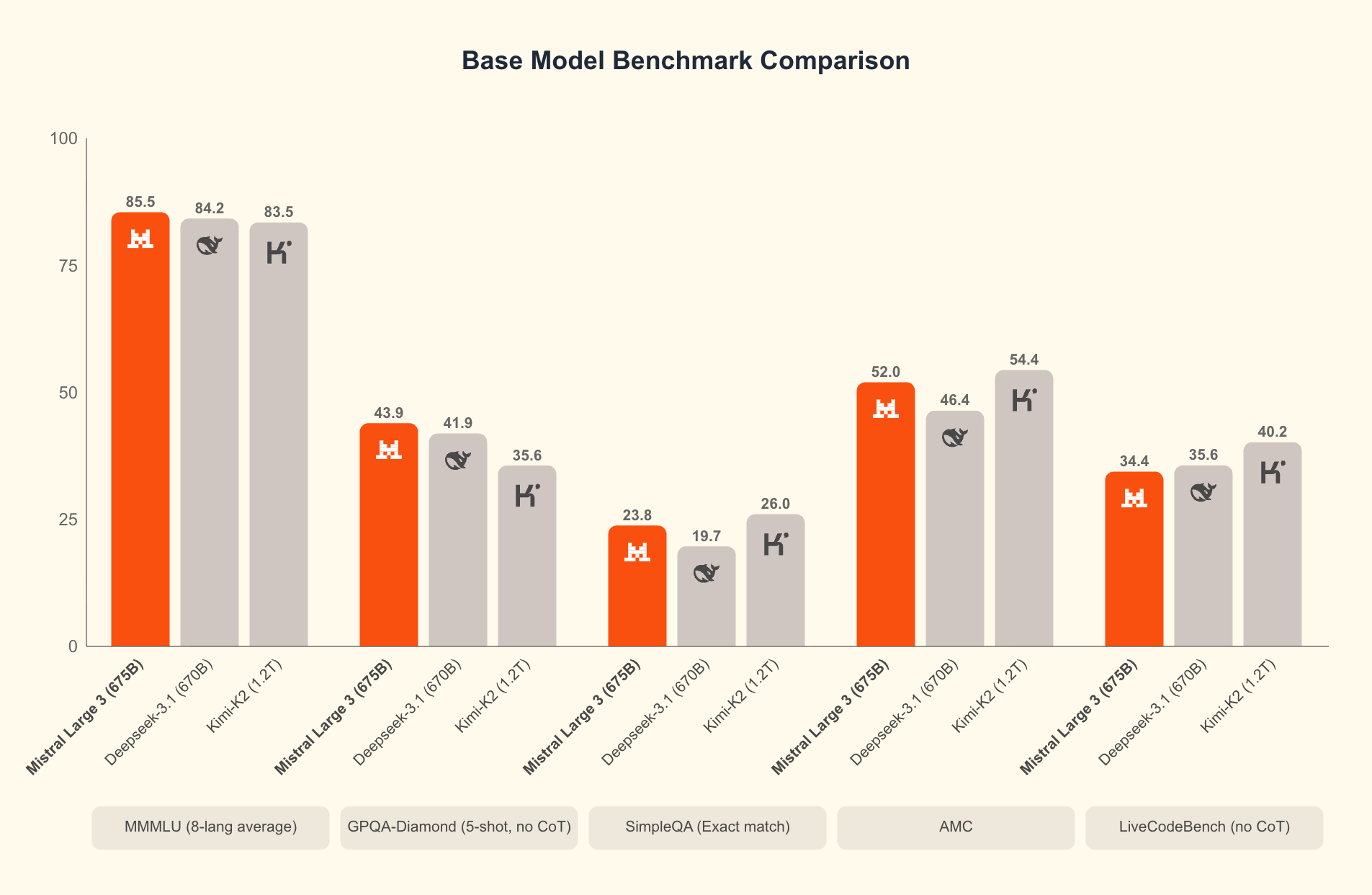
Benchmark data underscore Mistral’s ambitions. The company blog shows Large 3 matching top open‑source instruction models on general prompts and standing out in image understanding and multilingual dialogue. In comparisons by Artificial Analysis, Large 3 competes with a high‑end GPT‑5.1 Codex mini across intelligence, price, speed and context, with Mistral winning on cost (input $0.50 per million tokens, output $1.50 per million tokens). Medium’s analysis notes the Ministral 14B Reasoning variant achieved 85% accuracy in the AIME 2025 math contest, leading similarly sized open models. Versus Meta’s Llama 3 and Alibaba’s Qwen3‑Omni, Large 3 leads in multimodal integration, while Ministral 3 achieves 20–30% better token‑generation efficiency, reducing compute overhead. GetBind’s evaluation suggests the family is already suitable for mixed infrastructure enterprise deployment under complex reasoning and coding loads, though community testing is needed. Hacker News discussions praise real‑world results but flag stability under heavy load for further observation. NVIDIA’s developer blog adds that after optimization on GB200 NVL72, Large 3 delivered a 10x performance uplift, processing over 5 million tokens/sec per megawatt.
The release’s technical innovations extend beyond scale. Mistral Large 3 incorporates "post‑training optimizations," including instruction fine‑tuning and reinforcement learning, to improve agent tasks (such as retrieval‑augmented generation, RAG) and scientific workflows. Ministral 3’s visual capabilities extend to document parsing and chart analysis, applicable to robots (for example in collaboration with Singapore’s Home Team Science) and drones (in visual‑language‑action integrations with Helsing). CNBC reports Mistral sees this as a "new standard for global AI availability," unlocking potential for offline scenarios. Unlike closed models that depend on APIs, open weights permit local deployment, avoiding risks such as periodic outages. Co‑founder and Chief Scientist Guillaume Lample told TechCrunch: "Customers initially favored large closed models that required no fine‑tuning, but after deployment found them costly and slow, then turned to our small models—which often match or outperform closed models." He emphasized the open‑source mission is to "ensure AI is not monopolized by a few large labs, especially for users without reliable network access."
For the industry, Mistral 3 intensifies the tug‑of‑war between open and closed models. In 2025 open models moved from experiments to productivity: DeepSeek V3.2 and Llama 3 have already eaten into market share, while Mistral highlights a European perspective emphasizing multilingual support and privacy to sidestep U.S.‑China data barriers. On X, user @PaternalPath posted: "The open frontier just upgraded—Mistral 3 unlocks on‑device intelligence and multilingual agents." Another user, @NowadAIs, shared: "From 3B to 675B, 40+ language support, 80% cheaper." A Reddit r/LocalLLaMA thread comparing charts drew hundreds of upvotes. Still, challenges remain: Medium notes Large 3 still trails GPT‑4o and Claude 3.5 on absolute reasoning ability for complex tasks, and VentureBeat warns new releases require real‑world benchmarks to avoid hype exceeding reality.
Business impacts are significant. Mistral has partnerships with Stellantis for in‑vehicle AI and with Home Team on robotics, extending into physical AI. CNBC’s analysis says the family "opens new possibilities for enterprise agent workflows and edge applications," projecting open‑source market share could exceed 40% by 2026. X user @heardof_ai summarized: "Open‑source MoE enters production; agents can run on private infrastructure." For developers, the models are immediately available on Hugging Face and support deployment with vLLM, llama.cpp and Ollama. Mistral plans to release a dedicated inference variant of Large 3 to further close the gap with closed models.
The arrival of Mistral 3 is both a technical leap and a victory for open‑source principles. It shows that a small European team can challenge the giants on efficiency and helps turn the democratization of AI from slogan into reality. Developers are rushing to test whether this "675B magic box" can truly "catch up" to GPT‑4o—the answer will come from community evaluations. Regardless, an AI "European moment" has arrived.
Sources: