
 Amid the domestic large‑model competition during the Spring Festival period, MiniMax officially launched its latest flagship programming large model M2.5 on February 12, 2026, instantly igniting enthusiasm across the tech community and capital markets. As the world’s first production‑grade model natively designed for agent scenarios, M2.5 targets top international levels in programming and agent performance and is positioned against Anthropic’s Claude Opus 4.6. On launch day, MiniMax’s share price rose more than 20%, and market capitalization surpassed HK$180 billion, a new high. Meanwhile, Zhipu AI released GLM‑5 the previous day, also triggering market excitement; the two companies have been acclaimed as China’s “dual stars,” jointly advancing the country’s large‑model ecosystem from following to competing at the forefront. MiniMax’s move not only reinforces its standing in the open‑source AI ecosystem but also underscores domestic models’ global competitiveness in programming and agent domains. This event marks an acceleration of AI’s shift from a general‑purpose tool to a productivity revolution; below we analyze M2.5’s highlights and market impact.
Company profile: from SenseTime executives to a Hong Kong listing
MiniMax was founded in December 2021 by a team of former SenseTime executives and is headquartered in Shanghai. The company focuses on generative AI and large‑model development and raised funds quickly in its early stages: in October 2023 it secured RMB 250 million led by Alibaba and Tencent. In May 2024, a US$400 million round led by Saudi Prosperity7 Ventures pushed the company’s valuation to US$3 billion. MiniMax’s product line is known for open‑source and efficiency; its earlier model M2 was released on October 27, 2025, using an MoE (Mixture‑of‑Experts) architecture with about 10B active parameters/230B total parameters and offered advanced coding and agent capabilities.
In January 2026, MiniMax went public on the Hong Kong Stock Exchange, becoming the second Chinese LLM company to list after Zhipu AI. The IPO raised about HK$480 million (US$62 million), the stock doubled on the first day, and market capitalization climbed quickly. Paired with Zhipu AI as the “dual stars,” the two firms lead China’s open‑source model and API revenue landscape: Zhipu’s GLM‑5 and MiniMax’s M2.5 have each refreshed multiple benchmark records. MiniMax’s strategy focuses on agent scenarios and emphasizes production‑grade applications, complementing Zhipu’s broader return to foundational research.
Technical highlights of M2.5: MoE architecture and production‑grade agent design
M2.5 is built on an MoE architecture with total parameters around 200–230B and 10B active parameters, supporting local inference including quantized deployment on Apple Silicon M3 Ultra. The model is open‑sourced under the MIT license, allowing the community to use and modify it freely. Its core strengths are programming and agent capabilities: it supports full‑stack development across PC, mobile apps, and cross‑platform applications, excelling in advanced Excel processing, in‑depth research, and PPT generation. On WebDev leaderboards, M2.5 ranks near the top and approaches the overall performance of Gemini 3 Pro and Claude Sonnet 4.5.
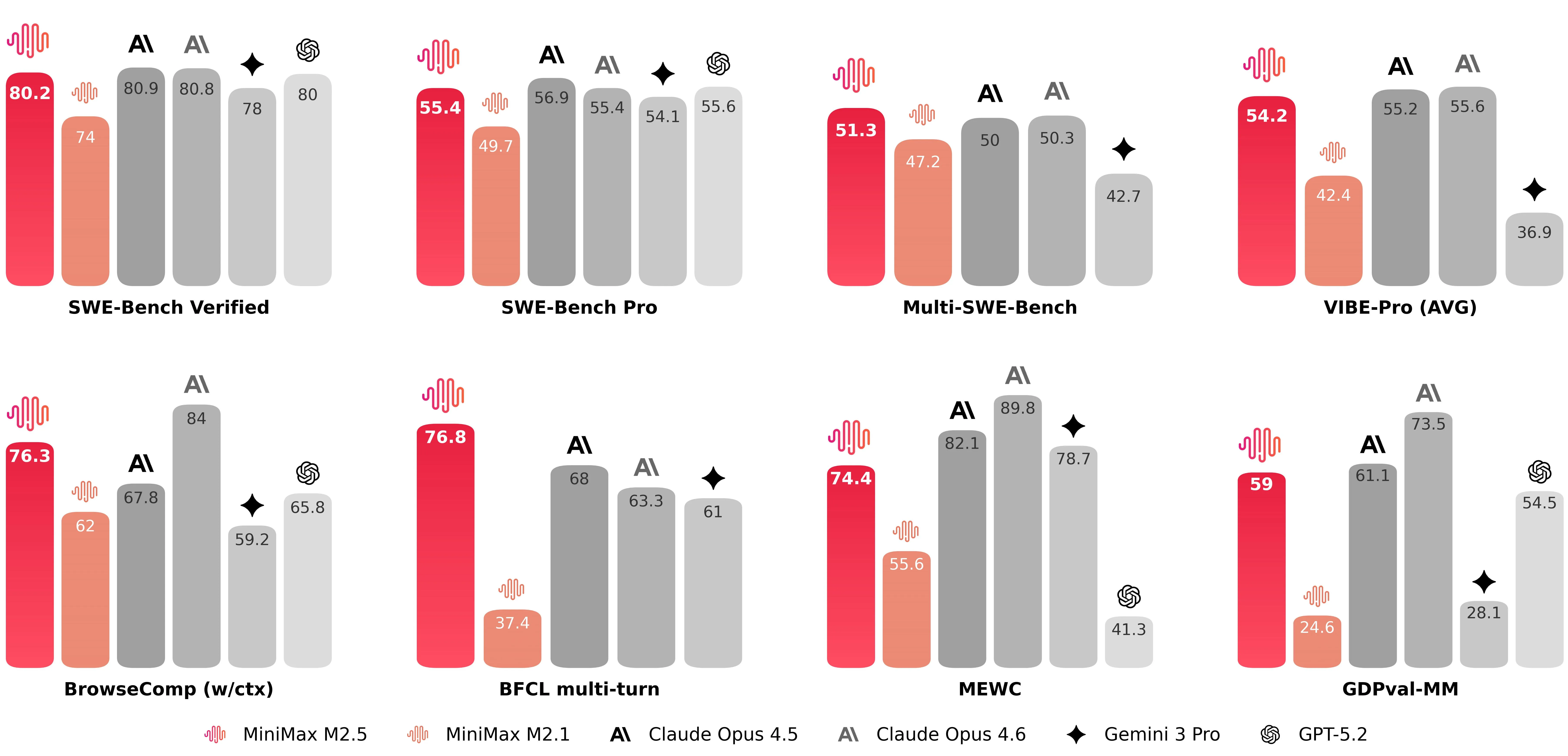
Programming capability is M2.5’s main selling point: the official claim is that it matches Claude Opus 4.6 in coding and agent tasks and achieves state‑of‑the‑art performance. The model supports a self‑directed multi‑agent group paradigm and can handle complex workflows such as automated code generation, bug fixing, and architecture optimization. Architectural details include full‑attention mechanisms, QK‑Norm, GQA, partial RoPE, and sigmoid routing to ensure efficient operation. It supports platforms including vLLM and Hugging Face for convenient deployment. API pricing is competitively positioned: M2.5‑Lightning input/output tokens are US$0.30/1M and US$2.40/1M respectively, with throughput up to 100 tokens/sec; M2.5 input/output token prices are halved and throughput can reach 50 tokens/sec. Pricing is comparable to Gemini 2.5 Flash and GPT‑5 Mini.
M2.5 emphasizes "cleverness in simplicity"; although outputs can sometimes be verbose, its efficiency and open‑source attributes have won praise. The Artificial Analysis Intelligence Index v3.0 rated it the highest intelligence index among open‑source models, with only 10B active parameters yet comparable to cutting‑edge closed‑source models.
Comparison with the previous generation: performance leap from M2 to M2.5
MiniMax’s previous‑generation M2 was released on October 27, 2025, using a 230B total‑parameter MoE architecture and providing advanced coding and agent modes, claiming to surpass Gemini 3 Pro and Claude Sonnet 4.5 at the time. M2 topped the Artificial Analysis open‑source rankings and supported local inference. M2.5 optimizes on this foundation: programming performance improved, the agent paradigm matured, and production‑grade scenarios are supported. Compared with GLM‑4.7, M2.5 is stronger on agent tasks while GLM‑4.7 leads in overall throughput. M2.5’s release fills M2’s gaps in deep research and office automation.
Market impact: skyrocketing market value and the domestic AI "dual‑star" pattern
After M2.5’s release, MiniMax’s stock rose more than 20% intraday and total market value surpassed HK$180 billion. This was driven by the model’s state‑of‑the‑art performance and open‑source strategy, attracting developers worldwide. Together with Zhipu AI’s GLM‑5 release on February 11, which has programming capability close to Claude Opus 4.5, the two companies have formed a "dual‑star" phenomenon: both listed in January 2026, with Zhipu up 13% on debut and MiniMax doubling. Recode China commented that this dual‑star pattern signifies China’s AI industry moving from catching up to running alongside global leaders.
The global impact should not be underestimated: MiniMax’s open‑source model promotes AI democratization and challenges incumbents such as OpenAI and Anthropic.
Outlook: an open‑source revolution and challenges for domestic AI
The release of M2.5 signals MiniMax’s push toward AGI. The company plans to deepen agent applications and expand into healthcare and education. Cooperation or competition with Zhipu will reshape the domestic AI ecosystem. Challenges include safety alignment and international regulation.
▶️ Enjoyed this article? Creating content is hard work!
Follow our YouTube channel:
AI Rosetta
Your likes, subscriptions and shares are our greatest support! 🙏
More AI news at:
https://www.airosetta.com