
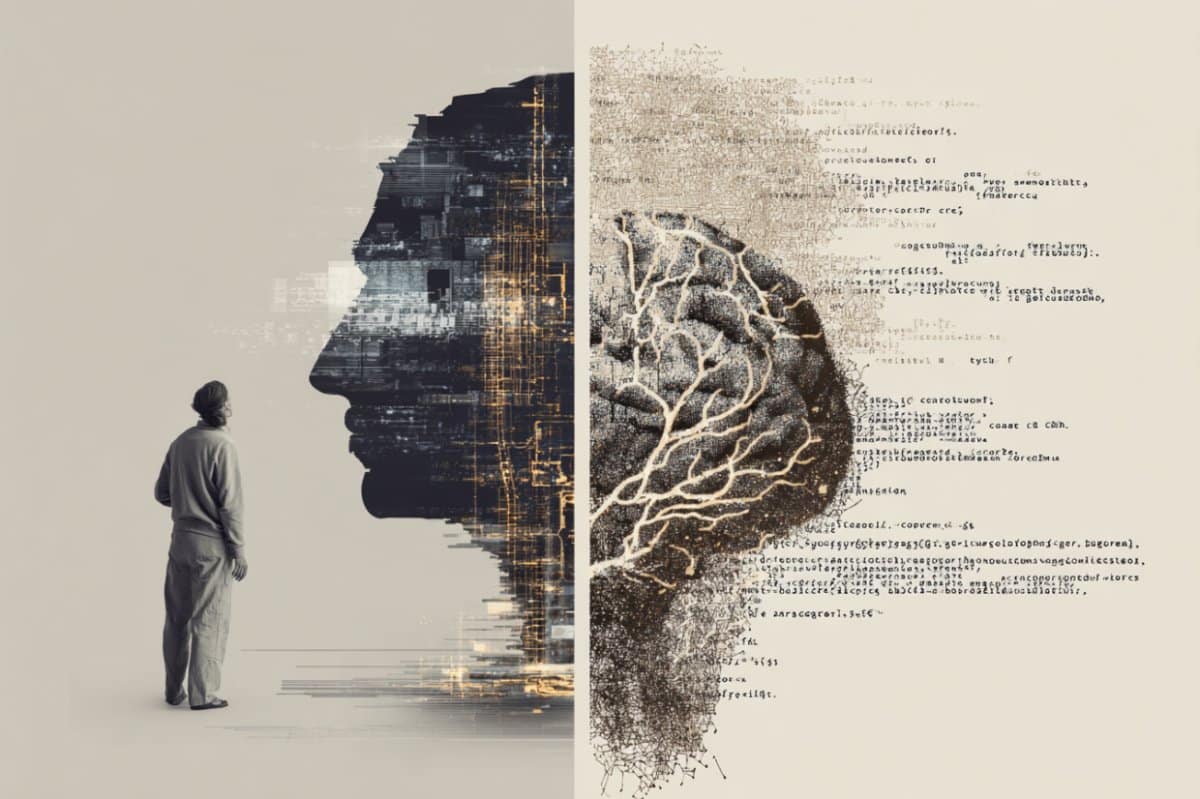
In November 2025, Neuroscience News reported a study that transcribes visual thought into text — the research team proposed a 'mind captioning' method that can generate accurate textual descriptions of images a person is viewing or recalling, without relying on conventional activation of language regions.
The experimental procedure is straightforward: subjects viewed large sets of images or recalled previously seen scenes while undergoing fMRI scans, and researchers recorded blood‑oxygen‑level signals from visual cortex and related perceptual areas. Instead of attempting to reconstruct sentences directly from language regions, they first mapped those brain‑activity patterns onto the representations used by visual‑language models (the pre‑trained image‑text embedding space). In other words, the team used deep visual models to capture semantic image embeddings and trained a "bridge" to project the brain's visual responses onto those embedding vectors, allowing a downstream text generator to produce natural‑language descriptions from the embeddings.
The key highlight is that the generated text accurately reflects objects, actions, and scene relationships rather than merely listing keywords. Experiments showed the system could produce descriptions for images being viewed as well as for scenes recalled by subjects — indicating the method taps into visual‑representation‑level information rather than word encoding in language production.
The authors documented training and validation in detail: they trained the visual‑language model with multiple sets of visual stimuli paired with text descriptions, then input subjects' fMRI data from viewing and recall tasks into the projection network. Evaluation used human annotators and automated similarity metrics to assess alignment between generated descriptions and ground‑truth content; under controlled experimental conditions the system produced highly readable sentences with strong semantic relevance.
But the team also emphasized several practical limitations: the current approach relies on fMRI, which has high spatial but low temporal resolution and limited portability, far from wearable, real‑time decoding; between‑subject variability in brain representations requires substantial individualized calibration, and cross‑subject generalization remains a challenge; moreover, model performance is limited for complex abstract scenes, emotions, or metaphorical memories.
The application prospects are attractive yet raise caution. In the short term, mind captioning could serve basic neuroscience research to dissect how visual representations map to semantics; in the long term it might help severely ill or aphasic patients express visual experiences in new ways. The authors also call for early ethical and societal discussion: brain‑data privacy, risks of non‑consensual reading, and legal and psychological consequences of externalizing thoughts require institutional responses.
The result elevates the combination of visual cognition and modern visual‑language AI models. The team said next steps include improving temporal resolution, reducing dependence on large scanners, and enhancing cross‑subject transfer. For younger audiences the work resembles sci‑fi "mind‑reading notebooks" — but researchers repeatedly warn it remains far from public availability and that more work is needed on reproducibility, safety, and ethics.