
May 13, 2026 — The AI security landscape has a new entrant: Microsoft’s Autonomous Code Security (ACS) team has officially launched MDASH (Multi‑Model Agentic Scanning Harness). The framework scored a high 88.45% on the authoritative CyberGym public benchmark, decisively outperforming Anthropic’s Claude Mythos Preview (83.1%) and OpenAI’s GPT‑5.5 (81.8%), and taking the top spot. This result not only marks a major Microsoft breakthrough in AI‑driven code security, but also highlights the clear advantages of “multi‑model agent collaboration” over a single leading model.
MDASH was developed by Microsoft’s security team and is already deployed in production. It helped Microsoft identify and remediate 16 Windows vulnerabilities during a recent Patch Tuesday, including four high‑severity remote code execution (RCE) flaws affecting critical components such as the TCP/IP kernel stack, IKEv2, the Netlogon service, and the DNS API library.
MDASH Implementation Details: 100+ Specialized Agents Working in Concert
Unlike single‑model solutions such as Anthropic Mythos and OpenAI GPT‑5.5‑Cyber, MDASH uses a multi‑model agent pipeline architecture with the following core attributes:
- More than 100 specialized AI agents: these agents operate across different stages, covering code comprehension, vulnerability hypothesis generation, static analysis, dynamic verification, adversarial debate, and exploitability proof‑of‑concept (PoC) generation.
- Hybrid model integration: it invokes both frontier models (e.g., the latest GPT/Claude series) and Microsoft’s own distilled models, using dynamic routing to combine their strengths.
- End‑to‑end agentic workflows: agents do not only find vulnerabilities but also generate working PoC exploit code and employ multi‑round “debate” mechanisms to reduce false positives. The system emphasizes reproducibility and aims for zero false positives (internally achieving 21/21 injected‑vulnerability zero false positives).
- Tight engineering integration: it is deeply integrated with Microsoft’s existing code repositories, fuzzing infrastructure, and security scanning pipelines to deliver “defense at AI speed.”
The CyberGym benchmark, developed by UC Berkeley, contains 1,507 real‑world vulnerability tasks drawn from 188 open‑source projects (based on Google OSS‑Fuzz). Tests require the AI system to produce a PoC that successfully triggers a vulnerability given the vulnerability description and an unpatched codebase. This benchmark closely mirrors real offense–defense scenarios and is among the strictest public standards for evaluating AI vulnerability discovery capabilities.
Microsoft’s security blog highlights that MDASH also shows very high recall on historical MSRC (Microsoft Security Response Center) cases, reaching 96%–100% detection capability on components such as clfs.sys and tcpip.sys.
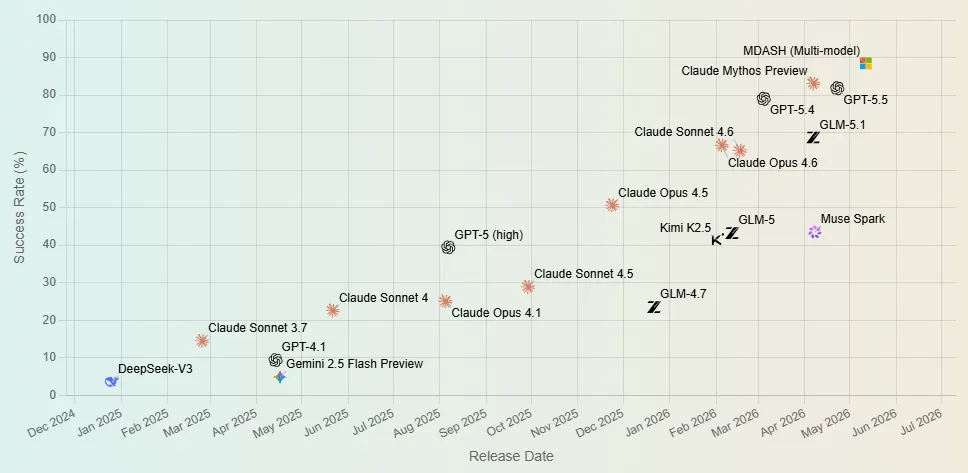
CyberGym benchmark scores over time, showing the rapid improvement in AI vulnerability discovery capabilities. Microsoft’s multi‑model MDASH system (top right) tops the leaderboard at 88.4%. (CyberGym / UC Berkeley)
Implications for Code Security and Industry
1. Multi‑agent architectures demonstrate clear advantages
MDASH’s success shows that for complex security tasks, a single oversized model is not necessarily optimal. By dividing labor, employing specialized agents, and integrating multiple models, multi‑agent systems outperform single models in accuracy, coverage, and interpretability. This paradigm shift could become the mainstream approach for future AI security tools, moving the industry from "prompt engineering" to "systems engineering."
2. Significant improvements in vulnerability discovery efficiency and quality
Traditional manual code review and conventional scanners struggle to cover massive codebases. MDASH can find high‑severity vulnerabilities that humans may miss in short timeframes, dramatically shortening the time from discovery to remediation. This is highly significant for Microsoft’s own product security and offers a replicable solution for other organizations. Similar frameworks may be integrated into DevSecOps pipelines to enable "security scanning on commit."
3. Accelerating the AI security arms race
Following Anthropic Mythos and OpenAI GPT‑5.5‑Cyber, Microsoft’s MDASH creates a three‑way competition among major providers. Heavy investment from the three vendors will accelerate industry progress, but it also increases the risk of "offense–defense asymmetry"—as defensive capabilities improve, offensive capabilities may also grow. Ensuring these powerful tools are used primarily for defense rather than abuse will become a regulatory focus.
4. Benefits for open‑source communities and SMEs
MDASH is currently in a limited private preview, but Microsoft has stated it will expand access over time. The open‑source community could adopt the multi‑agent design approach to develop more accessible code‑security tools, helping narrow the security capability gap between large enterprises and small‑to‑medium organizations and improving the overall security of the global software supply chain.
5. Broader societal and regulatory impacts
AI breakthroughs in code security speed the arrival of "defense at machine speed," but also introduce new challenges: model biases, risks of false positives/negatives, and potential misuse of powerful tools. Regulators (such as the UK’s AISI and the US CISA) may tighten access controls and auditing requirements for high‑capability AI security tools. This episode also underscores that AI security is not only a technical issue but one of governance and responsibility.
Conclusion: The Multi‑Agent Moment for AI Code Security
Microsoft’s launch of MDASH is another milestone in AI’s deep penetration into vertical security domains. By coordinating multiple model‑driven agents, it has reset the CyberGym benchmark record and offered a new paradigm for code security practice.
As software vulnerabilities grow more complex and attack surfaces expand, tools like MDASH make it possible for defense to outpace offense. With the maturation of multi‑agent architectures and wider adoption by other companies, AI‑driven security may become a standard part of software development.
Microsoft’s effort not only strengthens the security of its own products but also helps fortify global digital infrastructure. In the intensifying AI security competition of 2026, MDASH’s debut clearly injects significant new momentum into the race.
▶️ Enjoy this article? Content creation is hard!
Follow our YouTube channel:
AI Rosetta
Your likes, subscriptions, and shares are our greatest support! 🙏
For more AI news visit:
https://www.airosetta.com