
In the age of artificial intelligence, changes to the workplace have become an irreversible trend. In early 2026, a Microsoft study sparked global discussion: generative AI (such as ChatGPT and Copilot) is quietly permeating industries and affecting millions of jobs. Based on analysis of real user data, the report finds language‑intensive and information‑processing occupations are the most exposed, but AI is not an "employment killer" so much as a "productivity booster." The report not only lists the 40 jobs most exposed to AI, it also explains how AI raises overall efficiency through task automation and augmentation. At the same time, recent research from Goldman Sachs, the Brookings Institution and MIT indicates AI could reshape the global labor market over the next decade, driving productivity gains of more than 15% while also causing localized job displacement and skill gaps. How will this AI revolution change your work? Let’s take a closer look.
Key findings from Microsoft: an AI applicability ranking
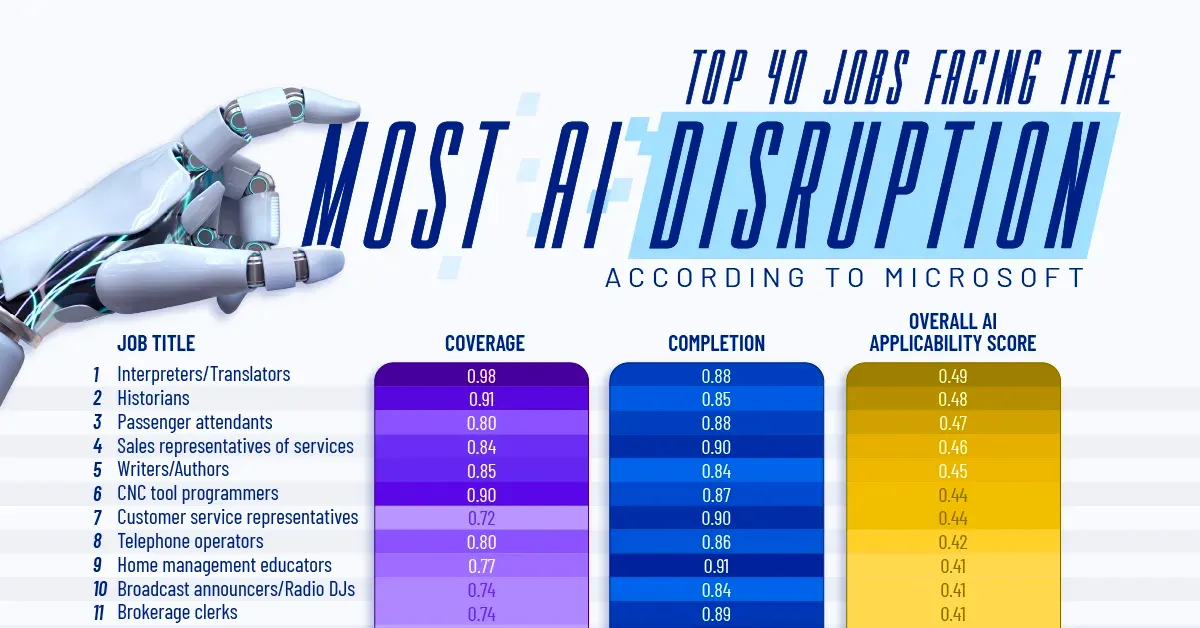
Microsoft’s research team analyzed more than 200,000 anonymized Copilot conversations between January and September 2024 to evaluate AI performance on real tasks. They introduced three key metrics: task coverage (how often AI handles tasks for that occupation), completion rate (AI success rate), and an overall AI applicability score (a composite measure). A higher score means tasks in that occupation are easier for AI to assist with or complete, though not necessarily fully replace. The report covers 40 occupations and reports an average completion rate of 87%, showing strong AI performance on most tasks.
The top ten occupations are mostly knowledge‑intensive and communication‑oriented:
- Interpreters and Translators (applicability score 0.49): coverage 0.98, completion rate 0.88. Tools like Copilot excel at real‑time translation and language processing.
- Historians (0.48): coverage 0.91, completion rate 0.85. AI excels at research and summarizing historical data.
- Passenger Service Agents (0.47): coverage 0.80, completion rate 0.88. Involves information provision and customer interaction.
- Service Sales Representatives (0.46): coverage 0.84, completion rate 0.90. AI can automate sales scripts and customer inquiries.
- Writers and Authors (0.45): coverage 0.85, completion rate 0.84. Generative AI can assist with content creation.
- CNC Tool Programmers (0.44): coverage 0.90, completion rate 0.87. Programming tasks can be optimized by AI.
- Customer Service Representatives (0.44): coverage 0.72, completion rate 0.90. Chatbots are already widely deployed.
- Telephone Operators (0.42): coverage 0.80, completion rate 0.86. Automated response systems are mature.
- Farm and Home Management Educators (0.41): coverage 0.77, completion rate 0.91. AI can generate educational content.
- Broadcast Announcers and Radio DJs (0.41): coverage 0.74, completion rate 0.84. AI aids scriptwriting and content recommendation.
These occupations share standardized tasks and language dependence. By contrast, physically demanding or real‑time judgment roles such as machine operators or caregivers show lower exposure since AI struggles with physical environments and complex interpersonal interactions. Microsoft emphasizes that AI applicability does not equal job disappearance but task transformation: for example, writers can use AI for brainstorming and focus more on creative output.
Why AI exposure occurs: from automation to augmentation
Why are these occupations most exposed? Generative AI performs strongly on information gathering, writing, teaching and consulting tasks. For example, nearly half of a translator’s tasks can be handled by AI since models like GPT can generate multilingual content in real time. Historians rely on large‑scale data analysis, and AI can accelerate summarization and hypothesis generation. In customer service, AI chatbots already handle more than 70% of simple queries, improving efficiency.
However, the report does not paint a doomsday scenario for jobs. Microsoft notes AI is more likely to "augment" than to "replace." A study from the Upwork online labor market found that after adopting generative AI, independent workers’ productivity and client satisfaction rose while churn declined, with novices benefiting most. MIT research also shows that when AI affects only a subset of tasks, employment in that occupation can grow by 6% and sales by 9.5%. This suggests AI can free workers from repetitive tasks and allow humans to focus on higher‑value work, such as strategic decision‑making or innovation.
From a broader perspective, the Brookings Institution estimates 85% of workers will have at least 10% of tasks affected by AI, and 30% will face more than 50% task disruption. High‑paying occupations (STEM, finance, legal) are most exposed because tasks are highly digitized. In contrast, low‑skill physical jobs like logistics mechanics show nearly zero exposure.
Global employment impact: opportunities and challenges
The employment shock from AI is not a new phenomenon. History shows technological revolutions, like the internet, replaced some jobs but also created new opportunities. Goldman Sachs predicts generative AI could displace 300 million full‑time jobs globally while boosting productivity in developed countries by 15% and increasing unemployment by only 0.5%. The U.S. Bureau of Labor Statistics (BLS), in its 2023–2033 employment projections, notes AI will accelerate automation but roles such as software developers and financial advisors may grow by more than 17%, well above the 4% average.
Positive effects are significant: a Wharton model indicates high‑exposure occupations may see short‑term declines, but the overall economy could grow by 0.75% driven by AI. The World Economic Forum stresses AI can "enhance" jobs—for example in logistics, automation of administrative roles shifts demand toward technical skills. McKinsey’s analysis of the New York region suggests AI could transform 1.1 million jobs by 2030 while producing a net increase of 700,000 positions, mainly in healthcare, engineering and construction.
Challenges remain. Stanford research shows employment declines in high‑exposure roles in 2024, especially among younger white‑collar workers. The International Labour Organization (ILO) warns that skill gaps in developing countries could exacerbate inequality. Additionally, AI bias and data privacy issues require vigilant oversight.
Response strategies: upskilling and policy safeguards
Facing the AI wave, individuals and companies must proactively adapt. An ADP survey shows most workers expect AI to affect their jobs but opinions vary: some see opportunity while others fear job loss. Experts recommend improving AI literacy, such as learning prompt engineering or data analysis. Employers can deploy training and change management to ensure AI enhances employee experience.
On the policy front, the OECD calls for stronger AI regulation and retraining programs. U.S. budget research to date shows AI has not caused mass unemployment, but ongoing monitoring is essential.
Outlook: a new workplace ecosystem in the AI era
Generative AI is not an apocalyptic prophecy but a catalyst for workplace evolution. Microsoft’s report reminds us technological change brings growing pains, yet history proves human adaptability. By 2030, AI could reshape 40% of global work hours while creating new roles like AI ethicists and data curators. The key is balance: let AI serve humanity, not the other way around. Whether you are an interpreter or a programmer, this revolution invites you to take part—are you ready to upskill and embrace the future?
▶️ Enjoy this story? Creating it takes a lot of effort!
Subscribe to our YouTube channel:
AI Rosetta
Your likes, subscriptions, and shares are our greatest support! 🙏
For more AI news visit:
https://www.airosetta.com