

On November 24, 2025, Microsoft released Fara‑7B, an experimental on‑device AI agent positioned for "computer‑use" scenarios. The company defines it as an intelligent agent that can run directly on a personal PC, able to read local files, drive applications, automate workflows, and complete complex tasks without sending data to the cloud.
The core highlight of Fara‑7B is "local execution." Microsoft emphasizes that sensitive workflows can be completed on the device — from opening and editing documents and running scripts to automating repetitive cross‑application operations — with all inputs and outputs remaining on the user’s machine. Microsoft summarized this as: it "runs locally on PCs, enabling automation of sensitive workflows without data ever leaving the device."
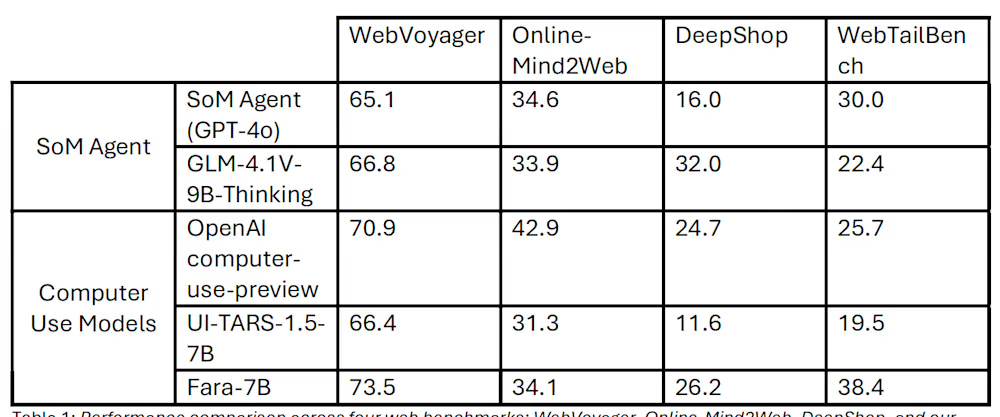
From a technical perspective, Fara‑7B belongs to a family of relatively small‑parameter models optimized for tool use; Microsoft claims the model can compete with GPT‑4o on many tasks oriented to computer operation. In official demos, Fara‑7B automatically completed multi‑step desktop tasks: reading a local CSV, searching and scraping data in a browser, invoking system‑level commands to process results, and then writing analysis back into a spreadsheet — the entire process without a cloud relay.
The key to enabling these capabilities is the agent’s "action interface" design. Fara‑7B does more than generate text; it can issue system commands (such as opening files, running programs, or calling local APIs) and update subsequent steps based on returned status. Microsoft highlighted security and permission controls; in the demo, all sensitive operations required user authorization and could be rolled back or audited in an isolated execution environment.
Regarding system requirements, Microsoft says the agent is targeted to personal PCs equipped with a discrete GPU or a modern CPU, and that specific performance and available features will vary with device capability. Compared with models that require large‑scale cloud inference, Fara‑7B has inherent advantages in latency and privacy, but gaps remain before it can fully replace cloud services for the general reasoning capabilities of very large models.
The arrival of Fara‑7B reflects growing demand for "local intelligence": businesses and individuals increasingly want AI capabilities on the desktop without sacrificing privacy. Microsoft positions this agent as part of a broader AI ecosystem that can complement cloud‑based Copilot‑like services and provide solutions for scenarios with high confidentiality requirements.
For younger developers and tech enthusiasts, the biggest attraction is the orchestration of automation and the creative freedom of local data processing. Whether automatically organizing portfolios, creating personal workflow assistants, or debugging privacy‑constrained applications locally, Fara‑7B opens new possibilities.
However, whether it can truly "rival GPT‑4o" will depend on more independent evaluations and real‑world feedback: differences between smaller models and very large models remain significant in broad commonsense reasoning, multilingual support, and long‑term memory. Microsoft’s message points the way: bring higher‑order "tool‑use" capabilities to local devices so AI not only speaks but also operates your computer.
Fara‑7B is an important step toward localized, controllable AI. It offers a practical path for privacy‑sensitive automation while reminding developers and users to pay attention to device capability, permission management, and auditing mechanisms — the practical details of deployment.