
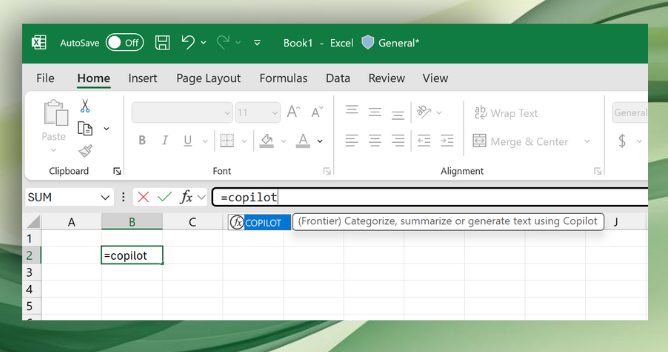
Microsoft in August 2025 unveiled a major upgrade for its Excel spreadsheet: a new feature called "Copilot" that embeds artificial intelligence (AI) into cell‑level operations, allowing users to generate and process data through natural‑language prompts and fundamentally changing traditional spreadsheet workflows.
Traditionally, Excel users have had to manipulate data with complex formulas and functions, but Copilot makes the process more intuitive and interactive. For example, a user can type a command in a cell such as "analyze sales trends for these two quarters" or "generate a forecast based on 2024 data," and the AI will immediately perform calculations and analysis and render the results into the specified cells, saving significant time on manual operations.
How does Copilot work?
Copilot integrates Microsoft's large language models with Excel's core calculation engine. When a user enters a natural‑language prompt, the feature parses the intended operation, automatically generates the corresponding Excel formulas or data‑processing logic, and inserts dynamic content directly into the spreadsheet cells to display real‑time results. Feedback and data obtained can also be used to further refine responses and processing accuracy, creating a closed‑loop intelligent experience.
Detailed use‑case demonstration
In Microsoft's demo, a financial analyst types "summarize last quarter's regional sales data and calculate growth percentages" into an empty cell. The system immediately pulls relevant data from existing sheets, runs aggregation and calculation functions, and outputs the results and growth rates in a concise table at the target location—without writing any formula code. Users can then refine the generated output with follow‑up requests, such as "highlight regions with growth over 10%," and Copilot will intelligently filter and mark the important information based on the prior result.
Copilot also supports complex pivot operations, trend forecasting, and text generation. For marketing teams, members can call on the AI within cells to draft short reports, distill key insights, or craft data‑driven strategic recommendations. This integrated workflow blurs the boundary between traditional software and an AI assistant.
Microsoft's strategic positioning
This update is part of Microsoft's broader effort to advance intelligence across Office 365, aligned with its Azure cloud AI services and the wider Copilot product family. Microsoft says it will continue to expand Copilot's applicability and interaction experience, with plans to bring the same AI capabilities to other Office apps such as Word and PowerPoint to build a cross‑product AI ecosystem.
GeekWire reported that Microsoft is focusing on making AI feel native within the familiar Excel environment, aiming to lower the barrier to AI adoption so ordinary professionals can handle complex data tasks. This approach contrasts with many standalone AI tools on the market and reflects Microsoft's design goal of "bringing intelligent productivity to the mainstream."
What younger users will notice
For younger digital natives, Excel Copilot offers an attractive interaction innovation. Without writing obscure functions, users can perform analysis and create content through typed dialogue—ideal for subculture groups and beginners to get started quickly, while also helping professional users gain faster data insights.
Early testers reported that "Copilot makes complex business data translate into clear insights very easily, significantly boosting work efficiency, like having a professional data analyst available at all times." Microsoft emphasizes that privacy, security, and operational transparency are core principles in Copilot's design to ensure enterprise and personal data remain protected.
By injecting AI intelligence directly into cell operations, Microsoft Excel's new Copilot feature ushers in a new era of human‑computer interaction. As the functionality continues to expand and improve, this intelligent assistant may become an essential tool for digital work, empowering millions of users worldwide to unlock the potential of their data and transform how they work.