
On September 2, 2026, Meta Platforms officially released its most powerful AI model to date, Muse Spark 1.3. The model is designed to extend agent workflows and enhance coding capabilities, and is now available in Muse Code and the Meta Model API. Meta Chief AI Officer Alexandr Wang said Muse Spark 1.3 surpasses OpenAI's GPT‑5.6 Sol in coding ability and performs on par with Anthropic's Claude Fable 5.1, reaching state‑of‑the‑art overall.
Details: Capability Upgrades and Efficiency Optimizations
Muse Spark 1.3 is the latest iteration of the Muse series (the 1.2 version was released about a month earlier), focusing on two main areas:
- Long‑horizon agent workflows
The model is designed to collaborate with users within a single long thread, handling multiple workflows in parallel. When faced with open‑ended goals, it can proactively use tools to construct context from messy or conflicting information sources, repair planning gaps, and continuously track learned content to deliver complete results. This capability directly serves Meta's long‑term vision for "personal agents" that can act on a user's behalf 24/7.
- Coding capabilities
Additional training was applied for longer‑horizon coding tasks to improve usability in common engineering workflows. Compared with version 1.2, the model is more restrained in unnecessary turns, produces more concise outputs, and yields cleaner code style. Meta engineers report about a 20% reduction in tool calls, roughly 25% lower token consumption, and faster, more efficient runs.
On public benchmarks, Muse Spark 1.3 (max variant) performed strongly across coding and agent tests: DeepSWE v1.1 scored 75.4 (surpassing GPT‑5.6 Sol's 73 and Opus 5's 74), Terminal‑Bench 2.1 reached 88.8 (on par with GPT‑5.6 Sol), and SWEAtlas CodeBase QnA and other tests were leading or near state‑of‑the‑art. Long‑context retrieval (MRCR) was particularly strong. On the Artificial Analysis Intelligence Index, the max variant scored 62, trailing Claude Fable 5.1 and Opus 5.
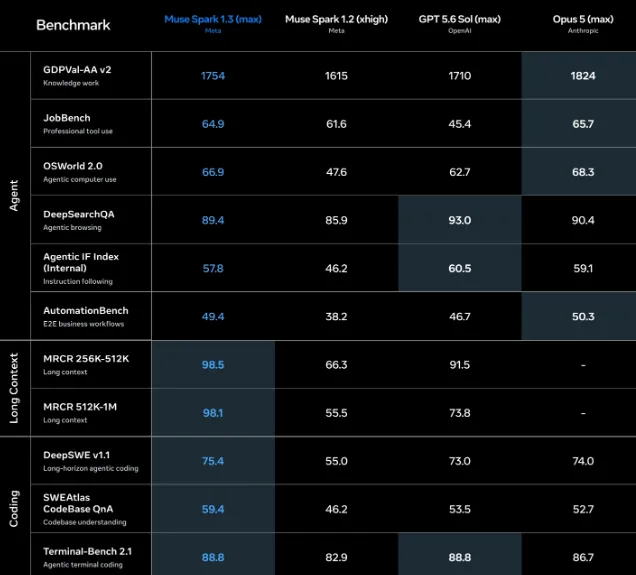
The model supports a 1,000,000‑token context window and is priced similarly to the previous generation (standard tier roughly $1.25 per million input tokens and $4.25 per million output tokens, with substantial discounts for caching). Meta also offers a lower‑priced "contributor" tier that permits Meta to use contributed data to improve the model. The Max inference mode will be released after additional safety testing.
Technical and Market Background
The Muse Spark series is led by Meta Superintelligence Labs and accelerated after Alexandr Wang (former Scale AI founder) became Chief AI Officer. The series has been iterating rapidly since mid‑2026 to close gaps with leading closed‑source models. The 1.3 release coincides with Anthropic Fable 5.1 and other labs' intensive updates, reflecting intense industry competition.
Meta emphasizes the model has reached a frontier of being "almost too cheap to meter," and plans to gradually integrate capabilities into Facebook, Instagram and Meta AI products.
Potential Impact: Meta's Return to Cutting‑Edge Competition and Ecosystem Positioning
1. Impact on Meta itself
Muse Spark 1.3 marks Meta's entry into the first tier on coding and agent tracks. Strong cost‑effectiveness and efficiency gains should attract developers to Muse Code and the API, and lay the groundwork for upcoming personal agent products. Rapid iteration also indicates returns on the company's organizational and compute investments.
2. Impact on the AI model competitive landscape
Against OpenAI and Anthropic's continued leadership, Meta achieving parity with cost advantages may intensify price and efficiency competition. Developers will gain more high‑value, lower‑cost options—particularly for long‑horizon coding and agent workflows. If Meta advances its previously indicated open‑weight plans, that could further affect the open‑source ecosystem.
3. Impact on agent deployment and application adoption
Stronger long‑horizon maintenance and reduced token consumption directly lower deployment costs and latency for complex agents, supporting scaled use in office automation, software engineering assistance and personal assistant scenarios. Combining these models with social products may also enable new consumer‑grade agent experiences.
4. Potential challenges and watch points
Stability in production, hallucination control and safety alignment still require ongoing validation. The delayed rollout of Max inference mode and regional availability differences may affect early adoption. A full, comprehensive comparison with Fable 5.1 and GPT‑5.6 Sol awaits more independent third‑party evaluations.
Industry Takeaway: Cost‑Effectiveness Becomes the New Battleground
The release of Muse Spark 1.3 demonstrates Meta's ability to rapidly narrow the gap with top labs. By focusing on coding and long‑horizon agents while maintaining aggressive pricing, Meta is pursuing a path of "good‑enough top performance, lower cost, faster iteration." As generative AI moves into practical deployment, pursuing the absolute highest score is no longer the only strategy; efficiency, cost and fit to real scenarios are increasingly crucial.
Alexandr Wang's emphasis on "competitiveness" and laying the groundwork for personal agents signals Meta's intent to convert model advantages into product and ecosystem strengths. Subsequent user feedback, independent benchmark reproductions and integration progress with social platforms will determine whether this catch‑up leads to sustained leadership.
The model is now available; developers can experience its coding and agent capabilities directly in Muse Code and via the API.
▶️ Enjoyed this piece? Creating content is hard!
Follow our YouTube channel:
AI Rosetta
Your likes, subscriptions and shares are our greatest support! 🙏
More AI news at: https://www.airosetta.com