
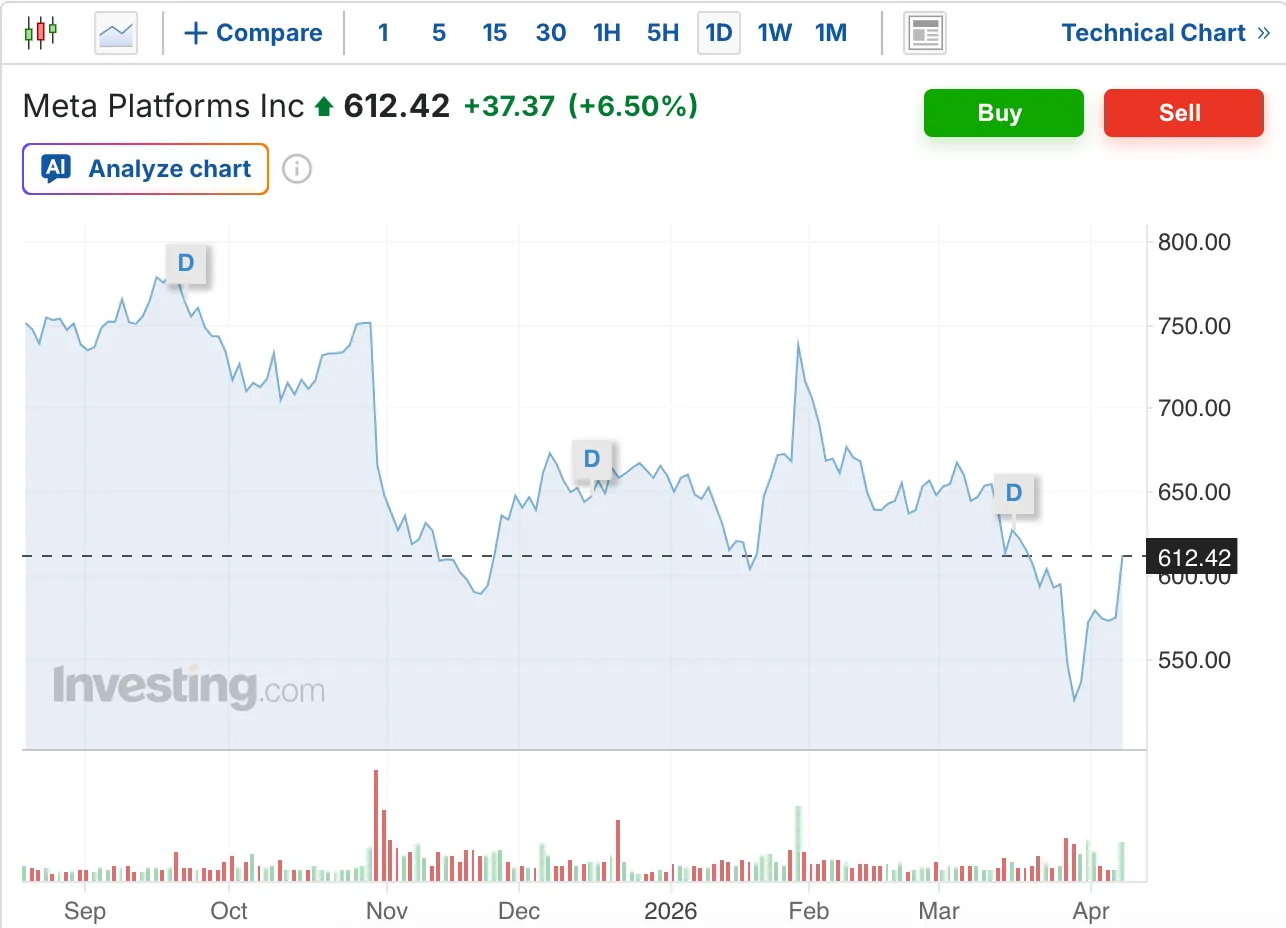
On April 8, 2026, Meta Superintelligence Labs (MSL) officially launched its first large language model since the lab's formation nine months ago—Muse Spark. Although Meta characterizes it as a "small and fast" foundation model, Muse Spark has demonstrated remarkable capabilities on complex tasks in scientific reasoning, mathematics and health, with some key metrics reaching or approaching current SOTA (State‑of‑the‑Art) levels. The release is viewed as a significant turning point in Meta's AI strategy: moving from the previously open‑source‑focused Llama series toward a dual track that includes closed‑source frontier models, initiating a new phase of "open‑access benefits + closed high‑end" coexistence. After the announcement, Meta's share price rose as much as 11% intraday and closed up more than 6%.
MSL was led and assembled by former Scale AI CEO Alexandr Wang in July 2025, with Meta investing heavily to recruit top talent and aiming to build a "personal superintelligence." Muse Spark is the lab's first product, internally codenamed "Avocado." Earlier reports said the project was delayed due to performance shortfalls; its debut as Muse Spark indicates substantive progress in model training, alignment and inference optimization at Meta.
Key highlights of Muse Spark: strong reasoning under an efficient architecture
Meta describes Muse Spark as a "small and fast" model, but its performance exceeds what its parameter count might suggest. On several challenging benchmarks, Muse Spark performed strongly:
- Scientific and mathematical reasoning: It scores significantly ahead on expert‑level scientific reasoning tasks such as GPQA Diamond, handling multi‑step complex reasoning and cross‑domain knowledge integration.
- Health and professional domains: It shows strong capabilities on medical and biology vertical benchmarks, with some metrics approaching or surpassing larger closed‑source models.
- Tool use and multi‑agent coordination: It supports visual chain of thought and multi‑agent orchestration, making it suitable for complex real‑world tasks.
- Efficiency advantages: While maintaining high performance, its compute consumption is substantially lower than comparable models, reflecting Meta's optimizations in "intelligence per parameter."
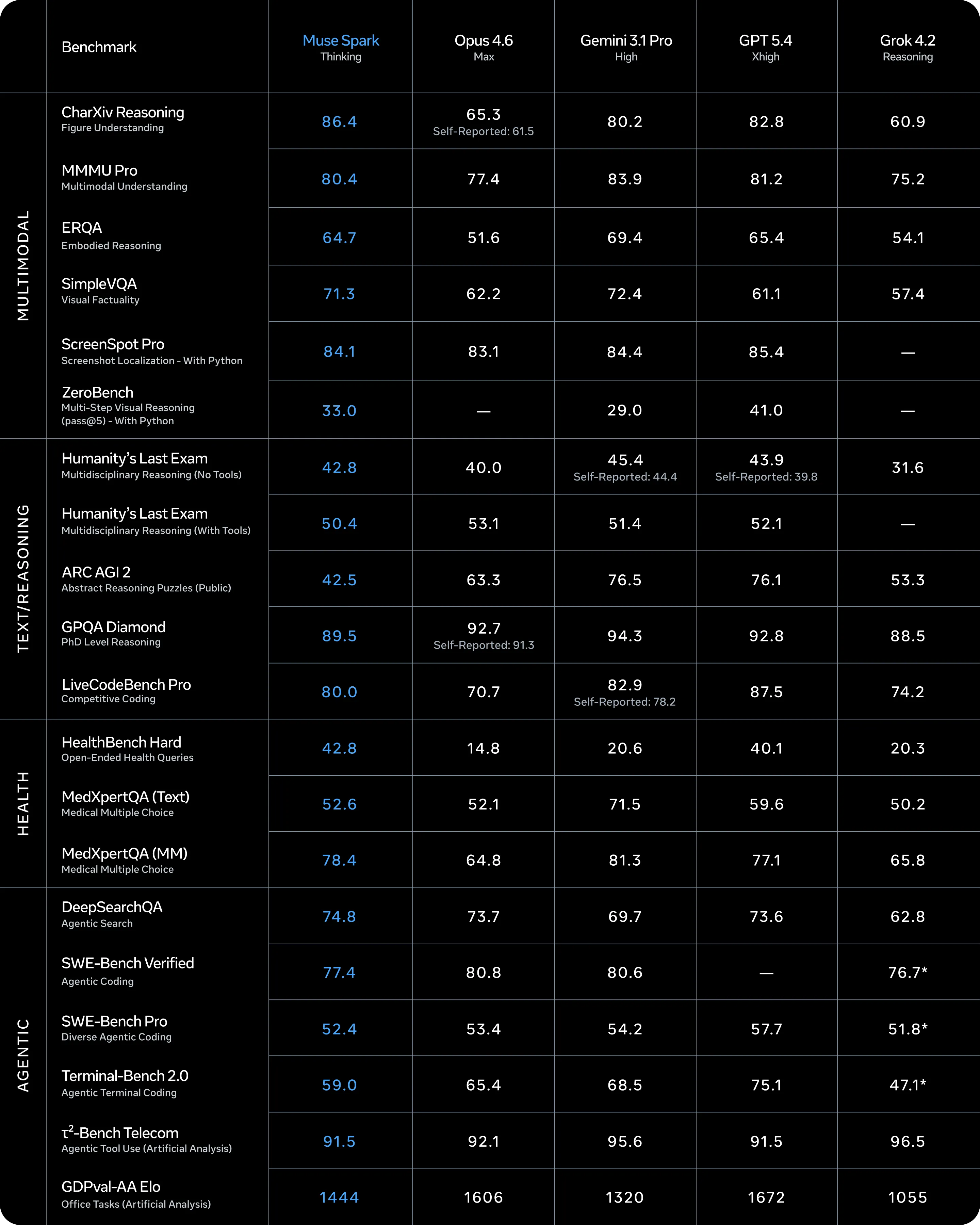
Unlike Meta's previously emphasized open‑source Llama series, Muse Spark adopts a closed‑source strategy, with weights and full training details not publicly released. The model has already been integrated into the Meta AI Assistant to improve dialogue quality, tool calling and complex problem solving, and Meta plans to offer a private preview API to select enterprise partners.
Nine‑month rapid iteration: early results of MSL's reorganization
The swift formation of MSL and the release of Muse Spark demonstrate Meta's efficient consolidation of AI talent and resources. After the release of Llama 4 in 2025, Meta conducted a major internal reorganization, concentrating top AI talent at MSL with Alexandr Wang as Chief AI Officer. Completing the transition from team formation to a frontier‑model release in just nine months indicates Meta has developed mature systems for compute scheduling, training workflows and alignment techniques.
Meta CEO Mark Zuckerberg has repeatedly stated that AI will be a core driver for the company over the next decade. The launch of Muse Spark not only fills Meta's gap in closed‑source high‑end models but also provides stronger foundational capabilities for its AI assistant and enterprise services, with potential to significantly enhance user experience and monetization.
Strategic shift: parallel open‑source and closed‑source tracks
Muse Spark's closed‑source positioning marks a clear adjustment in Meta's AI strategy. Previously, Meta's full open‑sourcing of the Llama series built significant influence in the global developer community. As AI competition advances into higher‑level reasoning and the agent era, Meta appears intent on preserving open‑source advantages while using closed‑source models to capture the high‑end market and technical strongholds.
This approach differentiates Meta from closed‑source leaders like OpenAI and Anthropic, and positions Muse Spark to more directly compete with Google's Gemini series. Analysts say the move enables Meta to maintain the vitality of the Llama open ecosystem while using closed models like Muse Spark to pursue higher‑margin enterprise AI services, achieving a balance between broad accessibility and premium offerings.
Industry impact: further polarization of the AI competitive landscape
The release of Muse Spark has multiple implications for the global AI landscape:
- Intensified competition: By advancing on both open and closed tracks, Meta further compresses competitors' room. The Llama series will continue to serve a wide developer base, while Muse Spark targets enterprise users that demand higher security and advanced reasoning.
- Accelerated technical iteration: Achieving SOTA‑level metrics in some areas demonstrates Meta's entry into the first tier for reasoning capabilities, likely prompting faster model updates from OpenAI, Anthropic and Google.
- Opportunities and challenges for the open‑source community: The Llama series will remain a core open‑source force, while Muse Spark's closed design offers enterprises a higher barrier option. Meta may explore more hybrid models of "open foundational models + closed enhanced services."
- Security and ethics debate: As a frontier model, Muse Spark's closed‑source design has triggered industry discussion about capability diffusion. Meta emphasizes multiple built‑in safety mechanisms and plans to work with governments and security experts to establish responsible deployment norms.
Outlook: Muse series may open a new chapter for Meta AI
Although Muse Spark starts as a "small model," Meta has stated plans to release larger Muse‑series models aimed at realizing a more complete "personal superintelligence." As capabilities iterate and APIs are gradually opened, Muse Spark could play a central role in Meta AI Assistant, enterprise services and multi‑agent systems.
From the open‑source surge of the Llama series to the closed‑source breakthrough of Muse Spark, Meta has completed a significant strategic adjustment in nine months. This reflects Meta's clear assessment of the AI competitive landscape and its strength in talent, compute and engineering execution.
At a critical junction as AI evolves from general chat to professional reasoning and agents, Muse Spark's launch provides the industry with a new example: open‑source and closed‑source need not be mutually exclusive, but can complement each other strategically. Whether Meta can maintain leadership with a dual‑track approach will depend most directly on the performance of subsequent Muse releases.
In any case, Muse Spark's debut clearly indicates that Meta is not content to rest on open‑source leadership and is determined to mount a strong push in closed‑source frontier models. The next act in AI competition is quietly beginning.
▶️ Enjoy this piece? Content creation is hard!
Follow our YouTube channel:
AI Rosetta
Your likes, subscriptions and shares are our greatest support! 🙏
More AI news at: https://www.airosetta.com