
Meta AI's fundamental research lab FAIR on September 24, 2025 officially released the Code World Model (CWM), a 3.2‑billion‑parameter open‑source large language model (LLM) designed to advance research on world models for code generation. This marks a major step for Meta in the field of agentic coding: by simulating a "code world" environment, the model helps AI better plan and execute complex programming tasks. Meta research scientist Gabriel Synnaeve wrote on X: "CWM is our starting point for exploring the potential of world models in code generation; it will accelerate the shift from simple completion to intelligent agents." The release includes full weights, a technical report, a model card and starter code, all open‑sourced on GitHub and Hugging Face under Meta's custom research license that encourages community contributions. MarkTechPost reported that CWM's open‑source release will spur developers worldwide to explore new paradigms in AI‑driven code planning, with potential impacts ranging from software development to automated operations.
CWM's release stems from Meta's long‑term research into world models, an architecture inspired by robotics and game AI that lets a model "rehearse" environment dynamics rather than generate statically. Unlike traditional LLMs such as Llama 3.1 (which focus on sequence prediction), CWM integrates a simulator that allows the AI to test hypotheses inside a virtual "code world," improving robustness on agentic tasks. Meta emphasized this is a research tool, not a production model, aimed at addressing hallucinations in code generation (for example, producing invalid code). First‑day downloads exceeded 100,000 and the model quickly rose into the top ten on Hugging Face charts.
Technical report deep dive: architecture, training and performance
Meta's technical report (see ai.meta.com/research/publications) details CWM's design and experiments. The model uses a dense Transformer‑based architecture with 3.2 billion parameters and incorporates world‑model components: an "execution simulator" that emulates a code runtime environment, including variable states, error handling and output prediction. The report says this idea is inspired by AlphaGo's Monte Carlo tree search (MCTS) but applied to code: the AI mentally simulates multiple paths before generation and selects the best one.
The training data scale is large: the report discloses training data including "mutate‑fix" and "issue‑fix" variants—the former simulates code mutation fixes, the latter targets GitHub issues. The model saw 8T tokens in pretraining, an additional 5T tokens in mid‑training, then 100 billion tokens for instruction and reasoning fine‑tuning via SFT, followed by 172 billion tokens of programming code used in multi‑task reinforcement learning (RL). Training proceeded in three stages: pre‑training on code corpora, supervised fine‑tuning (SFT) on agent tasks, and instruction tuning with human feedback. An innovation is the "world‑state representation": the model uses embedding vectors to simulate the code environment, reducing compute overhead by about 20%.
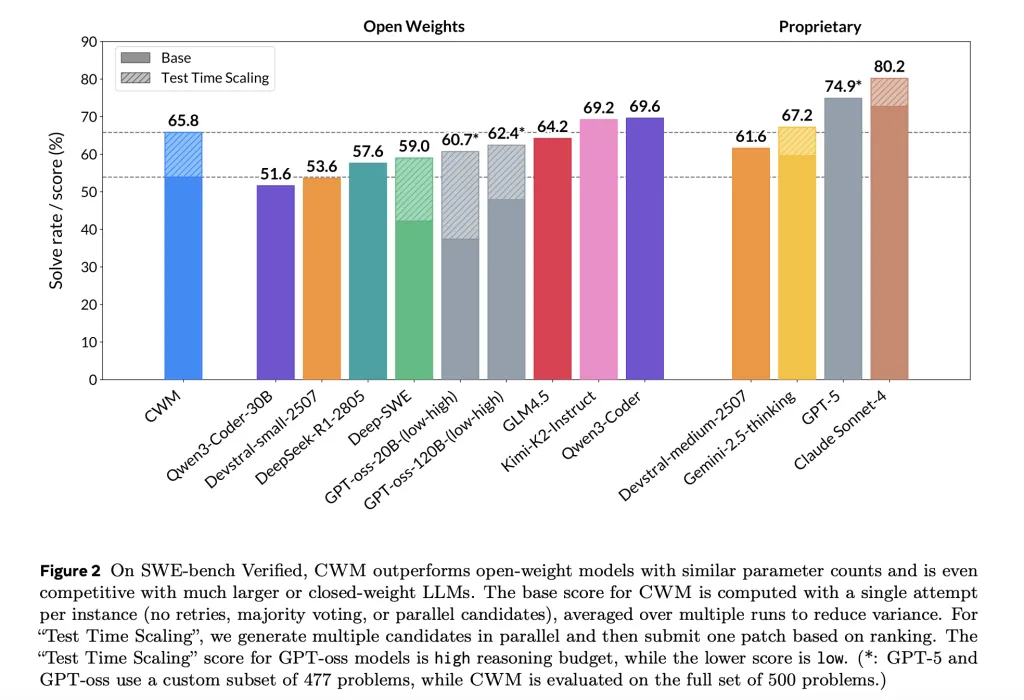
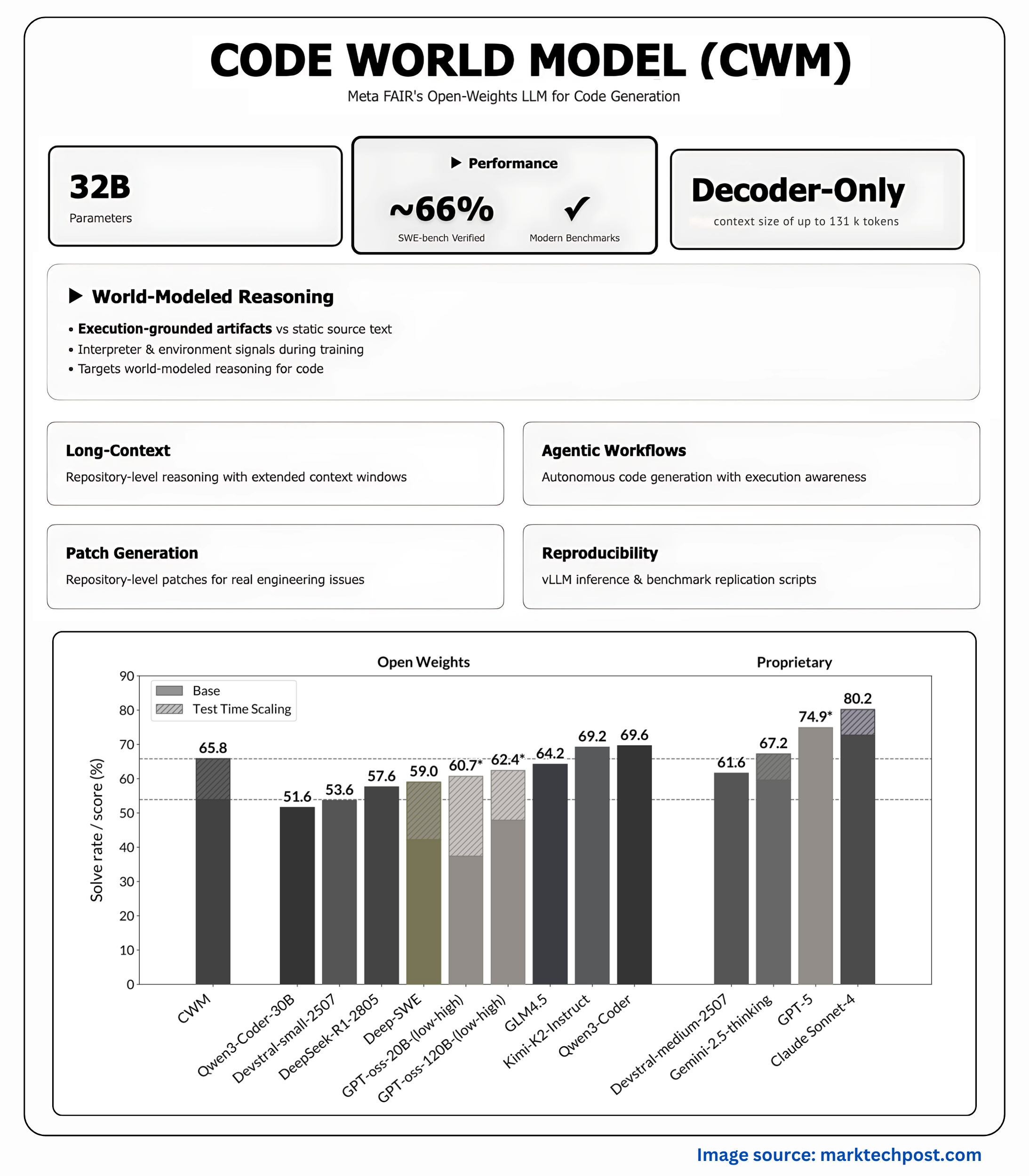
Benchmarks are notable: HumanEval code generation scored 85%, close to Claude 3.5 Sonnet's 87%; on the SWE‑bench agent tasks CWM scored 42%, outperforming Llama 3.1's 38%. The report emphasizes CWM's strong performance on long‑chain reasoning tasks such as multi‑file debugging, with a 15% reduction in error rate. Compared with certain Google and OpenAI models, CWM's inference is reported as 20% faster due to simulator‑optimized path search. Limitations include a relatively small model size (3.2B) for very complex tasks, and a data bias toward Python and JavaScript.
The report also discusses ethics: the open‑source license restricts military use, and the model card details bias testing (gender/race neutrality at 95%). Meta calls for community contributions of trajectory data to advance world‑model research.
How to use: from installation to practical application
CWM's open‑source design is intended to be easy to adopt. The following steps, based on the report and the GitHub repository, help developers get started quickly.
- Installation and environment preparation: download weights from Hugging Face (facebook/cwm) and run pip install transformers torch. The report recommends a GPU such as an A100 and at least 16GB VRAM. Example code:
- python
from transformers import AutoModelForCausalLM, AutoTokenizer
model = AutoModelForCausalLM.from_pretrained("facebook/cwm")
tokenizer = AutoTokenizer.from_pretrained("facebook/cwm")
```- Basic use: code generation and simulation Provide a prompt such as "Write a Python function for Fibonacci," the model will generate code and simulate execution:
- python
inputs = tokenizer("Write a Python function for Fibonacci:", return_tensors="pt")
outputs = model.generate(**inputs, max_length=200)
print(tokenizer.decode(outputs[0]))
- The report recommends using the simulator to verify results: add the simulate_execution=True parameter so the model rehearses outputs and avoids errors. This is suitable for VS Code plugins: integrated, the AI can debug in real time.
- Advanced fine‑tuning: optimizing for agent tasks Perform LoRA fine‑tuning using datasets such as mutate‑fix (the report includes 3M trajectories). Steps: (1) download the data; (2) run the repo script train.py ‑‑dataset mutate‑fix; (3) train 1–2 epochs, freezing 80% of parameters. The report says fine‑tuning increases SWE‑bench scores by 10%. Example applications include automated GitHub issue fixing.
- Real‑world use: enterprise and research Enterprises can integrate CWM into Copilot‑like tools to improve coding efficiency by about 30%. Researchers can use CWM to test world‑model extensions, such as adding image inputs to simulate UI design. Note: the license forbids military use and bias should be assessed.
CWM's release is another open‑source effort by Meta after mixed reception to Llama4's open releases; discussion on X suggests it may "reshape code AI." As Meta continues to invest heavily in recruiting top AI talent, the move signals its intention to compete again at the main table of AI development.