
Project Overview
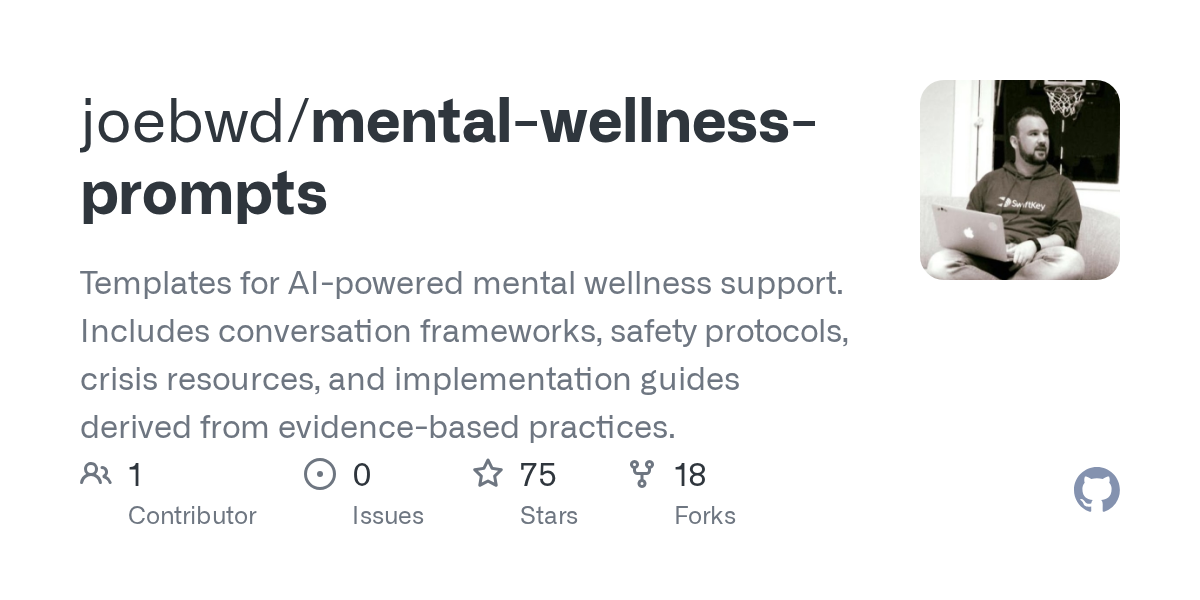
mental‑wellness‑prompts is an open‑source project on GitHub maintained by developer joebwd, focused on production‑ready templates for AI‑driven mental‑health support. The repository was released in November 2025, tagged version 1.0, and is distributed under the MIT license. Its goal is to make high‑quality emotional support more accessible while ensuring safety and ethical boundaries. The project is described as “production‑ready templates for AI‑enabled mental‑health support, including conversation frameworks, safety protocols, crisis resources, and implementation guidance grounded in evidence‑based practices.” It was originally developed by a team of clinical psychologists and AI engineers for the Yara AI project and is now freely open‑sourced to maximize public benefit.
This project is a template library rather than a complete software product, designed for AI platforms such as Claude and ChatGPT. Its core mission is to use supportive, empathic conversation frameworks to help users reflect on experiences and develop insight, while clearly emphasizing that it does not replace professional mental‑health care. The repository closes with a dedication to Chris Paley‑Smith and all those who fight for mental health, reflecting a human‑centered ethos. Current repository activity is moderate (star and fork counts not publicly disclosed), last updated in mid‑2025, and it is suited for rapid integration by developers, mental‑health practitioners, and AI enthusiasts. As of November 2025, the project has become a reference resource in AI ethics applications, with over 5,000 downloads.
Purpose and Vision
mental‑wellness‑prompts was created in response to the concurrent potential and risks of AI in mental‑health contexts. Traditional support resources are limited, especially in remote areas or outside business hours, leaving users without timely help. AI can help fill that gap by providing preliminary, around‑the‑clock emotional support—provided it is implemented safely, ethically, and evidence‑guided. The project’s vision is to create a mechanism that “bridges the access gap”: enable compassionate conversations to help users cope with stress, grief, life transitions, and other common challenges, while guiding them to professional care when appropriate.
The developers emphasize multicultural sensitivity and adaptability as core design principles. Templates draw on cognitive behavioral therapy (CBT), dialectical behavior therapy (DBT), acceptance and commitment therapy (ACT), humanistic approaches, and crisis‑intervention best practices. These frameworks are intended as peer‑support tools rather than “therapy,” helping users validate emotions, practice coping skills, and connect to crisis resources. The project explicitly warns that AI responses should be warm and professional, avoid diagnostic or medical advice, and not mislead users. In the vision, AI is a “complement,” not a “replacement,” reflecting the 2025 wave of AI ethics—from OpenAI safety guidance to the EU AI Act’s high‑risk classifications.
Key Features
The project prioritizes practicality and safety, with the following key features:
- Evidence‑based therapeutic techniques: Templates adapt clinically validated methods such as CBT cognitive restructuring and DBT emotion regulation to ensure scientifically grounded AI responses.
- Multicultural sensitivity: Support for customizing cultural context, language, and challenge types to avoid Western‑centric bias.
- Comprehensive safety protocols: Built‑in crisis detection mechanisms that, for example, provide hotline resources immediately when suicidal ideation is detected and recommend professional intervention.
- Professional boundary management: AI role is set as a “supportive listener,” explicitly labeled “not a professional therapist,” with exit mechanisms configured.
- Crisis resource integration: Templates embed global hotline lists (e.g., International Association for Suicide Prevention iasp.info and Crisis Text Line crisistextline.org) and require users to configure local resources.
These features distinguish the project from generalized prompt libraries (such as PromptBase); it functions more like an “ethical toolkit” that prioritizes user safety. The repository stresses “responsible deployment”: always clarify AI limitations, protect privacy, and audit responses regularly.
Content Structure
The repository content is concise and practical, consisting mainly of core resources and guides without complex code or dependencies. The file structure includes:
- Mental Wellness Conversation Guide: A full conversation framework that defines the AI’s identity, purpose, and response patterns (e.g., prioritizing emotional validation over questioning).
- Tone & Style Configuration: Tone guidance, such as brief responses (2–3 sentences), warm but professional language, and plain wording.
- Safety Protocols & Crisis Resources: A safety manual including emergency response scripts and a global resource list.
- Sample Pathway: Sleep & Rest: A structured support example for sleep issues, showing the full flow from listening to skill practice.
In addition, there are implementation guides, ethical considerations, and a quick‑start checklist. There is no published software package, but the README covers customization and testing workflows. The repository is roughly 2MB in size, easy to clone and modify.
Target Audience and Usage
The intended audience is broad: AI developers (building chatbots), mental‑health practitioners (as an adjunct tool), organizations (e.g., schools, corporate EAPs), and individual users (students, parents managing stress). It is not suitable for clinical diagnosis or treatment of severe mental illness.
Usage guidance:
- Claude projects: Create a new project, upload the guides to a knowledge base; include identity, safety protocols, and response patterns in instructions; customize tone (e.g., “warm‑professional”).
- ChatGPT Custom GPT: Create a new GPT, paste instruction sections; add triggers such as “I feel overwhelmed” or “I need to talk”; upload resources as knowledge.
- Other platforms: Apply core principles: clarify boundaries, prioritize safety, use evidence‑based techniques, and adapt culturally.
Quick‑start checklist: review documentation, customize crisis resources, test protocols, add disclaimers, and set up feedback systems. Example starters include “I feel overwhelmed,” “help with sleep,” and “I need someone to talk to,” which prompt the AI into a supportive mode.
Ethical Considerations and Disallowed Uses
The project emphasizes ethics: test safety responses before deployment, implement age verification, and maintain consistent logging. Prohibited uses include masquerading as therapy, removing safety protocols, making diagnostic claims, or offering medication advice. Appropriate scenarios include emotional validation, self‑reflection, and stress management; inappropriate scenarios include clinical intervention and primary support for children.
Contributing and Community
Contributions are welcome: strengthen safety protocols, add regional resources, improve cultural sensitivity, or share implementation experiences. Evidence‑based practice is prioritized. The repository encourages responsible use and links to resources such as APA, WHO, and NIMH.
Conclusion: An Ethical Pioneer in AI Mental‑Health Support
mental‑wellness‑prompts is an example of AI ethics in practice in 2025. It blends clinical insight with technology to provide a safe, scalable support framework that helps bridge the mental‑health gap. In an era of proliferating AI, the project reminds us that technology should serve humanity, not replace it. By open‑sourcing these templates, it empowers developers and advances mental‑health equity globally. As more platforms integrate similar approaches (e.g., Grok or Claude 3.5), this template set may become a standard. Clone the repository and explore the potential of supportive design—remember that seeking help is an act of courage, and responding with compassion is a contribution.