
On June 30, 2026, Chinese internet company Meituan officially released and open‑sourced the next‑generation trillion‑parameter model LongCat‑2.0. As the industry's first trillion‑parameter model to complete end‑to‑end training and inference on a ~50,000‑card purely domestic compute cluster, LongCat‑2.0 has a total parameter scale of 1.6T (average active ~48B, dynamic range 33B~56B) and natively supports a 1M ultra‑long context. This major release not only marks a technical leap for Chinese companies in ultra‑large‑scale model training but also provides an important practical case for autonomous and controllable domestic AI infrastructure.
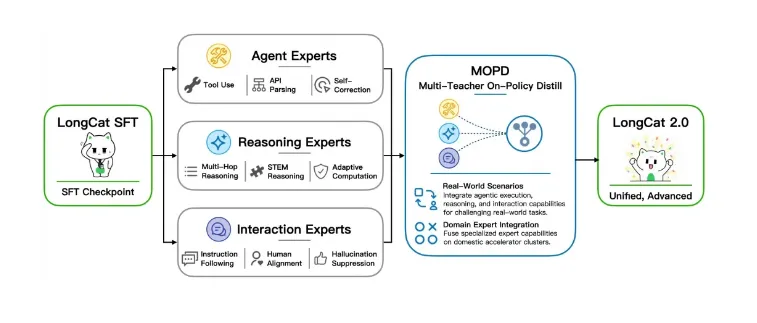
LongCat‑2.0 adopts an efficient mixture‑of‑experts (MoE) architecture and is deeply optimized for agentic encoding, complex task planning, and multi‑modal scenarios. Its open‑source release further lowers the barrier for the industry to access cutting‑edge models and is expected to accelerate iteration and innovation in the domestic AI application ecosystem.
Technical highlights: a balanced breakthrough in scale, efficiency and scenario fit
The core innovations of LongCat‑2.0 are reflected in the following aspects:
- Massive‑scale MoE architecture: Total parameters reach 1.6T, with about 48B parameters dynamically activated during inference (range 33B~56B). This sparse‑activation design preserves large capacity while significantly reducing per‑inference compute, achieving a favorable balance of performance and efficiency.
- Native 1M ultra‑long context support: Single inferences can handle input on the order of millions of characters, far exceeding most international mainstream models. This capability is especially suited for long‑document analysis, codebase understanding, and multi‑turn complex dialogue scenarios.
- Agentic capability optimization: The model has targeted enhancements for agent applications, demonstrating strong performance in code generation, task planning, and tool invocation, making it suitable for enterprise automation and complex workflows.
- Full‑stack adaptation to domestic compute: Training and inference were conducted entirely on domestic compute clusters (around 50,000–60,000 cards). This is currently the largest reported case of a domestic compute‑trained trillion‑parameter model, validating the usability of the local hardware ecosystem for ultra‑large‑scale training.
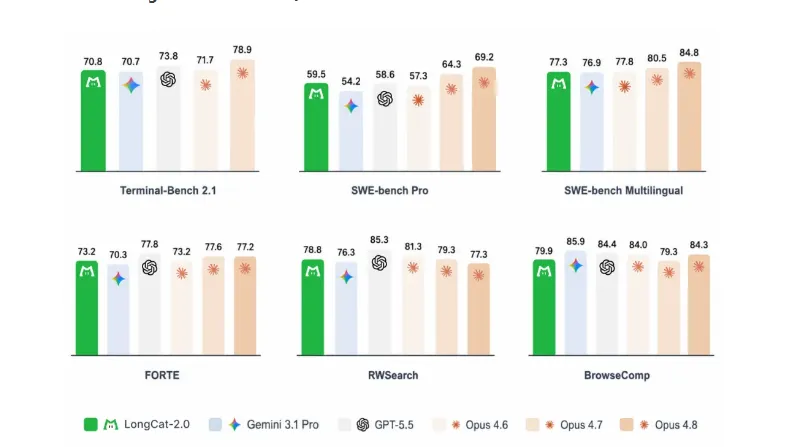
The Meituan LongCat team says the model achieved competitive results on benchmarks such as SWE‑bench Pro and Terminal‑Bench, and demonstrated high deployment efficiency in real enterprise scenarios.
Context of release: breakthroughs in domestic compute and industrial autonomy needs
There is a deep industrial background to the birth of LongCat‑2.0:
- Urgency of domestic compute autonomy: Against increasing uncertainty in the international chip supply chain, Meituan chose to train the trillion‑parameter model entirely using domestic compute, which carries important demonstrative significance. Although domestic large models have been released before, full‑process training of a trillion‑parameter model on domestic compute is a first at this scale.
- Meituan's business‑driven needs: As a local services giant, Meituan has rich experience in AI application scenarios. The development of LongCat‑2.0 directly serves its agentic application needs—such as intelligent customer service, content generation, and supply‑chain optimization—driving intelligent upgrades across its business.
- Open‑source strategic choice: Unlike some international giants that keep models closed, Meituan chose to open‑source LongCat‑2.0 to pool community efforts, accelerate the construction of China’s AI ecosystem, and broaden its technical influence.
This release, together with moves by domestic newcomers like DeepSeek, forms a concentrated emergence of trillion‑parameter models in China in 2026, showing rapid catch‑up in large‑scale training and scenario adaptation by local AI firms.
Far‑reaching impact: multi‑dimensional reshaping of technology, industry and ecosystem
Impact on technical development:
- Boost to confidence in domestic compute: The success of LongCat‑2.0 verifies the stability of ~50,000‑card domestic clusters for trillion‑parameter training, providing valuable experience and technical pathways for even larger future training runs.
- Innovation in model efficiency paradigms: The combination of MoE architecture, dynamic activation and ultra‑long context practice offers the industry a new reference for efficient large‑model design, helping reduce training and inference costs.
- Benchmark for agentic capabilities: Its optimizations for complex task planning and tool use will drive rapid development of the domestic agent ecosystem.
Impact on industry landscape:
- Deepening of Meituan’s AI presence: This release further solidifies Meituan’s leading position in consumer internet AI and could enable the company to export technical capabilities to more partners.
- Acceleration of open‑source ecosystem: The open‑source move will attract developer community participation in optimization and vertical application development, creating a virtuous cycle and lowering the barrier for SMEs to access advanced models.
- New variables in international competition: The emergence of Chinese open‑source trillion‑parameter models supplements the global AI competition landscape, particularly showing unique advantages in cost‑sensitive and scenario‑driven markets.
Potential challenges and risks:
- Ongoing cost of compute investment: Despite this breakthrough, maintaining continuous iteration of trillion‑parameter models still requires massive compute and energy investment.
- Safety and compliance requirements: Ultra‑large‑scale models need strengthened content safety, alignment, and intellectual property protection to avoid potential risks.
- Test of ecosystem maturity: After open‑sourcing, effectively managing community contributions and ensuring model quality and safety will remain a long‑term practical challenge.
Conclusion: another milestone in China’s AI自主创新
The release and open‑sourcing of Meituan LongCat‑2.0 is a major highlight of China’s AI industry in the first half of 2026. It not only demonstrates local firms’ technical strength in ultra‑large‑scale model training but also reflects a strategic vision of driving industrial collaboration through open‑source sharing.
Going forward, as more domestic compute clusters mature and algorithmic optimizations deepen, China is likely to form a more competitive AI ecosystem in the trillion‑parameter era. For developers, this means more high‑performance open‑source tools to choose from; for industry, it is a solid step toward autonomy, control, and greater intelligent efficiency.
▶️ Enjoy this article? Creating content is hard work!
Follow our YouTube channel:
AI Rosetta
Your likes, subscriptions and shares are our greatest support! 🙏
More AI news at: https://www.airosetta.com