

As large language models (LLMs) see broader application, AI foundation models tailored for the medical field have attracted increasing attention from major companies and governments. From mid‑November 2025 to mid‑January 2026, the global medical AI sector experienced a concentrated release period, during which multiple tech giants and research institutions launched specialized models for clinical decision support, medical imaging analysis and precision diagnosis. This wave reflects a deepening integration of AI from general‑purpose tools into medical verticals, enabled by larger‑scale datasets and advances in agent‑style architectures. According to Crescendo AI’s medical AI roundup, the key releases in this period focused on multimodal processing and low‑hallucination designs aimed at improving diagnostic accuracy and clinical efficiency. This article synthesizes representative model releases from the United States, China and Europe based on authoritative sources such as the FDA device listings, official corporate announcements and academic papers, and analyzes their technical features and impact.
United States: Giant players dominate, multimodal and agent‑style models lead
US companies were the most active in releases during this period, benefiting from a mature ecosystem and regulatory support, with emphasis on imaging diagnostics and agent‑based AI.
- OPENAI: On January 7, 2026, OpenAI released ChatGPT Health, which securely integrates medical records, fitness apps and wearable device data to provide visualized interpretations and personalized health recommendations. The project involved collaboration with over 260 clinicians, is not intended for diagnostic use, and employs encryption and HIPAA‑level protections, with initial rollout in limited regions.
- Microsoft: At Ignite 2025 (November 18–21, 2025) Microsoft introduced medical AI tools including multimodal imaging analysis and report‑generation systems (such as tools similar to MedImageInsight). These tools were integrated into Azure AI Studio and support agent orchestration.
- Google: On January 13, 2026, Google released MedGemma 1.5 (a 4B‑parameter multimodal model) and MedASR (medical speech‑to‑text). MedGemma 1.5 extends support to CT, MRI and pathology images and is compact enough for offline deployment.
- Anthropic: On January 11, 2026, Anthropic launched Claude for Healthcare, supporting multimodal agents and clinical decision support with emphasis on HIPAA compliance.
- NVIDIA: On December 15, 2025, NVIDIA released Nemotron‑3‑Nano‑30B‑A3B (a hybrid Mixture‑of‑Experts model) supporting precision medicine; on January 12, 2026 NVIDIA partnered with Natera to expand base models and shorten genomic analysis time by 75%.
- OpenEvidence: In 2025–2026 OpenEvidence advanced development of a "medical super‑intelligence," using multi‑cloud agent AI to handle complex medical data; it highlighted multimodal AI at JPM 2026 (January 2026).
- FDA approvals: Brainomix 360 Triage Stroke received expanded approval in April 2025 for stroke imaging; it was approved earlier in 2025 with European expansion in 2025.
China: Policy‑driven, emergence of diagnostic and evidence‑based medicine models
In China, national strategy has driven emphasis on diagnostic accuracy and low‑hallucination models.
- National Health Commission: On November 4, 2025, it announced an AI+ healthcare plan aiming to build advanced health data infrastructure by 2027.
- Baichuan Intelligence: On January 2026 Baichuan released Baichuan‑M3‑235B (based on Qwen‑3), which outperformed GPT‑5.2 on the HealthBench benchmark, features low hallucination rates and supports long‑sequence clinical dialogues.
- WORK Medical Technology: On December 29, 2025, it received Hunan province approval for an AI blood cell morphology analyzer, reducing laboratory workload.
- Chinese researchers: In 2025 researchers developed automated evidence‑based medicine (EBM) systems to process large volumes of literature, integrating AI into digital intelligent EBM (i‑EBM).
Europe: Regulation‑driven, imaging and multimodal models advance
Europe emphasizes compliance, influenced by the EU AI Act (the main high‑risk provisions come into force in August 2026 and implementation is phased). An earlier report saying the EU AI Act "takes effect January 2026" is incorrect; the act is being implemented gradually.
- European Commission: On December 16, 2025 it announced measures to modernize the health sector with AI at the core, promoting data sharing and guideline development.
- Philips: In 2025 Philips emphasized that AI medical device regulation must balance patient safety with competitiveness of the European AI ecosystem.
- GenAI4EU: Launched a funding initiative in November 2025 to support multimodal AI deployment in medical imaging, continuing into March 2026.
- TICON model: Retrieval did not conclusively confirm a November 2025 release of TICON for digital pathology; it may be a researcher‑led effort and requires further verification.
- CNAG: In January 2026 CNAG released a generative AI model trained on cell atlas data to support diagnostics and personalized treatments.
- Brainomix: In 2025 Brainomix expanded 360 Triage Stroke deployment in Europe for stroke imaging analysis.
Model comparison analysis
The table below compares representative models from the three regions (based on verified data):
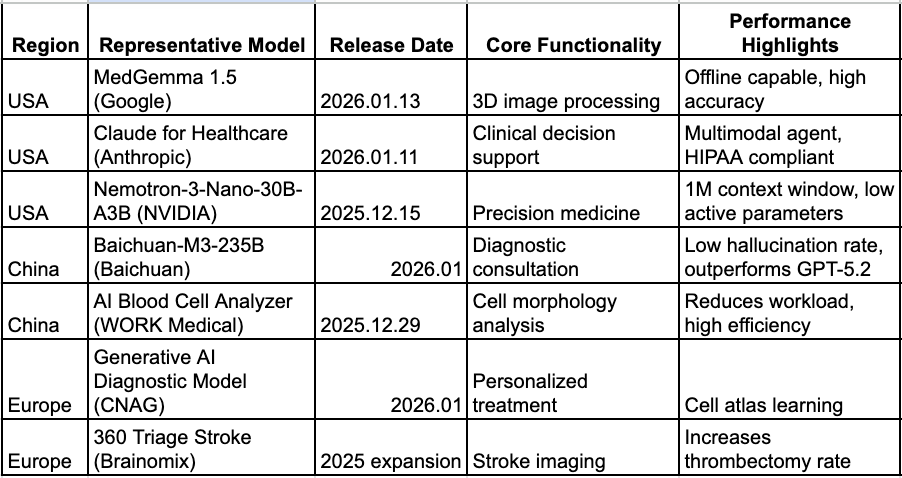
The comparison shows US models leading in multimodality and agent‑style designs; China emphasizes low hallucination and high diagnostic accuracy; Europe focuses on context and regulatory compliance. Shared trends include agent designs and open‑source licensing (e.g., Apache 2.0) to reduce deployment costs.
Industry impact and outlook
These releases accelerate the transformation toward precision medicine but face challenges such as data bias and ethical concerns. Looking to 2026, cross‑regional collaboration (for example NVIDIA and Natera) is expected to increase, and regulation (such as the EU AI Act) will drive standardization. The medical AI market is projected to grow rapidly, with China’s industry scale expected to expand substantially, the US leading in innovation, and Europe ensuring fairness.
▶️ Enjoyed this article? Creating great content takes effort!
Subscribe to our YouTube channel:
AI Rosetta
Your likes, subscriptions and shares mean the world to us! 🙏
For more AI news, visit:
https://www.airosetta.com