
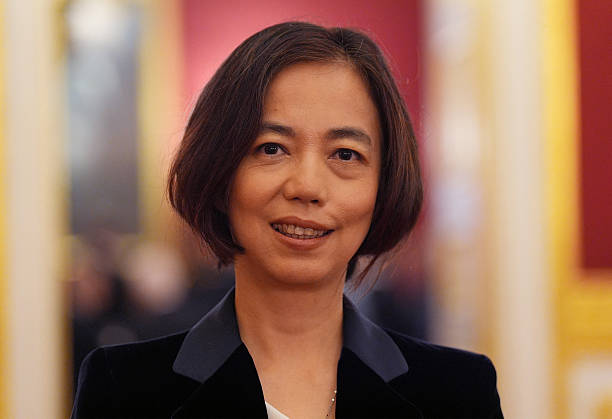
After stepping down from a full‑time faculty position at Stanford this March to become a part‑time professor and launch a startup, AI pioneer Fei‑Fei Li formally introduced the Marble spatial model through her company World Labs on November 12, 2025, marking a major advance in the field of "spatial intelligence." The model is viewed as a key entry in the world‑models competition and stands in sharp contrast to Google DeepMind's Genie 3 (released August 2025) and Yann LeCun's JEPA/LeJEPA framework (with the latest LeJEPA released November 2025). All three aim to build AI "internal world simulators" to enable more efficient planning, reasoning and interaction, but they differ in focus, methodology and application scenarios. The following analysis is based on authoritative sources (such as the DeepMind official blog, arXiv papers, and analyses from TechCrunch and Forbes).
1. Overview of the three models
- Marble (Fei‑Fei Li, World Labs): A multimodal world model focused on generating persistent, editable 3D spatial environments from text prompts, supporting AI‑native tools and hybrid 3D editors. This is World Labs' first commercial product, intended to give AI "spatial intelligence" so machines can understand the physical world more like humans. It is not a pure generative model but emphasizes interactivity and practicality (e.g., game/VFX creation).
- Genie 3 (Google DeepMind): DeepMind's general world model that generates diverse interactive 3D environments from text or image prompts, supporting 720p resolution, 24fps and multi‑minute real‑time simulation. It is the third generation in the Genie series (after Genie 1/2) and aims to be a frontier tool toward AGI for creating infinitely interactive worlds.
- JEPA/LeJEPA (Yann LeCun, Meta/NYU): The evolution of the Joint‑Embedding Predictive Architecture (JEPA), LeJEPA is the 2025 variant focusing on self‑supervised learning to build abstract world models that support planning and causal reasoning. LeCun regards it as a cornerstone toward "objective‑driven learning." It is non‑3D‑generative and focuses on internal representation prediction.
2. Differences in core goals and design philosophy
All three stem from the "world model" concept (AI simulating reality to plan actions), but their philosophical emphases differ:
- Marble: Fei‑Fei Li emphasizes that "spatial intelligence is the next frontier for AI" (a16z interview), aiming to bridge 2D vision and the 3D physical world and to support human‑AI collaborative creation. It treats the world model as a "3D asset generator," focusing on persistent environments (e.g., downloadable scenes) rather than real‑time simulation. Design philosophy: practicality, integrated editing tools, suitable for games/VFX/robotics design. Unlike LeCun's abstract prediction, Marble is more "embodied," emphasizing spatial structure (e.g., Gaussian splats representation).
Genie 3: DeepMind's goal is "infinite world generation," as a stepping stone to AGI, enabling the creation of diverse interactive environments from a single prompt (e.g., game levels). Philosophy: generative plus interactivity, emphasizing long‑horizon consistency, superior to Marble's static editing. Compared with LeCun's JEPA, Genie focuses more on visual/dynamic simulation than abstract embeddings.
- JEPA/LeJEPA: LeCun's vision is "machine‑learning internal world models," building causal representations via self‑supervised prediction and supporting hierarchical planning (H‑JEPA). Philosophy: non‑generative, non‑pixel‑level reconstruction, instead efficient embedding prediction (energy‑based) to avoid high computational cost. LeJEPA removes heuristics to achieve provable generalization. Unlike Marble/Genie’s 3D generation, it is more abstract and suited to multimodal planning rather than visual rendering.
Comparison table (core differences):
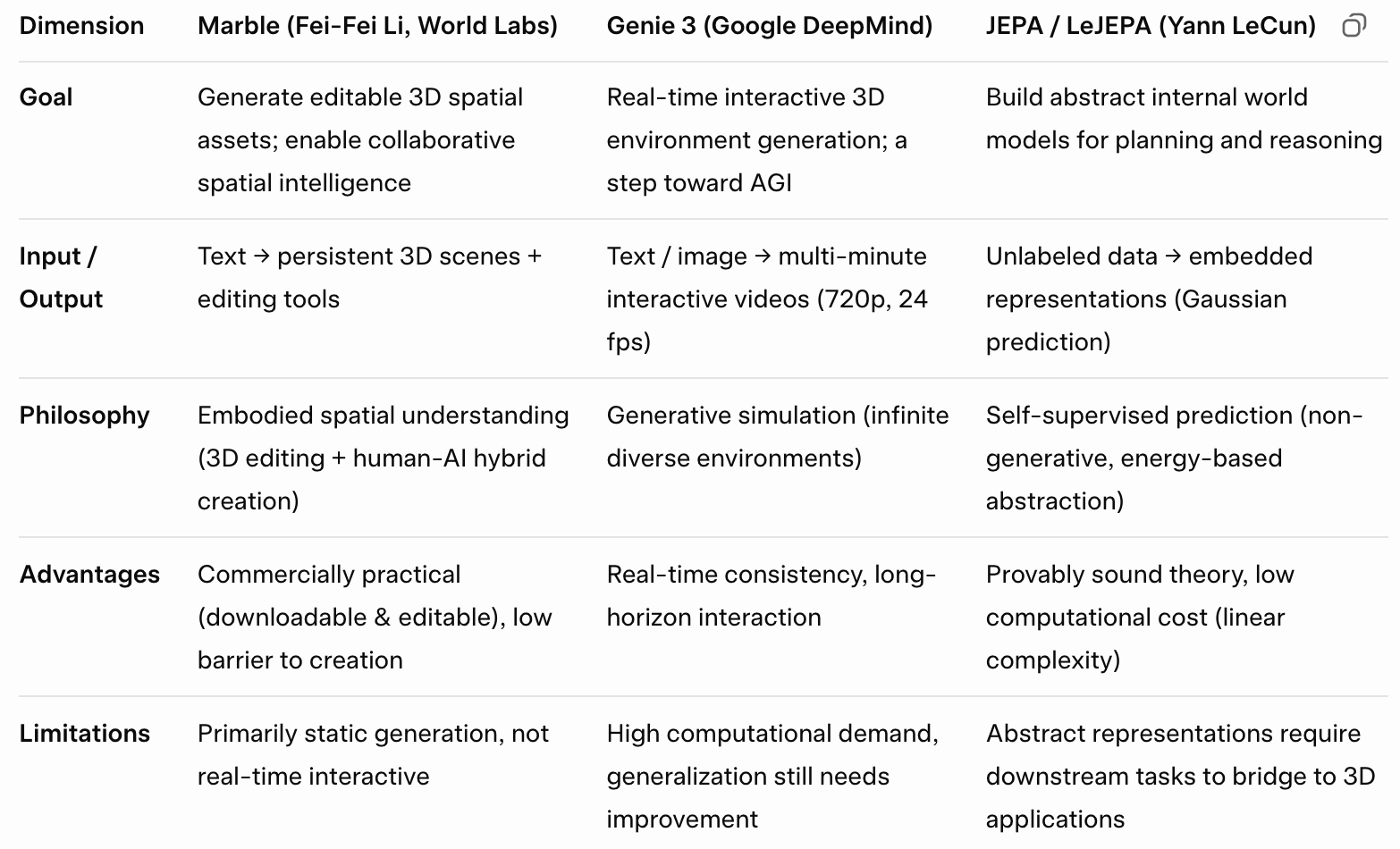
Sources: Forbes world‑models competition analysis, TechCrunch comparison.
3. Methodological and technical differences
- Marble: Uses multimodal diffusion models plus Gaussian splats to generate 3D meshes from text, supporting AI editing (e.g., drag‑and‑drop objects). Training data includes large‑scale spatial datasets (akin to a 3D ImageNet) and emphasizes "persistence" (persistent worlds), unlike Genie's temporary simulations. Unlike LeCun's embedding prediction, it is closer to "3D Stable Diffusion," focusing on spatial structure rather than causal dynamics.
- Genie 3: Based on Transformer+diffusion architectures, it generates video‑level interactive environments from prompts and supports user inputs (e.g., keyboard control). Innovations include long temporal consistency (multi‑minute coherence) and the use of SIMA 2 (Scaled Interactive Motion Agent) to enhance agent interactions. Compared to Marble, it is more dynamic (real‑time rendering) but computationally intensive (requires GPU clusters); unlike JEPA it generates pixel‑level outputs rather than abstract representations.
- JEPA/LeJEPA: Core is energy‑based prediction, enforcing Gaussian‑like embeddings via SIGReg (Sketched Isotropic Gaussian Regularization) to enable heuristic‑free self‑supervised learning. Formula:
 linear complexity, compatible with ViT/ResNet backbones. Unlike Marble/Genie’s 3D generation, it builds an "internal simulator" suitable for planning (e.g., robot pathing) rather than visualization.
4. Differences in applications and potential impact
- Marble: Suited for creative tools (e.g., Unity integration to generate game levels), VFX (film 3D scenes), and robotics design (spatial planning). Impact: accelerates commercialization of "spatial AI"; Li calls it a bridge from "words to worlds." Potential: lowers 3D content costs but raises copyright questions regarding training data sources.
- Genie 3: Targets game development (infinite level generation) and simulation training (e.g., autonomous driving). Impact: DeepMind positions it as an AGI cornerstone, supporting SIMA agents learning inside generated worlds. Potential: real‑time interactivity improvements but high energy costs limit mobile deployment.
- JEPA/LeJEPA: Suited for multimodal planning (e.g., robotic causal reasoning) and efficient pretraining (2–5% downstream gains). Impact: LeCun emphasizes it as foundational for "human‑level AI," supporting hierarchical world models (H‑JEPA). Potential: low‑resource deployment but requires bridging to 3D applications.
5. Overall assessment and outlook
Analyses from Forbes and EntropyTown indicate the three represent three paths for world models: Marble's "spatial generation," Genie 3's "interactive simulation," and LeCun's "abstract prediction." Marble is more commercial (first product), Genie 3 is more frontier (AGI‑oriented), and JEPA is more theoretical (provable). Hacker News discussions suggest hybridizing their strengths (e.g., Marble+JEPA representations) may become a trend. Challenges include computational efficiency, data ethics, and generalization (non‑visual domains). Looking toward 2026, spatial world models may dominate AI competitions and help shift AI from "chatbots" toward "embodied agents."