
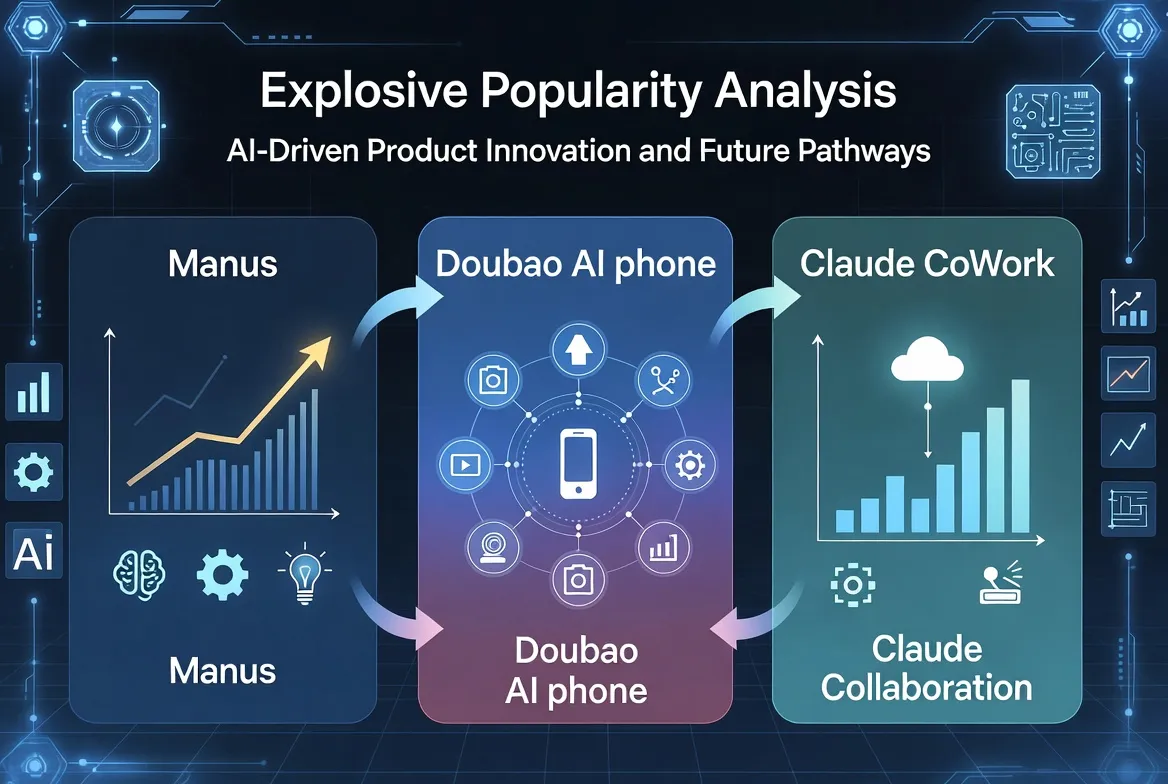
During the 2025–2026 AI wave, multiple AI products went viral at remarkable speed, signaling the convergence of technical innovation and user demand. Notably, China’s AI agent Manus surpassed one million users within a week after its March 2025 launch, drawing global attention; the Douban mobile app, as a cultural social platform, remained popular through community‑driven recommendations; and Anthropic’s Claude CoWork quickly rose to prominence after its January 2026 release, highlighting nontechnical users’ appetite for AI agents. These cases illustrate the core logic of product virality in the AI era: a trajectory from technical breakthrough to ecosystem building.
Manus: From overnight sensation to an AI agent revolution
Manus is a general‑purpose AI agent launched by Butterfly Effect (the original developer of Monica), headquartered in Singapore with a Wuhan, China development team, and officially released on March 6, 2025. Within a week its user base exceeded one million, sparking intense discussion across the global tech community and even driving invitation codes to sell for tens of thousands on secondary markets. Three factors explain its rapid rise.
First, technical innovation was the core driver. As the world’s first truly general AI agent, Manus can decompose complex tasks into sub‑tasks and autonomously execute them—such as researching, writing code, organizing invoices and generating reports. It employs a multi‑model architecture (including models like Anthropic’s Claude 3.5 Sonnet and a fine‑tuned version of Alibaba’s Qwen), combined with independent agents for dynamic adaptation. MIT Technology Review tests indicated Manus excelled at market research and coding tasks, outperforming chatbots like ChatGPT. This “action engine” met users’ demand for AI that moves from “answering” to “doing,” marking a leap from concept to productization for AI agents.
Second, marketing and viral spread magnified the effect. Manus used an invite‑only mechanism to create scarcity, fueling secondary market speculation. A 4‑minute 17‑second demo video went viral across Weibo and X, provoking heated discussion. CSDN analysis attributed the craze to curiosity about a product comparable to yet not released by OpenAI; the founders’ background (such as Monica’s million‑user base) also strengthened brand momentum.
Third, user demand and timing mattered. The 2025 surge in AI agents meant Manus met widespread demand for efficient tools, especially in work scenarios like personalized travel planning, stock analysis and financial reporting. Sina Finance noted that it lowered the barrier to AI adoption and benefited many industries.
Looking ahead, Manus is expected to focus on expansion and commercialization. Media outlets predicted increased autonomy and support for more domains such as educational course design and B2B procurement. At the end of 2025 Meta acquired Manus for $2 billion, signaling its integration into a global ecosystem. Reuters suggested this would push Manus from a tool toward a platform, integrating more models and enabling cross‑border collaboration. Tech in Asia commented that Manus might expand into areas like music generation in 2026 while confronting regulatory challenges. Overall, Manus exemplifies the AI agent trend and is likely to evolve from “execution” toward “decision‑making,” but will need to address data privacy and ethical issues.
Doubao AI phone: Engineering units sold out overnight and a regulatory warning from rapid deplatforming
The Doubao AI phone is an engineering‑unit product (model Nubia M153) from a collaboration between ByteDance and ZTE’s Nubia brand, sold on ZTE’s mall on December 1, 2025 as a “technical preview engineering unit.” The first batch of 30,000 units sold out within 24 hours, with resale prices on secondary markets peaking at ¥36,000, but within days it was blocked by mainstream apps due to cross‑app permission issues, triggering industry alarm. Three factors contributed to its rapid rise.
First, technical innovation and permission breakthroughs. The Doubao AI phone includes a “Doubao Phone Assistant” based on the Doubao 2.0 large model (trillion‑parameter scale) and obtained Android’s INJECT_EVENTS permission, allowing the AI to simulate user input (such as taps and swipes) to automate cross‑app operations. A demo video showed a voice command “order me the cheapest milk tea,” after which the assistant opened a food delivery app, compared prices, placed an order and completed payment. The Paper reported this feature filled a gap in the AI phone market, ahead of Apple and Huawei, and user demand for “real intelligence” drove quick sell‑outs.
Second, marketing and scarcity effects. ZTE’s mall limited supply to create FOMO, and a viral Douyin video amplified purchase enthusiasm. OFweek noted ByteDance’s ecosystem effects and user sharing created a loop that led to the 24‑hour sell‑out.
Third, timing and market gap. China’s AI hardware market surged in 2025 and consumer demand for smart devices rose. The Doubao AI phone addressed a pain point by delivering a seamless experience from entertainment to productivity. However, the deplatforming stemmed from excessive permissions: apps such as WeChat, Alipay and Taobao triggered risk controls and forced account logouts. Southern+ reported this undermined app giants’ traffic dominance, reducing single‑app session time and threatening ad revenues.
Details of the takedown: from December 3 users reported “abnormal login environment” on WeChat and Alipay‑related apps refused logins. ByteDance quickly disabled the WeChat automation feature and affected accounts were restored. Secondary prices fell from ¥12,000 to ¥4,800. Yahoo Finance described this as a typical conflict between AI innovation and existing ecosystems, with public debate shifting from “craze” to “ban.”
Going forward, Doubao AI phone makers will adjust for compliance. ByteDance plans to optimize privacy protections and work with app providers to standardize permissions. SCMP predicted a relaunch in 2026, possibly partnering with more manufacturers (such as vivo and Lenovo) to become an AI hardware benchmark, but balancing innovation with regulation will be essential to avoid repeat bans.
Claude CoWork: An AI productivity revolution under rapid iteration
Claude CoWork launched on January 13, 2026 as an extension of Claude Code, simplifying document automation for nontechnical users. Three factors explain its rapid popularity.
First, user‑friendly design. Anthropic’s blog said that user demand shifted from Claude Code toward noncoding tasks, driving CoWork’s development. TechRadar tests showed it supports folder access and multi‑step execution, improving productivity. Reddit users reported nontechnical users “fell in love” with its simplicity.
Second, the myth of rapid development. CoWork was primarily built from Claude Code within ten days, sparking discussion about “AI self‑bootstrapping.” YouTube videos framed this as a shift from AI as a tool to AI as a colleague. Business Insider noted that memes on X accelerated the viral spread.
Third, market demand. As AI agents rose in 2026, CoWork met the need of millions for office automation. LinkedIn posts suggested it threatened the survival of dozens of startups.
Future plans for CoWork include platform expansion and security. Anthropic intends to support Windows, cross‑device sync and stronger safety guards. TechRadar predicted it could become a mainstream productivity tool in 2026 but must resolve downtime and permission risks. Fortune analyzed that it will reshape work and create new roles.
Common patterns and industry outlook
The three viral cases share common factors: technical innovation that meets user needs, viral marketing that amplifies adoption, and a supportive social context. First, technical innovation is the foundation: Manus’s general agent architecture, Doubao phone’s INJECT_EVENTS permission breakthrough, and Claude CoWork’s document automation all directly address user pain points such as efficiency gains and cross‑platform interaction. These innovations stem from progress in AI models—trillion‑parameter scales and multimodal capabilities—that move products from proofs of concept to practical tools. MIT Technology Review noted that demand‑driven innovation was key to these virality cases, with users seeking efficiency tools in the post‑pandemic era. Second, viral marketing magnified effects: Manus’s demo and invite system, Doubao phone’s Douyin spread, and CoWork’s “AI self‑bootstrapping” narrative leveraged social platforms to create FOMO. Business Insider observed that meme culture on X and Reddit accelerated dissemination, forming positive feedback loops as users shared experiences. Third, social conditions helped: looser AI regulation in 2025 and economic recovery, combined with a global AI investment boom, provided fertile ground. CSDN reported that China’s preference for domestic AI and global interest in agent tools were common background factors.
In trend terms, Manus and CoWork represent the AI agent movement, emphasizing autonomous execution and productivity gains and signaling a paradigm shift from chat to action. The Doubao AI phone illustrates hardware–AI integration and regulatory conflict, showing how permission innovations can disrupt ecosystems while warning of cross‑platform collaboration challenges.
Looking ahead, deep AI integration will become mainstream: products will evolve from single features to ecosystems—Manus integrating more models, Doubao phones refining permissions, and CoWork supporting cross‑device workflows. Platform expansion will focus on internationalization and multimodality: Manus and CoWork may release enterprise versions, and Doubao phones could partner with more manufacturers. Ethical balance is critical: privacy protection and risk controls must be strengthened, with the Doubao takedown highlighting the need for standardized permission practices. In 2026, products are expected to move toward sustainability and compliance: Fortune projected the AI agent market could double in size but warned of job displacement and bias risks. The Doubao incident may spur industry standards, encouraging cooperation between AI hardware and app ecosystems. Overall, these products suggest AI’s shift from tool to partner, but success depends on balancing innovation with responsibility.
▶️ Enjoyed this article? Creating great content takes effort!
Subscribe to our YouTube channel:
AI Rosetta
Your likes, subscriptions and shares mean the world to us! 🙏
For more AI news, visit:
https://www.airosetta.com