
In 2026, local deployment of large models has become a necessity for developers, researchers and enterprises. The choice of inference framework can produce 2–6x performance differences on the same hardware. After several recent in‑depth technical evaluations, this article synthesizes authoritative test data and real‑world deployment experience to comprehensively analyze vLLM, SGLang, llama.cpp, MLX and Ollama, focusing on core principles, advantages and disadvantages, applicable scenarios, and presenting a side‑by‑side comparison in table form.
1. Overview of Core Principles of the Five Frameworks
1. vLLM — PagedAttention + continuous batching production‑grade engine
vLLM is currently the most widely used inference framework in production, both locally and in the cloud. Its main innovation is the PagedAttention mechanism, directly inspired by operating system virtual memory paging.
Traditional Transformers allocate large KV caches during inference and often require all requests in a batch to finish before starting the next batch, causing significant memory waste (utilization commonly only 60–80%) and throughput bottlenecks. vLLM splits the KV cache into fixed‑size "pages" (typically 512–2048 tokens) and dynamically allocates and reclaims them much like an OS manages memory. This allows efficient memory reuse even when request sequence lengths vary greatly, boosting memory utilization to over 95%.
At the same time, vLLM introduces Continuous Batching: when one request finishes, a new request is immediately inserted into the execution queue without waiting for the whole batch to complete. This greatly improves GPU utilization, especially in high‑concurrency API service scenarios.
vLLM supports multiple backends including NVIDIA, AMD, Google TPU and Intel Gaudi; its ecosystem is mature and integration is straightforward.
Repository: https://github.com/vllm‑project/vllm
2. SGLang — agent framework with RadixAttention prefix‑tree caching
SGLang, developed by part of the original vLLM team, is a next‑generation inference framework designed for complex interactive scenarios. Its core innovation is RadixAttention (a radix‑tree attention cache).
While conventional frameworks typically discard the KV cache after a request completes, SGLang persistently stores prefixes of all historical requests in a tree structure (Radix Tree). When a new request arrives, the system intelligently finds the longest matching prefix and reuses the already‑computed KV cache, only computing the newly added portion. This is extremely effective in RAG (retrieval‑augmented generation), multi‑turn dialogue and AI Agent scenarios.
For example, in enterprise knowledge‑base Q&A where multiple users query different passages of the same document, SGLang can significantly reduce redundant computation. Official tests show that in high‑prefix‑hit‑rate scenarios SGLang can achieve 3–6.4x speedups versus vLLM. SGLang also includes deep optimizations for structured outputs (JSON modes) and multi‑agent collaboration.
Repository: https://github.com/sgl‑project/sglang
3. llama.cpp — ultra‑light, cross‑platform native GGUF engine
llama.cpp, led by Georgi Gerganov, is a classic project often described as the "Swiss Army knife" of local large models. Its core design philosophy is extreme simplicity and portability.
Implemented in pure C/C++ with almost zero external dependencies, it supports a wide range of quantization schemes from 2‑bit to FP16. Models are stored in the GGUF format and use mmap (memory mapping) for very fast model loading—even 70B models can load in seconds. It does not depend on CUDA, Metal or other specific frameworks, allowing it to run on devices from Raspberry Pi and phones to servers.
llama.cpp focuses on single‑user, efficient single‑stream inference, performing exceptionally well in resource‑constrained environments, though its high‑concurrency capabilities are relatively limited.
Repository: https://github.com/ggerganov/llama.cpp
4. MLX — native framework for Apple Silicon unified memory
MLX is developed by an Apple‑affiliated team and is tailored for Apple Silicon (M‑series chips) and their unified memory architecture.
Conventional frameworks often copy data between GPU memory and system memory during inference, while MLX allows CPU and GPU to share the same physical memory pool, eliminating copy overhead. MLX also deeply optimizes matrix acceleration instruction sets (AMX) and employs techniques like Lazy Evaluation to maximize bandwidth utilization.
On high‑memory devices such as M4 Max/M4 Ultra, MLX often outperforms other frameworks by 1.5–3x, making it especially suitable for local large‑model experiments and long‑running Agent scenarios.
Repository: https://github.com/ml‑explore/mlx
5. Ollama — the most user‑friendly local model runtime
Ollama is not primarily a low‑level inference engine but a highly packaged local runtime platform, with llama.cpp as a major underlying engine.
Its core value is extreme ease of use: a single command can download, run and manage models (e.g. ollama run llama3.1), and it provides a Web UI, OpenAI‑compatible API, local model management and customizable Modelfile support. Ollama lowers the barrier to local deployment, enabling non‑expert users to run 70B‑class models on personal machines.
Ollama also supports custom Modelfiles to create tailored models and can switch backends (llama.cpp, MLX, etc.). It behaves like an "operating system" for local large models, ideal for rapid experimentation and daily use.
Repository: https://github.com/ollama/ollama
2. Detailed Performance and Feature Comparison
vLLM: On NVIDIA H100 running Llama 3.1 70B, vLLM leads in throughput and is suited for high‑concurrency production environments.
SGLang: Best performance in multi‑turn dialogue and RAG scenarios due to high prefix hit rates.
llama.cpp: Extremely efficient single‑GPU inference, especially strong on low‑resource devices.
MLX: Dominates other frameworks on M4 Max/M4 Ultra hardware.
Ollama: Best‑in‑class usability, but its high‑concurrency throughput is noticeably inferior to vLLM and SGLang; better suited to individuals and small teams.
3. Comparison Table of the Five Frameworks
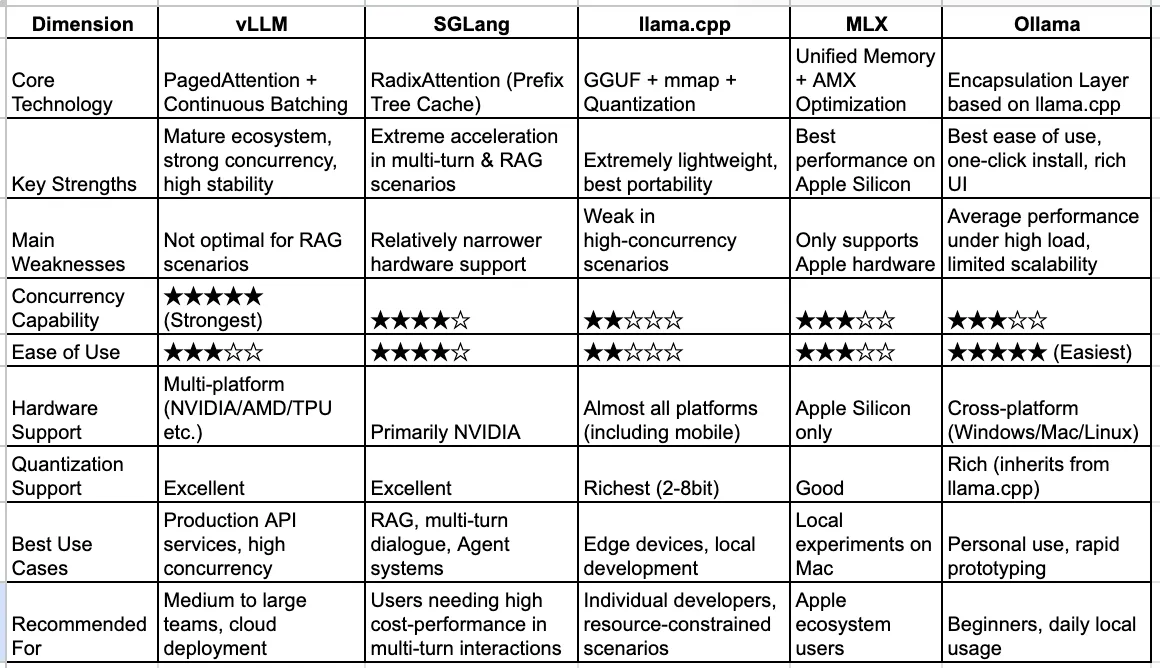
4. Selection Guide
- Production, prioritizing maximum throughput and stability: prefer vLLM, the most reliable production‑grade option today.
- RAG, multi‑turn dialogue, AI Agent systems: SGLang is the best choice, offering significant cost and speed advantages.
- Apple Mac users: MLX has few competitors, especially on M3/M4‑series high‑memory devices.
- Edge devices, smart hardware, ultra‑lightweight deployments: llama.cpp is the first choice.
- Beginners, rapid validation, everyday local use: Ollama is the friendliest entry point and can act as a frontend to other engines.
Recommended hybrid strategy: many mature teams adopt a combined approach such as Ollama (local development/testing) + vLLM (production services) + SGLang (high‑value RAG/Agent endpoints).
5. Future Trends
In 2026, competition among local inference frameworks has shifted from pure speed to scenario fit and engineering intelligence. We may see more hybrid frameworks—for example, combining SGLang's RadixAttention with vLLM's production stability, or Ollama integrating MLX/vLLM as backends.
With advances in quantization (FP8, INT4), new hardware (Blackwell, Apple M5, Ascend, etc.) and maturation of unified multi‑backend interfaces, developers will have more flexible options. Ultimately, there is no absolute best framework—only the one best suited to the current hardware, workload and business needs.
Summary recommendations:
- Beginners/individuals: start with Ollama;
- For ultimate performance: choose SGLang (NVIDIA) or MLX (Apple) depending on hardware;
- Production deployment: primarily vLLM, supplemented by SGLang for complex scenarios;
- Cross‑platform edge deployment: llama.cpp remains the baseline guarantee.
Local model inference has entered a "many flowers bloom" phase. Understanding each framework's positioning and limits is key to balancing performance, cost and usability in 2026 AI practice.
Sources:
1. Official project repositories (most authoritative)
- vLLM: https://github.com/vllm‑project/vllm
- SGLang: https://github.com/sgl‑project/sglang
- llama.cpp: https://github.com/ggerganov/llama.cpp
- MLX: https://github.com/ml‑explore/mlx
- Ollama: https://github.com/ollama/ollama
2. Official documentation and technical reports
- vLLM documentation (PagedAttention principles): https://docs.vllm.ai/
- SGLang documentation (RadixAttention): https://sgl‑project.github.io/sglang/
- llama.cpp GGUF format spec: https://github.com/ggerganov/llama.cpp/blob/master/gguf‑spec.md
- MLX documentation: https://ml‑explore.github.io/mlx/
- Ollama documentation: https://github.com/ollama/ollama/blob/main/docs/README.md
3. 2026 technical evaluations and deep articles
- Feiyang Observations: "2026 Local Inference Frameworks Four‑way Contest" https://mp.weixin.qq.com/s/cV6nUgEh7Tm16‑7DOkpX‑A
- Java to AI Notes: "2026 Tests: Ollama / vLLM / SGLang / llama.cpp / MLX Full Comparative Report" https://mp.weixin.qq.com/s/5NjrfOoru8a_9k46E8S‑Hg
- QbitAI: 2026 local inference framework performance special https://www.qbitai.com/ (search "2026 local inference frameworks")
- Synced: SGLang vs vLLM practical comparison https://www.jiqizhixin.com/ (search "SGLang RadixAttention")
4. Other authoritative benchmarks and reports
- Artificial Analysis inference performance ranking (2026): https://artificialanalysis.ai/
- Hugging Face vLLM & SGLang optimization cases: https://huggingface.co/blog
▶️ Enjoyed this article? Creating great content takes effort!
Subscribe to our YouTube channel:
AI Rosetta
Your likes, subscriptions and shares mean the world to us! 🙏
For more AI news, visit:
https://www.airosetta.com