
A paper published on 26 November 2025 in Nature Communications, "Temporal structure of natural language processing in the human brain corresponds to layered hierarchy of large language models", was produced by a multi‑institution team including the Hebrew University of Jerusalem, Princeton University and Google Research. The study investigates the potential of large language models (LLMs) as computational frameworks for understanding human brain language processing. Unlike traditional psycholinguistic models that rely on symbolic representations and hierarchical tree structures, LLMs represent words and their context as continuous numeric vectors (embeddings). These embeddings are transformed through multiple nonlinear layers in the model to produce complex language representations. The core finding is that the layered hierarchy of LLMs closely corresponds to the temporal dynamics of the human brain during natural language comprehension, providing new evidence for LLMs as models of human language cognition.
The paper highlights three fundamental principles of LLMs: context representations based on embeddings, next‑word prediction, and learning via error correction. Neural correlates of these principles have been observed in brain imaging and electrophysiology. For example, contextual embeddings can effectively predict brain activity, next‑word prediction manifests as spontaneous neural activity, and surprising words elicit larger neural responses. The study extends this line of work by examining whether the layerwise sequence of LLMs aligns with the brain's temporal processing. Using electrocorticography (ECoG) data, the authors demonstrate a correspondence between LLM layers and the temporal dynamics of language areas in cortex.
Methods
The study collected ECoG data from nine epilepsy patients (seven of whom had electrodes in predefined regions of interest). Participants listened to a 30‑minute audio podcast ("Monkey in the Middle", NPR 2017). Neural signals were preprocessed to extract high‑gamma band activity to capture language‑related responses. The authors used GPT‑2 XL and Llama‑2 as representative LLMs, input the podcast transcript into the models, and extracted contextual embeddings for each word at every model layer.
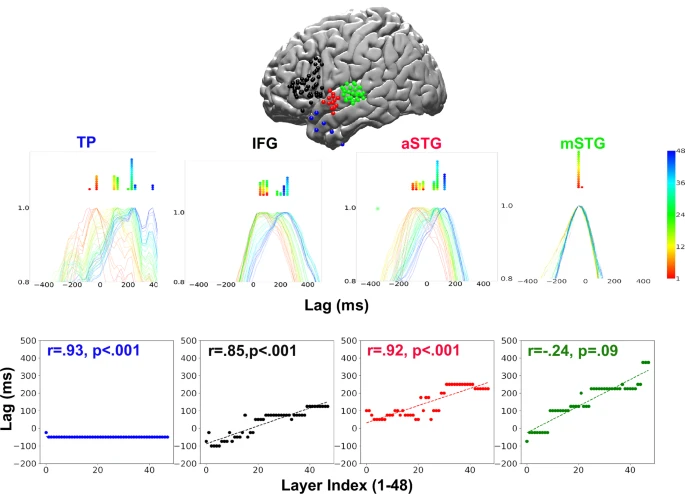
Target brain regions included four areas along the language processing stream: middle superior temporal gyrus (mSTG, 28 electrodes), anterior superior temporal gyrus (aSTG, 13 electrodes), inferior frontal gyrus (IFG, 46 electrodes) and temporal pole (TP, 6 electrodes). Electrodes were selected based on prior significant encoding performance for static embeddings (GloVe). The authors trained linear encoding models that used embeddings from each model layer to predict neural responses. Performance was measured as the correlation between real neural signals and model predictions.
To distinguish prediction effects, words were categorized as "predicted words" (the top‑probability word from GPT‑2 XL; 1,709 tokens) and "non‑predicted words" (words not in the top‑5 probabilities; 1,808 tokens). The authors also compared LLMs with classical symbolic methods, including phonemic, morphological, syntactic and semantic symbolic representations.
Main results
In the inferior frontal gyrus (IFG, commonly associated with Broca’s area), encoding results revealed a temporal sequence: early LLM layers peaked in encoding performance near word onset, while later layers peaked at progressively later times. This suggests that the hierarchical transformations in LLMs map onto cortical temporal receptive windows, with early layers processing immediate information and later layers integrating longer context. The pattern was more pronounced for predicted words, indicating that accurate model prediction enhances alignment with brain dynamics.
Extending the analysis across other language regions, the study confirmed cumulative information processing along the language pathway: from auditory regions (mSTG) to syntactic‑semantic regions (IFG), temporal receptive windows lengthened. This replicates neuroscientific findings that information accumulates along the language pathway. Middle‑layer embeddings provided the best predictions of cortical activity, and the high spatiotemporal resolution of ECoG revealed precise alignment between model layers and temporal brain dynamics.
Compared with symbolic methods, LLMs showed significantly superior performance in predicting brain dynamics. Symbolic representations (e.g., phoneme trees or syntactic trees) failed to capture temporal sequences, whereas LLM embeddings, transformed through nonlinear layered computations, better approximated neural responses. These results support the view that LLMs provide a more powerful cognitive model for temporal aspects of language processing.
The study also replicated previous findings that middle model layers most accurately predict brain activity, while emphasizing the temporal correspondence of the layerwise sequence. Results generalized to Llama‑2, indicating that the observed alignment is not limited to a single model architecture.
Discussion and significance
Key contributions of the study include: first, evidence that the layerwise computations of LLMs can model the temporal dynamics of language comprehension in Broca’s area, suggesting the brain’s temporal processing resembles hierarchical progression in LLMs; second, validation across multiple language regions, reproducing the neuroscientific result of hierarchical information accumulation and supporting LLMs as models of spatiotemporal language processing in cortex; third, demonstration of LLMs’ advantage over symbolic approaches and provision of benchmark datasets for future theory testing; and finally, release of aligned neural and linguistic data as a public resource for free speech comprehension dynamics.
Limitations noted by the authors include potential data contamination that could affect LLM performance (although paid materials were used), that benchmark evaluations assess isolated knowledge and do not capture real‑world uncertainty, and that ethical and syntactic challenges remain weaknesses for current AI. The study opens avenues for comparing LLMs with other language theories, such as traditional symbolic models or emerging hybrid approaches.
Overall, the paper bridges AI and neuroscience, indicating that LLMs are not only engineering tools but also viable frameworks for understanding brain language processing. Future work can extend these analyses to other modalities (e.g., reading or language production) or evaluate additional LLMs (such as GPT‑4 series) to further elucidate human cognitive mechanisms.
▶️ Enjoyed this article? Creating content takes real effort!
Follow our YouTube channel:
AI Rosetta
Your likes, subscriptions and shares are our greatest support! 🙏
More AI news at: https://www.airosetta.com