
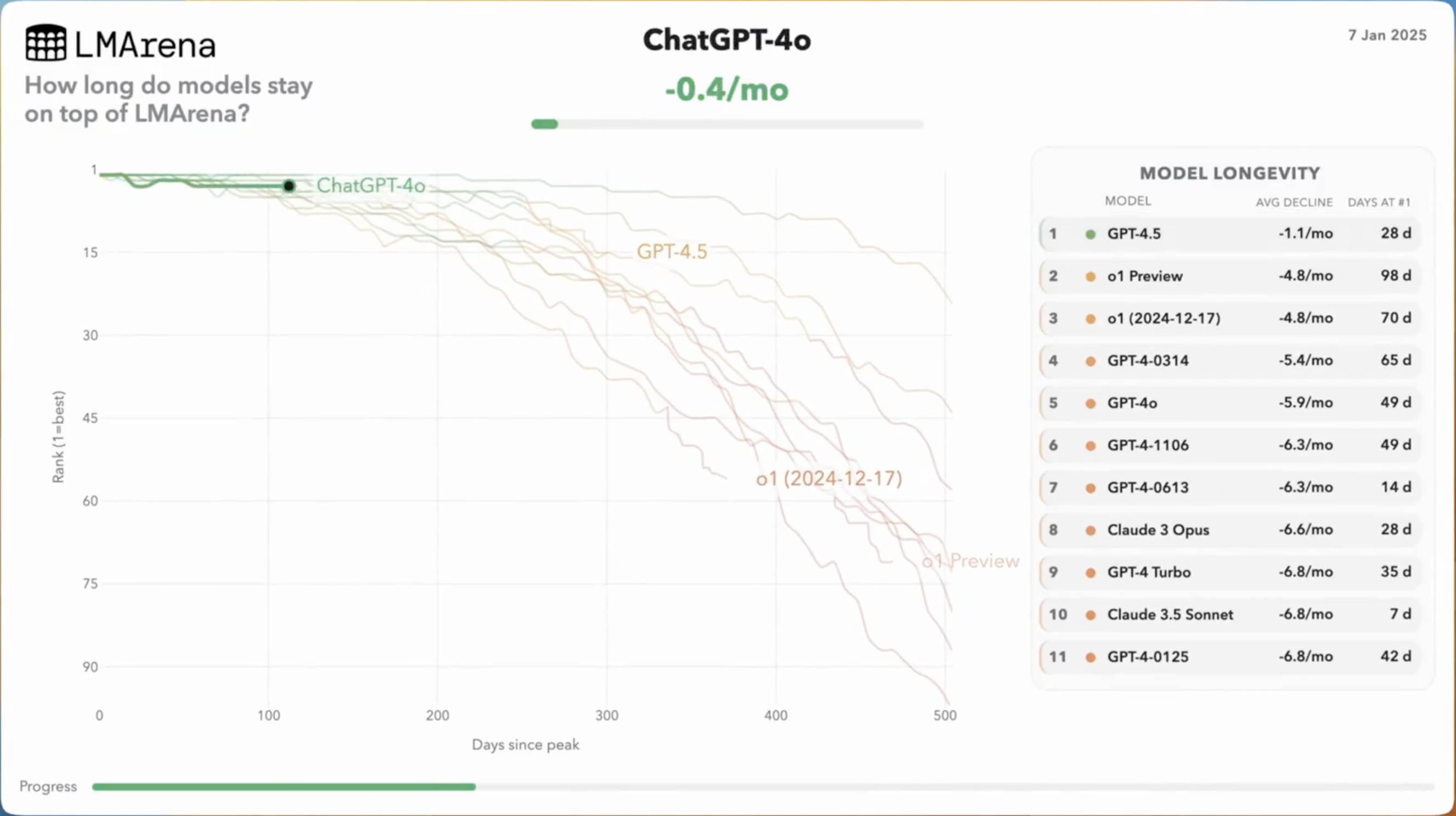
In the field of artificial intelligence, performance evaluation of large language models (LLMs) has become a focal point for developers, researchers and enterprises. The LMSYS Chatbot Arena (known as LM Arena or lmarena), a globally recognized open leaderboard, ranks various large models in real time through crowd voting and an Elo scoring system. Since its launch in 2023 the leaderboard has become a "gold standard" for measuring model capability, influencing R&D directions at giants from OpenAI to Anthropic. Recent analyses show that since GPT‑4 took the top spot in mid‑2023, models have averaged only about 35 days at No.1, meaning leadership in AI is turning over at an astonishing pace. This phenomenon not only reflects accelerating technical progress but also has profound implications for product development and commercial applications. Based on LM Arena historical data and other authoritative sources, this article explores the causes, cases and implications of this trend.
Evolution of the LM Arena leaderboard and statistical insights
LM Arena is maintained by the LMSYS team at the University of California, Berkeley, and collects user preference data via anonymous random pairwise matches to produce Elo scores (similar to chess ratings). Since going live in May 2023, the leaderboard has processed millions of votes and covered hundreds of models. From mid‑2023 onward, OpenAI's GPT‑4 initially held the top spot with strong multimodal capability and reasoning performance, but that dominance was soon challenged.
According to LMSYS official analysis, since the GPT‑4 era, models that reached No.1 have averaged only about 35 days at the top. This figure is far shorter than earlier expectations—not half a year or a year, but measured in months. Even more striking, many models fall out of the Top 5 roughly five months after peaking, and struggle to remain in the Top 10 after seven months. Stanford HAI's 2025 AI Index report corroborates this trend: both closed models (such as the GPT family) and open models (such as the Llama family) have shown large leaderboard volatility, with turnover accelerating from a quarterly cadence to a monthly one between 2023 and 2025.
Looking back, GPT‑4 rose to the top after its March 2023 release and maintained a lead for a period, but by early 2024 it was briefly overtaken by Anthropic's Claude 3 Opus. Later, OpenAI's GPT‑4o (May 2024) — with approximately a 78‑day lead — became one of the longest‑running top models. In mid‑2024 Anthropic's Claude 3.5 Sonnet and OpenAI's o1‑preview successively reached the top: the former emphasized efficient reasoning, while the latter introduced a "chain‑of‑thought" style mechanism and was hailed as a leading reasoning model. Into 2025 iterations accelerated further: Google's Gemini 1.5 Pro, Meta's Llama 3.1‑405B, and subsequent GPT‑5 and Claude 4 variants rotated through the top positions. By January 2026 the leaderboard's top models had become GPT‑5.2 (Elo ~1350+), Claude Opus 4.5 (close behind) and Gemini 3 Pro; these newcomers benefited from larger training datasets and optimized algorithms.
LM Arena historical visualizations on the Observable platform show that while model families (e.g., the GPT series) accumulate more total leading days, individual version "dynasties" are extremely short. Some models held the lead for only a few weeks, closely related to AI hardware advances (such as the upgrade from NVIDIA H100 to B200 GPUs) and shifts in training paradigms (for example, wider adoption of Mixture‑of‑Experts architectures). TechCrunch has noted that industry fascination with LM Arena has driven competition but also exposed benchmark limitations: it emphasizes general chat rather than specialized tasks. Nevertheless, the leaderboard remains a "wild benchmark" that reflects genuine user experience.
Typical cases: from peak to decline
Concrete examples highlight the impact. OpenAI's o1 model (released September 2024) briefly dominated with advanced reasoning and the "o1 thought" mode, viewed as a generational leader. It quickly topped LM Arena and sparked talk of an "AI new era" on Reddit and X. By January 2026 o1 had fallen to 56th place, far surpassed by later models such as GPT‑5 and the Claude 4 series. Similarly, Anthropic's Claude 3 Opus (released March 2024) briefly overtook GPT‑4 and was celebrated for complex‑task performance, but it has since slid to 139th, well below the current Top 20. OpenLM.ai's extended leaderboard shows Claude 3 Opus with an Elo around 1265 while Top models exceed 1300.
These cases are not isolated. Gemini 1.5 Pro ranked among the top three in 2024 but was replaced by successors by the end of 2025. Vellum AI's analysis found that although o1 outperformed GPT‑4o and Claude 3.5 Sonnet on reasoning benchmarks, its overall generality was insufficient to withstand the influx of new models. Stanford HAI further observed that between 2024 and 2025 closed models' win rates on the leaderboard fell from 60% to 50%, while open models (such as the Llama family) accelerated catch‑up through community optimization. This rapid turnover stems from exponential growth in compute resources: training a top model remains costly, but the return cycle has shortened, prompting major players to release updates more frequently.
Deeper impact: base model capabilities "flattening" the product layer
The core implication is that improvements in base model capabilities now outpace the update cycles of most AI products. Traditional software development cycles are 3–6 months, while model turnover is about 35 days, meaning product teams integrating an older model may find a new leader has already emerged — producing a "reverse flattening" in which product features are driven by rapid progress in underlying models rather than the other way around.
For example, enterprise AI applications (such as chatbots or code assistants) built on Claude 3 Opus can be outcompeted within months. Clarifai's 2026 AI trends report warns that in 2026 LLMs like GPT‑5, Gemini 3 and Claude 4 will dominate the market, and enterprises should migrate toward model‑agnostic architectures to cope with rapid replacements. Analyses on Medium also predict that AI development trends in 2026 will emphasize platform integration over reliance on a single model. The rise of multimodal leaderboards (such as LMSYS's multimodal Arena) further accelerates this process, and Claude 3 Opus's multimodal advantage eroded quickly.
From a commercial perspective, this compresses moats: companies like OpenAI may lead but their advantage windows have shrunk to months, forcing faster release cadences (for example from GPT‑4 to GPT‑5). FelloAI's 2026 best‑AI rankings show current top models upgrading context windows, pricing and multimodal capabilities, yet real user data indicate ranking volatility affects adoption. Deepchecks' benchmark evaluations emphasize that while Claude 3 Opus still excels on certain subtasks, its overall decline highlights the harshness of constant iteration.
Outlook: acceleration and challenges in AI development
Overall, LM Arena statistics reveal a Moore's‑law‑like acceleration in AI: from GPT‑4 in 2023 to GPT‑5.2 in 2026, model performance appears to double roughly every six months. This drives innovation but also brings challenges such as concentration of compute among a few giants and the risks of overreliance on single benchmarks. The industry should pursue broader evaluation suites combining measures like MMLU and HumanEval to mitigate single‑leaderboard bias.
In this wave there is no eternal ruler. Developers should embrace agile iteration, and enterprises must build flexible ecosystems to avoid being "reverse‑flattened." As LMSYS states, Arena is not only a ranking but a mirror of AI evolution. Looking toward 2026, AI's golden age is only beginning, but speed has become the decisive factor.
▶️ Enjoy this article? Creating it takes real effort!
Follow our YouTube channel:
AI Rosetta
Your likes, subscriptions and shares are our greatest support! 🙏
More AI news at: https://www.airosetta.com