
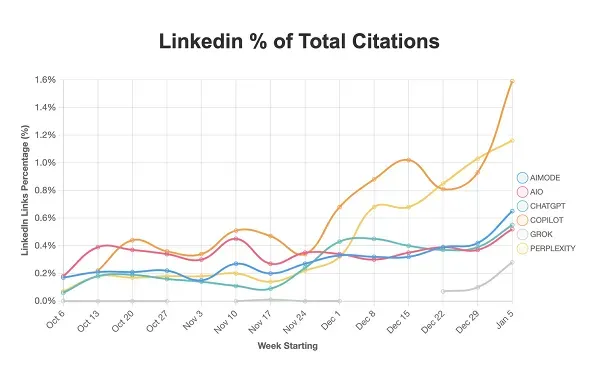
Against a backdrop of declining search‑engine traffic, LinkedIn articles are becoming a popular citation source for AI chatbots. According to Social Media Today’s latest report, LinkedIn has risen to become the second‑largest citation source in AI tools, behind Reddit. The trend reflects AI content generation shifting from traditional search toward a generative engine model, requiring creators to adjust strategies for "Generative Engine Optimization" (GEO).
Declining Search Traffic and the Rise of AI Citations
Global digital media are facing sharp drops in referral traffic. Press Gazette, citing Chartbeat and the Reuters Institute, reports that as of November 2025 Google search referrals to publishers have fallen by one‑third; since May 2023 Google Search referrals are down 21%, Google Discover down 18%, and total external referrals down 24%. Many sites report Google traffic declines of 20%–50%, directly affecting monetization and visibility.
At the same time, AI chatbots such as ChatGPT, Google AI and Perplexity are reshaping how people get information. A SEMRush study analyzing 230,000 prompts across ChatGPT, Google AI and Perplexity in October 2025 found LinkedIn to be the second‑largest citation source in AI responses, after Reddit. This ranking highlights LinkedIn’s authority in professional content, especially for B2B and career‑related queries.
Further Spotlight data reinforce the trend: over the past three months ChatGPT’s citations of LinkedIn rose 4.2x, Perplexity’s rose 5.7x, and the average citation rate across large language models (LLMs) increased roughly 4–5x. The Spotlight database recorded 19,202 LinkedIn source citations in total, with more than 15,000 coming from the LinkedIn Pulse article platform. This indicates AI tools increasingly favor LinkedIn’s native content rather than external links.
Why Citations Are Increasing
The surge in AI citations of LinkedIn articles is not accidental. Spotlight’s Michael Hermon noted that over the past three months Spotlight’s extensive database shows ChatGPT’s citations of LinkedIn increased 4.2x, Perplexity 5.7x, and the average across LLMs about 4–5x. Of the 19,202 LinkedIn sources recorded, over 15,000 were LinkedIn Pulse articles. This growth may stem from how AI evaluates source reliability.
LinkedIn’s unique ecosystem is a key factor. As a professional social platform, LinkedIn emphasizes user verification, including real names, employment histories and company affiliations, which enhances content authority and credibility. AI chatbots may use these signals (such as the completeness and activity of LinkedIn profiles) to gauge source trustworthiness, although exact algorithmic details are not public. By contrast, Reddit’s higher citation rate likely reflects its community‑driven, real‑time discussions, while LinkedIn excels in professional depth.
In addition, the structured nature of LinkedIn Pulse articles (for example, clear headlines, summaries and keyword‑friendly formats) makes them easier for AI to extract and cite. Unlike traditional SEO, GEO emphasizes credibility and contextual relevance. Experts suggest that LinkedIn content may carry increasing weight in AI training data, further driving this trend.
Comparison with Other Platforms
Among AI citation sources, LinkedIn ranks second to Reddit and well ahead of other social platforms. Reddit’s diversity and immediacy (such as subreddit discussions) make it the top source for general queries. LinkedIn, focused on career and industry insights, is particularly suited to business, technology and professional development topics.
Other platforms like Twitter (X) or Facebook have lower citation rates, possibly due to fragmented content and higher noise. SEMRush’s research shows citation‑source diversity in AI responses is increasing, but professional platforms like LinkedIn are growing fastest. This contrasts with declining Google traffic: traditional search relies on external links, while AI tools increasingly integrate reliable sources directly.
The contrast highlights a shift in the content ecosystem: from "click‑driven" models to "response integration." Publishers such as The New York Times and BBC have seen severe traffic losses, while closed ecosystems like LinkedIn benefit from AI’s internalized citations.
Impact on Creators and SEO
The trend creates new opportunities for creators. Social Media Today recommends publishing native articles on LinkedIn and engaging in vertical communities (for example, tech or marketing groups) to improve visibility in AI responses. Updating employment history, verifying company identity and building interactions can enhance AI trust scores for content.
From an SEO perspective, traditional tactics (like keyword stuffing and backlinks) are giving way to GEO strategies. These include producing high‑quality, authoritative content and distributing it on platforms favored by AI. LinkedIn Pulse’s citation dominance suggests creators should prioritize platform‑native publishing rather than relying solely on website blogs. Spotlight’s research indicates this can help offset declining Google traffic and maintain brand exposure in the AI era.
However, challenges remain. The opacity of AI citations can create a "black box" problem that makes it hard for creators to track impact. Overreliance on a single platform such as LinkedIn may also increase content homogenization.
Expert Views and Outlook
Hermon of Spotlight says LinkedIn’s rise "offers creators a way to shape AI chatbot responses by sharing expertise and building a presence in professional communities." SEMRush’s Louis Ifnewman adds that the trend underscores the role of authoritative sources in AI responses and recommends creators diversify their platform strategies.
Looking ahead, as AI tools like ChatGPT and Perplexity become more widespread, LinkedIn may become a primary citation source in certain fields. By 2026 GEO is expected to become mainstream, and creators should invest in professional social networks. Press Gazette warns that if traffic declines persist, publishers may need to shift toward paywalls and AI partnership models.
Overall, the increase in LinkedIn article citations in AI responses signals a profound change in the digital content ecosystem. Creators should seize the opportunity to optimize content for the AI era, ensuring authority and relevance remain core strengths.
▶️ Like this article? Creating is hard work!
Subscribe to our YouTube channel:
AI Rosetta
Your likes, subscriptions and shares are our greatest support! 🙏
More AI news at: https://www.airosetta.com