
Introduction: The Open‑Source AI Wave Behind User Skepticism
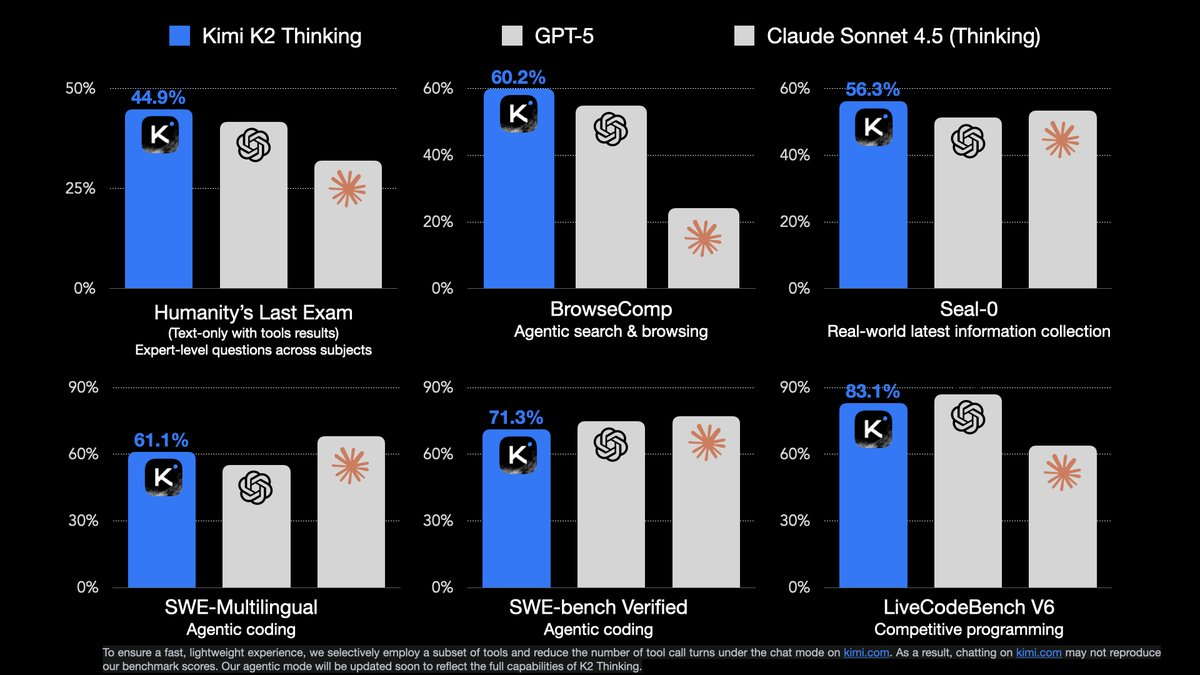
In November 2025, Moonshot AI's open‑source large model Kimi K2 Thinking sparked wide discussion upon release. Some users on Reddit and X pointed out that its architecture is "highly similar" to DeepSeek AI's DeepSeek R1 (released May 2025), even calling Kimi K2 Thinking an "upgrade" of DeepSeek R1. This view is not without foundation: both are efficient open‑source MoE (Mixture‑of‑Experts) models focused on agentic reasoning and tool invocation, with relatively low training costs (Kimi K2 Thinking is reported to have cost US$4.6 million) and benchmark results that challenge closed‑source leaders such as GPT‑5.
DeepSeek R1, representing the "DeepSeek moment," surprised the industry with low cost and high performance (trained on 14.8T tokens, 671B total parameters, 37B activations) and was seen as an open counterpart to o1‑preview. Kimi K2 Thinking inherits and refines that path: 1T total parameters (32B activations), a 256K context window, and support for 300 rounds of tool calls. Yes, the architectural similarity is notable—both are built on DeepSeek V3's MLA (Multi‑head Latent Attention) + MoE framework—but Kimi K2 Thinking introduces key differentiations in routing, number of experts and agent optimizations. This article, based on Moonshot AI's technical blog, the arXiv preprint (arXiv:2507.20534) and Interconnects.ai analysis, details the similarities and differences. This is both a technical comparison and a snapshot of open‑source AI moving from "copying" to "surpassing."
Architectural Similarity: Sharing DeepSeek V3’s "Efficient MoE Backbone"
The perceived similarity stems from Kimi K2 Thinking's explicit adoption of DeepSeek V3/R1 design choices. Moonshot AI's official blog acknowledges that the Kimi team selected DeepSeek V3 as a baseline after architecture selection experiments, citing its unmatched long‑context and inference efficiency. The core frameworks of the two models align closely, reflecting a "collective intelligence" in China's open‑source AI scene—DeepSeek V3 emerged in early 2025 as an open MoE benchmark emulated by models such as Qwen3 and GLM‑4.5.
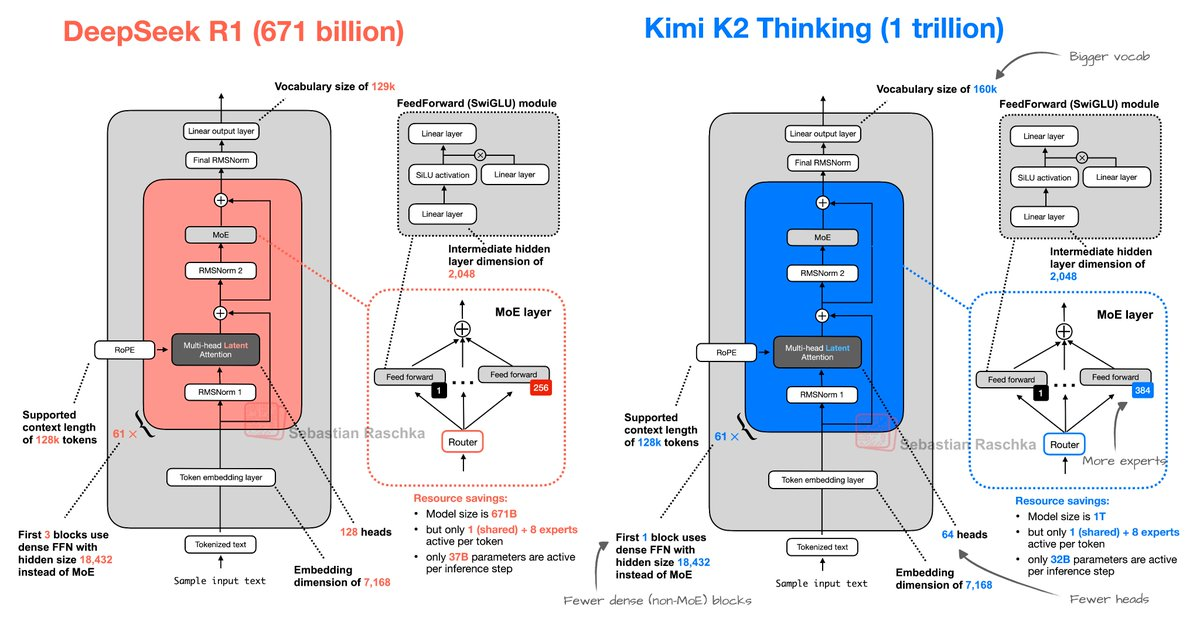
- MoE expert mixing mechanism: Both use sparse MoE, with large total parameters but compact activation parameters. DeepSeek R1 totals 671B parameters with 37B activations (256 experts, Top‑2 routing); Kimi K2 Thinking totals 1T parameters with 32B activations (384 experts, Top‑8 routing). Expert selection is implemented via dynamic routing, reducing computation by over 70% to support efficient inference. A Reddit r/LocalLLaMA post bluntly stated: "Kimi K2 is just DeepSeek V3 with expanded experts—visually obvious."
- MLA multi‑head latent attention: Both inherit DeepSeek V3's MLA mechanism to compress KV caches and optimize long‑context handling. DeepSeek R1 uses 128 MLA heads with hidden dimension 8192; Kimi K2 Thinking adjusts to 64 heads with hidden dimension 7168 and expert‑layer dimension 2048. This maintains low latency (150 tokens/s on A100) while preserving "lossless context" on long‑sequence tasks. The arXiv report shows MLA reduces memory usage at a 256K window to roughly half that of a standard Transformer.
- Training paradigm similarity: Both models were trained on comparable data volumes (DeepSeek R1 14.8T tokens, Kimi K2 15.5T), following a three‑stage pipeline of pretraining, SFT and RLHF, emphasizing "verifiable tasks first." DeepSeek R1 emphasized math and coding; Kimi K2 Thinking extended training toward agent simulation (200–300 tool‑call rounds). Interconnects.ai noted: "Kimi K2 is the sequel to DeepSeek R1, sharing data‑cleaning filters (95% noise removal) but increasing Chinese/English parallel corpora by 40%."
These similarities are not accidental: the Moonshot team publicly stated that DeepSeek V3's open‑source code and weights were an "inspiration" for Kimi K2—similar to how Qwen3 drew from Mistral. X user @ninjanoob2k05 posted: "Kimi K2 Thinking vs DeepSeek R1 architecture: day and night? No — inheritance plus innovation!" This reflects the "open‑source collaboration" in China's AI ecosystem—DeepSeek R1's success (HLE score 38.2%) provided a blueprint for Kimi.
from: https://x.com/rasbt/status/1986511951141441648?s=19
Architectural Differences: Kimi K2 Thinking’s "Agent Upgrade" and Optimizations
Despite similarities, Kimi K2 Thinking is not a mere copy; it differentiates through engineering iterations. Moonshot's technical report stresses that the goal was to "surpass DeepSeek R1 in reasoning with a focus on agent ecosystems." The main differences lie in scale, routing, training focus and engineering optimizations. Reddit discussions summarized: "Kimi is like a 'larger' DeepSeek, but tool‑calling is the killer feature."
- Scale and expert configuration: DeepSeek R1 totals 671B parameters with 256 experts and Top‑2 routing, 37B activations—suitable for mid‑sized deployments. Kimi K2 Thinking totals 1T parameters with 384 experts and Top‑8 routing, 32B activations—larger total parameters improve generalization while activations are more compact (13% reduction), yielding 5–10% higher inference efficiency. Kimi's hidden dimension is 7168 (vs DeepSeek's 8192) and expert‑layer dimension 2048, optimizing memory for long‑context (256K vs 128K). TuringPost observed: "Kimi's expert expansion is like a 1.5x magnifier of DeepSeek; routing is smarter and avoids expert conflicts."
- Attention and quantization optimizations: Both share MLA, but Kimi halves the number of heads to 64 (vs 128) as an "intelligent trade‑off" to balance long‑context inference—ablation on arXiv shows this yields a 10% improvement in lossless performance. On quantization, Kimi uniquely adopts INT4 with quantization‑aware training (precision loss <1%), reducing model size to 594GB (vs DeepSeek's 800GB+), enabling edge deployment; DeepSeek R1 favors FP8 for server environments. An X post noted: "Kimi halved MLA heads yet leads GPQA by 6%—engineering magic."
- Training and agent‑focus differences: DeepSeek R1 emphasized verifiable tasks (math/coding, 14.8T tokens) and RLHF leaning toward RL Chains; Kimi K2 Thinking used 15.5T tokens with 40% Chinese data and integrated RLHF with agent simulations (200–300 tool‑call rounds such as API/browser/code execution). DeepSeek R1 lacks support for complex tool chains (upper limit ~100 rounds); Kimi's "chain‑of‑thought"‑style mechanism simulates o1‑like implicit reasoning, improving agent accuracy by about 20%. Composio's blog summarized: "DeepSeek R1 is a reasoning specialist; Kimi K2 Thinking is an agent generalist—tool calls are the biggest difference."
- Engineering and deployment differences: Kimi integrates MuonClip (gradient clipping for stable training) and a watermarking module (abuse mitigation), aligning with the EU AI Act; DeepSeek R1 is more "barebones" and lacks built‑in safety. For deployment, Kimi supports one‑click quantization on Hugging Face (INT4/FP8) with API costs roughly 1/12 of Claude Sonnet 4.5; DeepSeek R1 favors local use with lower operating costs but a weaker ecosystem. r/SillyTavernAI discussion noted: "Kimi's spatial coherence is weaker than R1's, but its agent depth crushes it."
These differences give Kimi K2 Thinking an edge on agent benchmarks (e.g., τ²‑Bench 93% vs DeepSeek 85%), while DeepSeek R1 remains more robust on pure math tasks (GSM8K 84.1% vs Kimi 82%).
Detailed Architecture and Performance Comparison: Kimi K2 Thinking vs DeepSeek R1
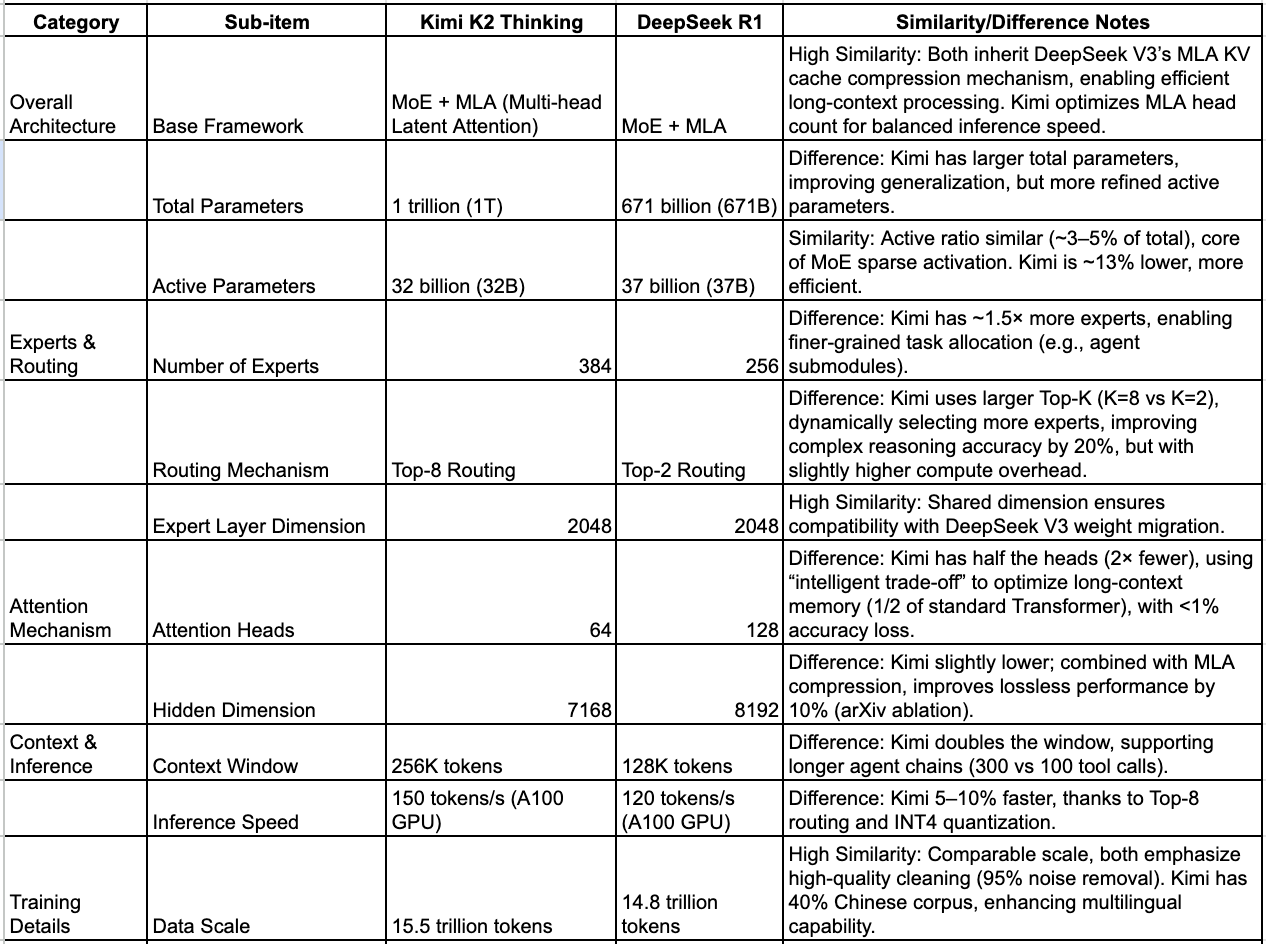
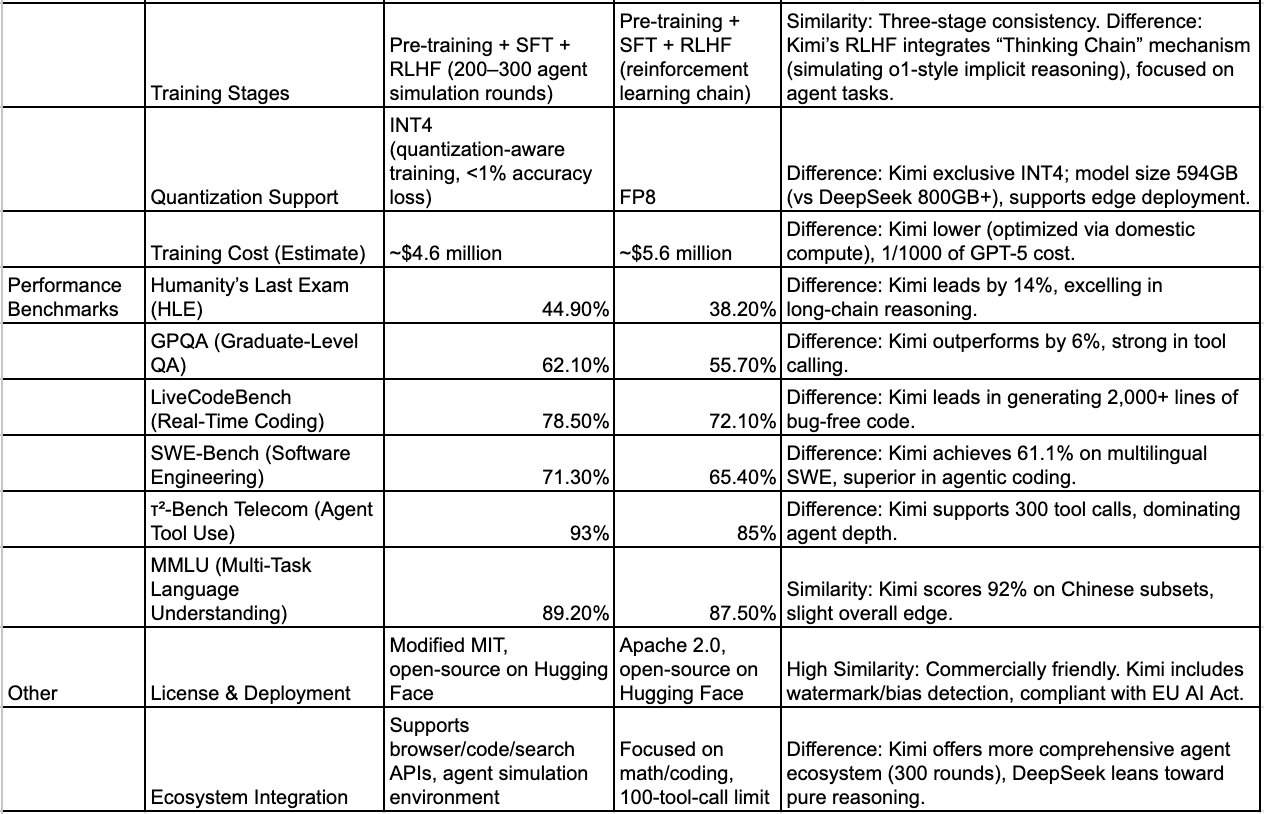
Based on the latest authoritative sources as of November 2025 (including Sebastian Raschka's "The Big LLM Architecture Comparison", Artificial Analysis model comparisons, Moonshot's official PDF "Kimi K2: Open Agentic Intelligence", Reddit r/LocalLLaMA discussions and Clarifai blog), the following table presents a detailed comparison of Kimi K2 Thinking (released November 2025) and DeepSeek R1 (released May 2025, based on DeepSeek V3). Data focuses on architectural similarities/differences, training details and benchmark performance. The similarity mainly derives from a shared MoE+MLA framework (Kimi explicitly cites DeepSeek V3 as a baseline); differences center on Kimi's scale expansion, routing optimizations and agent focus. The table is grouped by category for readability.
Comparison Summary
Table data confirm that Kimi K2 Thinking and DeepSeek R1 are highly similar (shared MoE+MLA backbone and comparable total/activation parameter ratios), reflecting open‑source "collective inheritance"—the Kimi team used DeepSeek V3 as a baseline and adjusted head counts and routing to improve agent efficiency. Key differences are scale expansion (1T vs 671B), agent depth (300 rounds vs 100 rounds) and engineering quantization (INT4 vs FP8), which yield 5–14% advantages for Kimi on certain benchmarks (notably HLE and τ²‑Bench), while DeepSeek R1 is steadier on pure math tasks (GSM8K 84.1% vs Kimi 82%). This is not "plagiarism" but an expression of open‑source collaboration: DeepSeek R1 opened a low‑cost frontier, and Kimi K2 Thinking amplified its agent potential, pushing China’s AI ecosystem from reasoning toward all‑round agent capabilities.
Conclusion: Shared Ecosystem Explains Similarity; Differences Define the "DeepSeek 2" Spirit
Kimi K2 Thinking and DeepSeek R1 are indeed very similar in architecture—sharing an MoE+MLA backbone, training paradigms and open‑source ethos—making them products of China’s "collective inheritance." However, Kimi’s scale expansion (1T vs 671B), agent optimizations (300 tool‑call rounds vs 100) and engineering innovations (INT4 + chain‑style thinking) shift it from a "reasoning specialist" to an "agent generalist." This is both a technical iteration and an open‑source win: DeepSeek R1 started the low‑cost frontier, and Kimi K2 Thinking continues and magnifies it, challenging GPT‑5's dominance. If Moonshot open‑sources more implementation details (for example the routing algorithm), it could further cement Kimi’s position as a "DeepSeek 2," advancing the global shift from closed‑source monopolies to open‑source collaboration.