
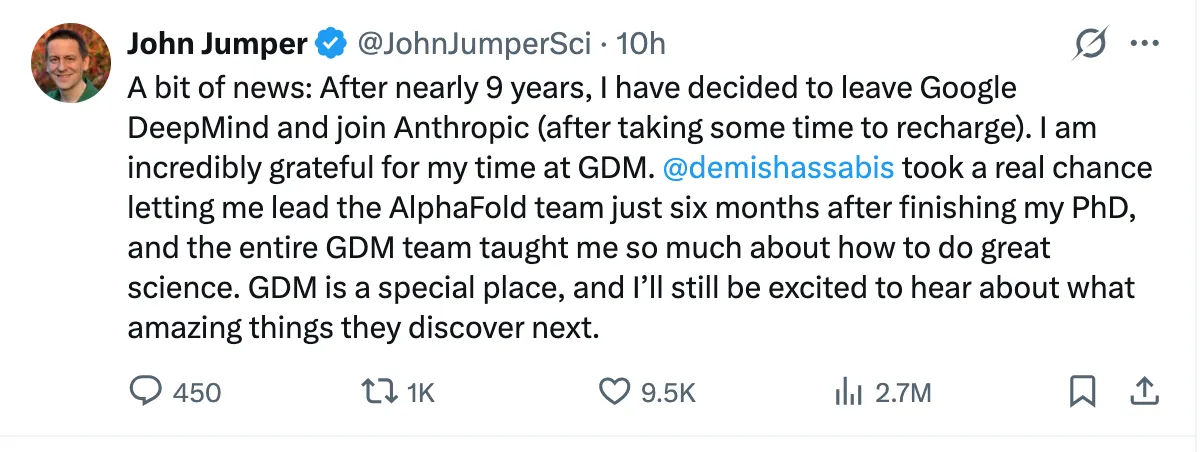
On June 19, 2026, Google DeepMind senior research scientist and 2024 Nobel Prize in Chemistry laureate John Jumper announced on X that after nearly nine years he has decided to leave Google DeepMind to join competitor Anthropic. The news quickly sent shockwaves through the global AI community, seen as another major example of talent loss at Google and underscoring the intensity of the current competition for top AI talent.

Jumper wrote on X: "After nearly nine wonderful years at DeepMind, I have decided to leave and join Anthropic (I will take some time off before officially starting)." DeepMind CEO Demis Hassabis later posted to thank Jumper for his contributions and wished him well in his new role.
John Jumper: Background and Achievements
John Jumper is a leading scientist at the intersection of AI and biology, credited with helping to solve the "protein folding problem." He was born in the United States on January 1, 1985, earned dual bachelor's degrees in physics and mathematics from Vanderbilt University in 2009, and then pursued theoretical chemistry at the University of Chicago, receiving his PhD in 2017. During his doctorate, his research focused on computational biophysics and the application of machine learning to molecular simulation.
After completing his PhD in 2017, Jumper joined Google DeepMind and within six months became one of the principal leaders of the AlphaFold project. The AlphaFold systems developed under his leadership used deep learning to revolutionarily solve the protein folding problem that had challenged biology for more than 50 years. Previously, traditional methods could take years or decades to determine a protein's 3D structure; before AlphaFold's release, roughly 200,000 structures had been solved over decades, whereas AlphaFold2 has predicted about 200 million protein structures and published databases and open‑source resources.
In 2024, Jumper and DeepMind CEO Demis Hassabis jointly received the Nobel Prize in Chemistry — the first time scientists from the AI field received a Nobel — recognizing their pioneering contributions to protein structure prediction. The release of AlphaFold2 was hailed as a "ChatGPT moment for biology," and its predicted protein structure database, covering nearly 200 million protein structures, has become a standard tool for biomedical researchers worldwide.
Jumper's contributions extend beyond AlphaFold. During his time at DeepMind he participated in multiple interdisciplinary projects, applying AI to drug discovery, enzyme engineering, and studies of disease mechanisms. His work has significantly accelerated drug development, playing key roles in areas such as oncology drugs, COVID‑19–related protein research, and antibiotic development. Colleagues describe Jumper's research style as rigorous, cross‑disciplinary and practically oriented — a rare talent who understands cutting‑edge theory and can turn ideas into world‑class systems.
After joining Anthropic, Jumper is expected to focus on research in biological AI and scientific agents, helping Anthropic advance in protein design, molecular simulation and scientific discovery agents.
Recent Talent Exodus at Google DeepMind
Jumper's move to Anthropic is not an isolated case. In recent months, Google has lost several core talents:
- Noam Shazeer (second author of the Transformer paper, co‑lead on Gemini) joined OpenAI in mid‑June.
- Several other senior researchers have also moved to competitors such as Anthropic and OpenAI.
This wave of "talent outflow" has been interpreted in the industry as evidence of pressure on Google's AI strategy execution, compensation incentives and research autonomy. Anthropic and OpenAI have successfully attracted some of Google's top talent by offering large equity incentives, a more focused sense of mission and more flexible research environments.
Potential Consequences and Industry Impact
Impact on Google DeepMind:
- Weakened technical capacity: Jumper's expertise in protein AI and scientific computing will be difficult to replace in the short term, potentially slowing DeepMind's progress in biological AI and multimodal scientific models.
- Lowered morale and attractiveness: Continued departures may affect team stability and reduce DeepMind's appeal to external top talent.
- Pressure to adjust strategy: Google may need to reassess compensation structures, research directions and internal culture to retain and attract core personnel.
Impact on Anthropic:
- Capability leap: Jumper's arrival will significantly strengthen Anthropic's capabilities in biological AI and scientific computing, aiding Claude's applications in drug discovery and protein design.
- IPO boost: This high‑profile hire is likely to enhance Anthropic's valuation and market confidence, providing strong support ahead of a potential IPO.
- Stronger competitive position: Anthropic's layout in safety alignment and scientific AI will become more complete, narrowing gaps with OpenAI and Google.
Impact on the wider AI industry:
- Talent war intensifies: Poaching between OpenAI, Anthropic, Google DeepMind, Meta and other leaders is escalating, driving up compensation and equity incentives for top AI talent.
- Accelerated cross‑disciplinary integration: Movement of researchers with physics and biology backgrounds will deepen AI's integration with basic sciences, potentially spurring more breakthrough applications.
- Industry ecosystem differentiation: Talent shifts may accelerate Google's transition from a general platform focus toward more vertical scenarios, while emerging players like Anthropic rise rapidly through aggressive hiring.
Conclusion
John Jumper's move from Google DeepMind to Anthropic is one of the most emblematic events in AI talent mobility in 2026. It not only highlights the challenges Google faces in retaining top talent but also underscores the rapid rise of companies like Anthropic in strategic positioning and attractiveness.
As AI competition enters a new phase where talent is paramount, building a stable and effective talent ecosystem will be a core issue for every leading AI company. DeepMind's continued departures may become an important catalyst for strategic adjustments, while Anthropic further consolidates its position in AI safety and scientific computing.
▶️ Enjoy this article? Creating it takes a lot of work!
Subscribe to our YouTube channel:
AI Rosetta
Your likes, subscriptions and shares are our greatest support! 🙏
For more AI news visit:https://www.airosetta.com