
July 16–17, 2026, the 67th International Mathematical Olympiad (IMO) was held in Shanghai, China. After two days of competition on six highly challenging problems, seven high‑school contestants achieved perfect scores of 42/42 and received gold medals, with China and the United States placing first and second in the team rankings. At the same time, on X, former Google engineer Deedy Das ran benchmark tests on the official contest problems using several state‑of‑the‑art large language models (LLMs). Multiple leading models also achieved perfect 42/42 scores, marking a significant breakthrough for AI in complex mathematical proofs. Anthropic's Claude Fable 5, OpenAI's GPT‑5.6 Pro/Sol, Moonshot AI's KIMI K3, and Axiom Math's AxiomProver performed strongly on high‑difficulty testbeds such as IMO‑ProofBench. This achievement continues the rapid evolution of AI mathematical ability—from a silver‑level performance in 2024 and gold in 2025 to perfect scores in 2026—and has far‑reaching implications for mathematics education, scientific research, and AI development.
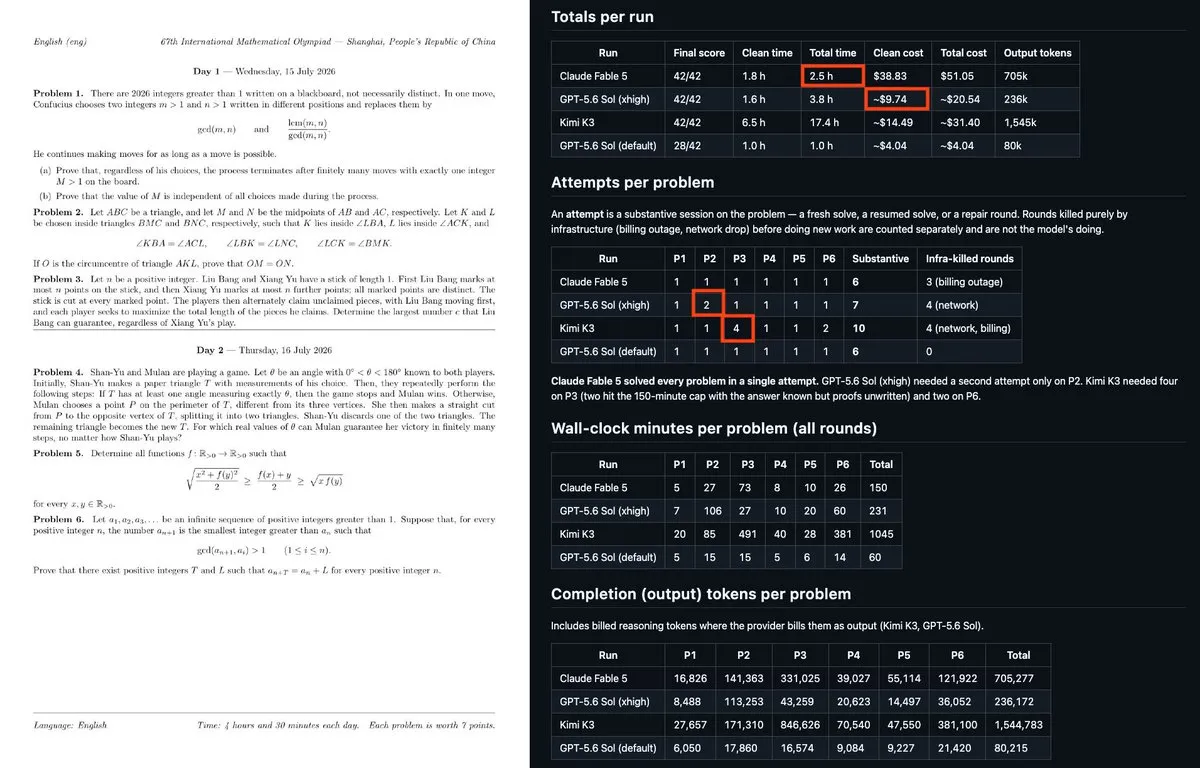
IMO 2026 Problem Test Overview
The IMO is the world’s premier mathematics competition for high‑school students and is known for its extreme difficulty. Its six proof problems demand rigorous logic and creative insight. As a reference, over the past seven years 4,347 students competed and only 30 perfect scores were recorded, representing about 0.69% of participants. The AI benchmark used the actual 2026 problems and combined human evaluation with automated verification for scoring. Several models produced complete, zero‑error proofs with logically coherent and rigorous steps.
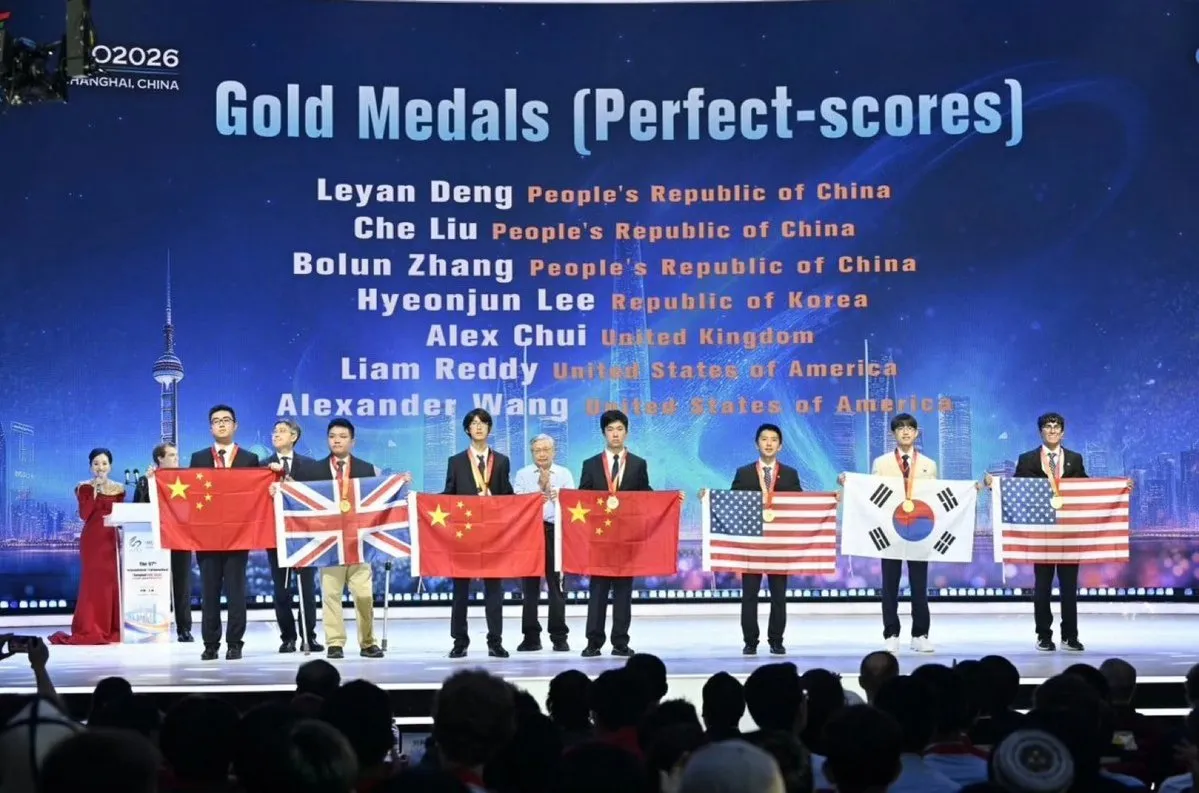
Key perfect‑score models:
— Claude Fable 5: solved each problem on the first attempt and was the fastest overall, taking 2.5 hours and costing $51.
— GPT‑5.6 Sol: required one additional attempt compared with Claude Fable 5, and was the least costly, taking 3.8 hours and costing $20.
— KIMI K3: solved all problems but required four attempts and consumed a large number of tokens. Total time was 17.4 hours and cost $31.
— AxiomProver (Axiom Math): used Lean‑style formalization to prove all problems.
Based on attempt counts and token consumption, Problem 3 (P3) and Problem 6 (P6) were the most difficult, followed by Problem 2 (P2).
Contestants had nine hours to solve the six problems, while Fable and Sol each produced solutions within four hours.
Detailed Comparison of Proof Processes (Example IMO‑style Problem)
Example problem type: a typical number theory or geometry proof (similar to IMO 2026 problems).
Claude Fable 5:
- Process: using the Mythos architecture, the model decomposes the problem, builds a complete logical chain through multiple rounds of chain‑of‑thought, and finally cross‑checks with an internal verifier. Outputs are well‑structured and rigorously stepped with minimal extraneous derivation.
- Highlights: notably creative solutions, often proposing concise and novel proof paths.
GPT‑5.6 Pro/Sol:
- Process: invokes external tools to search relevant theorems, applies agent‑style planning for stepwise solving, and finishes with self‑verification. The process is more 'engineered' with frequent but efficient tool calls.
- Highlights: strong at multi‑step complex reasoning and suitable for proofs requiring auxiliary computation.
KIMI K3:
- Process: employs a 2.8T‑parameter MoE architecture to load all relevant knowledge into a long context window, generating an overall proof framework and then refining details. Emphasizes global reasoning and often offers novel perspectives.
- Highlights: excels at long‑context handling, well‑suited to geometry problems with large information requirements.
AxiomProver:
- Process: translates proof steps into Lean 4 formal code and interactively verifies each step, ultimately producing both a human‑readable proof and machine‑verifiable code.
- Highlights: offers the strictest formal verification, effectively minimizing human‑error risk.
Common features: next‑generation models show much higher single‑pass accuracy, reducing reliance on trial‑and‑error search and significantly improving reasoning depth and efficiency.
Deep Dive: How It Was Achieved
- Training strategies: targeted fine‑tuning on past IMO problems, mathematical papers, and synthetic proof data to strengthen logical reasoning.
- Inference techniques:
- Chain of Thought (CoT) and Tree of Thoughts (ToT) help models systematically explore proof paths.
- Integration of symbolic computation tools and formal verifiers such as Lean 4 to ensure correctness.
- Architectural innovations: MoE, long‑context attention mechanisms, and specialized hardware acceleration improved efficiency.
- Safety and alignment: RLHF and constitutional‑AI techniques were used to ensure outputs are rigorous and minimize hallucinations.
Potential Impacts: Mutual Empowerment of Mathematics and AI
1. Impact on math education
- Teaching transformation: AI can provide personalized explanations and proof guidance, improving learning efficiency.
- Increased access: open models can give students worldwide access to high‑quality mathematical resources.
- Challenges: preventing overreliance and fostering original student thinking remain essential.
2. Impact on scientific research
- Accelerated breakthroughs: AI assistance in conjecture testing and proof generation can shorten research cycles.
- Cross‑disciplinary advances: stronger mathematical tools can drive progress in physics, biology and other fields.
- Verifiability requirements: AI‑generated proofs still need human expert review.
3. Impact on the AI industry
- Expanded capability boundaries: perfect scores demonstrate AI's abstract reasoning potential and may push progress toward AGI.
- Changing competition: strong performances by Chinese models intensify global competition and encourage open‑source collaboration.
- Commercial applications: models with advanced mathematical skills can accelerate deployment in finance, optimization and related domains.
4. Potential risks
- Intellectual property: ownership of AI‑generated proofs requires clarification.
- Security concerns: erroneous proofs could mislead research.
- Employment impact: mathematics‑related jobs may face transformation.
Industry Takeaway: AI and Human Intelligence Working Together
Multiple large models achieving perfect scores on IMO 2026 problems represents a historic advance in AI mathematics. This result stems from large‑scale training, improved inference techniques, and hardware optimization, and underscores the strong mathematical reasoning capabilities of LLMs. Together with recent reports of mathematicians using LLMs to tackle significant problems, LLMs are increasingly becoming human collaborators.
For Chinese AI companies, strong showings by models such as KIMI K3 offer confidence. Going forward, continued efforts in open ecosystems and real‑world applications will be needed to move from "catching up" to "leading." In addition, Huawei announced that its AI assistant Xiaoyi reportedly achieved a full 42‑point score at IMO 2026, and RedNote (Xiaohongshu) technology REDtech posted on the evening of July 22 that its dots‑note 3.0 model achieved a 42‑point perfect score on the official IMO 2026 problems and claimed to be the first Chinese model to receive an official IMO gold certification, reportedly the second global model to reach this result after Google’s Gemini.
Breakthroughs in AI mathematics will profoundly change how knowledge is produced. We look forward to more models demonstrating their potential in real IMO problems and research, advancing human–AI exploration of the unknown.
Source information:
Lean (from Axiom): https://github.com/AxiomMath/IMO2026
Fable: https://github.com/deedy/imo‑2026/blob/main/solutions/claude‑fable‑5.pdf
Sol: https://github.com/deedy/imo‑2026/blob/main/solutions/gpt‑5.6‑sol‑xhigh.pdf
Kimi K3: https://github.com/deedy/imo‑2026/blob/main/solutions/kimi‑k3.pdf
Repo: https://github.com/deedy/imo‑2026/blob/main/REPORT.md
▶️ Enjoy this article? Publishing is hard work!
Follow our YouTube channel:
AI Rosetta
Your likes, subscriptions and shares are our greatest support! 🙏
More AI news at: https://www.airosetta.com