
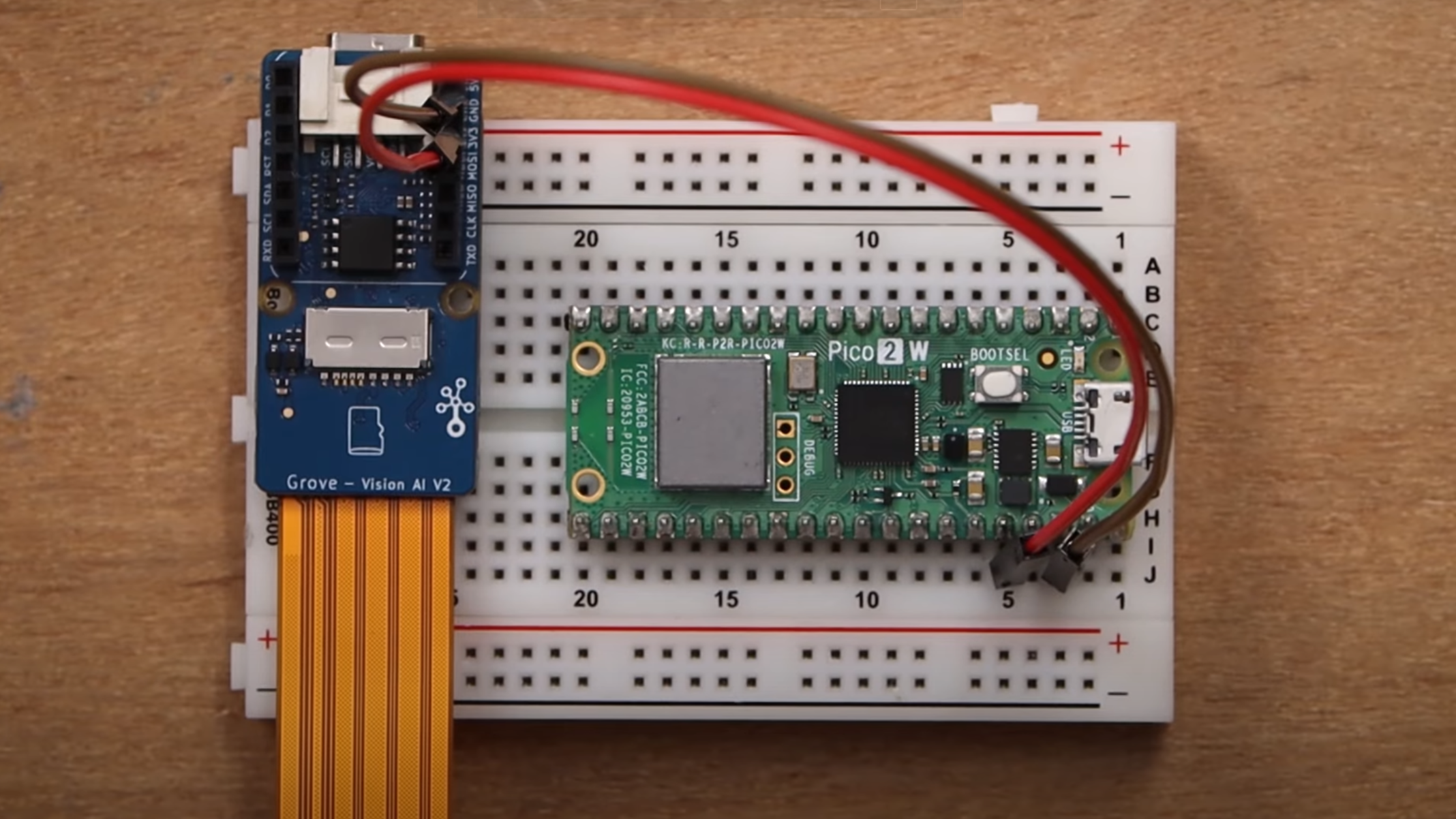
In AI model development, high power consumption has long been a contentious issue. Many large AI systems require substantial electricity, increasing costs and raising concerns about environmental and energy sustainability. However, by accepting some trade‑offs in capability and accuracy, satisfactory image recognition can be achieved on extremely low‑power hardware. Hackaday reported on September 7, 2025, on an innovative project—the Grove Vision AI board—which exemplifies this idea. The board can perform near‑real‑time image recognition at just 0.35 watts, demonstrating the potential of edge AI in resource‑constrained environments.
The core of the Grove Vision AI board is the WiseEye processor, which integrates two ARM Cortex‑M55 CPUs and an Ethos‑U55 neural processing unit (NPU) designed for AI acceleration. The board operates by connecting a camera module to a host device (such as another microcontroller or a more powerful computer). When the host sends a signal, the Grove board captures a photo, runs recognition, and returns the result to the host. In the report, developer Jaryd demonstrated this using a UART interface; although the project repository supports I2C to simplify signaling, UART's flexibility also makes it suitable for various scenarios. This design makes the Grove board an efficient edge computing module, particularly well suited for IoT and embedded systems.
To run at such low power, the board's recognition model accepts several constraints. It supports YOLO8 but only for single‑object detection, with the resolution reduced to 192×192 pixels and quantized to INT8 precision. Quantization converts floating‑point models into integer operations to reduce computational overhead. Despite these limits, the real‑world performance is still impressive: frame rates can reach 20–30 fps with good accuracy. Jaryd emphasized that the power draw is even lower than a single key on a typical RGB‑backlit keyboard (assuming the keyboard LEDs run at a low duty cycle). While that comparison is somewhat exaggerated, it highlights the board's energy‑efficiency advantage—pushing AI toward lower‑power boundaries without sacrificing too much practicality.
The Grove Vision AI board's model is not fixed. The report notes users can choose other available models, although quality varies, which allows for customized applications. If the default model is insufficient, users can train their own models to further expand applicability. This flexibility makes the board more than an out‑of‑the‑box tool—it is a platform for developer experimentation. For example, in surveillance systems it can be used to detect specific objects, such as intruders or anomalies, without relying on cloud processing, thereby reducing latency and privacy risks.
The report situates the project within the broader edge AI context. Edge AI focuses on delivering high performance on resource‑limited devices, and the Grove board exemplifies this trend. By contrast, many large AI models (used for complex image processing) require hundreds of watts or even kilowatts, while the Grove board can handle basic recognition tasks at just 0.35 watts. This not only lowers costs but also reduces carbon footprint. The report also mentions that, for low‑demand use cases, even speech recognition can run on more constrained devices, further illustrating the philosophy of "minimizing resources while maximizing efficiency."
However, this innovation is not isolated. In Hackaday's comments, several readers shared related perspectives. A user named ramzi pointed out that similar functions have been achieved since the 1990s using wavelets—a mathematical tool for analyzing repeating patterns in signals, commonly used in image compression and edge detection. For example, wavelets can efficiently capture similar patterns when identifying boundaries, thereby reducing computation. Another commenter, Jan, requested more details, while M added the example of the Viola–Jones algorithm. Viola–Jones was used for face detection in digital cameras in the late 1990s and could run on low‑end microcontrollers (such as the 8051 series) to perform repeated detections in seconds. Its cleverness lies in using Haar features and dynamic programming to compute region features in constant time—requiring only 3–4 simple arithmetic operations even as region areas change. Importantly, unlike neural networks, Viola–Jones can exit early when subregions contain no targets, avoiding full forward passes and saving time and energy.
The comments also contained skepticism. User Andrew criticized the keyboard‑power analogy in the article as inaccurate: a single RGB LED's power is far below 0.35 watts, and a 104‑key RGB keyboard's total power would not exceed 35 watts. He argued that such exaggeration undermines the project's credibility. notmyfault2000 defended the comparison by noting that if an RGB LED runs at 5V and 20mA with 100% duty cycle, three channels could reach about 0.3 watts, but real keyboards use matrix scanning and reduced duty cycles to save power. Greg A added that modern blue or white LEDs typically have maximum currents around 3mA, not 20mA, since high currents can burn out LEDs or cause excessive brightness. This discussion reflects the community's sensitivity to power details and reminds developers to be cautious in publicity.
The report also criticized the choice of demo images. The photo shows a UART connection but only connects power and ground, which may mislead readers about the four jumper wires actually required. Another commenter, rasz_pl, joked that the board's recognition accuracy is only 50%—for example, mistaking a hand for a face—suggesting there is room for accuracy improvements under simplified models. CaptSutter200 asked about the power consumption of similar Google tasks, prompting comparisons between cloud and edge computing: cloud AI is powerful but energy‑intensive, while edge devices like the Grove board prioritize efficiency.
Regardless, the Grove Vision AI board demonstrates the potential to democratize AI. By sacrificing some capability and accuracy, it brings image recognition into the low‑power domain, suitable for smart homes, robots, and portable devices. The report concludes that some people deliberately degrade recognition to explore AI's limits, reminding us that technical progress must balance ethics and practicality. Although some comments framed the project as "old wine in new bottles" (citing wavelets and Viola–Jones precedents), the Grove board's integration and ease of use help it stand out. As NPUs are optimized and model‑compression techniques advance, low‑power AI like this is likely to see broader adoption and help drive a wave of sustainable computing.